
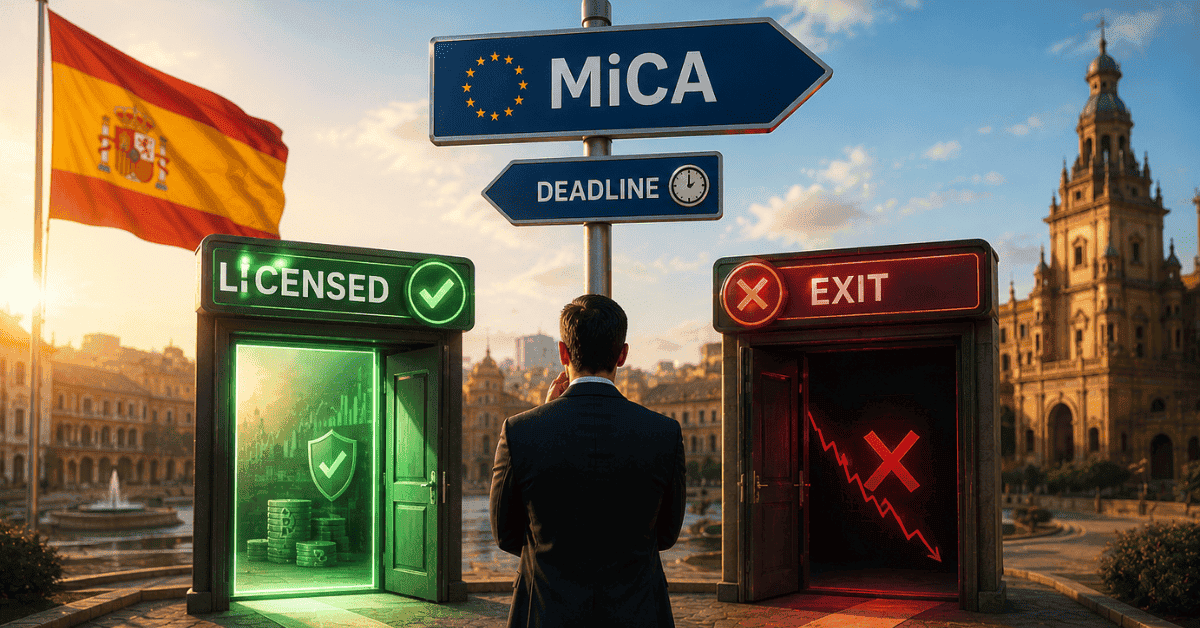
Spain MiCA deadline enforcement is becoming one of the clearest signs that Europe’s crypto grace period is ending for real.
Spain’s market regulator, the CNMV, has ruled out extensions or waivers for crypto firms that fail to secure authorisation under the EU’s Markets in Crypto-Assets Regulation. That means platforms without the right licence will not be allowed to keep serving Spanish users as if the deadline is flexible.


The message is simple: get authorised, use a valid EU passporting route, or prepare to stop regulated activity.
This matters because Spain is not treating MiCA as a soft transition. It is treating the deadline as a hard market-access test.
Why Spain’s Position Matters
MiCA was designed to create one crypto rulebook across the European Union.
For crypto companies, the benefit is clear. A platform authorised in one EU country can potentially passport services across the bloc. That creates a single regulated market instead of 27 different national systems.
But the trade-off is also clear. Firms need approval.
Under ESMA’s MiCA framework, legacy crypto-asset service providers can only rely on transitional arrangements until July 1, 2026, or until they are granted or refused authorisation. After that, unlicensed firms are expected to stop offering regulated crypto services to EU clients.
Spain’s latest position removes any doubt for firms hoping regulators might look the other way.
No Waivers Means Less Room for Delay
The important part of Spain’s stance is not only the deadline. It is the refusal to offer exceptions.
Crypto firms often operate close to regulatory cutoffs, especially when licensing processes are slow, costly or uncertain. Some may hope for more time, temporary permissions or quiet tolerance if they already have local users.
Spain is signaling that this approach will not work.
That puts pressure on exchanges, custodians, brokers and other crypto-asset service providers to finalize their MiCA position immediately. If they cannot, they may need to limit onboarding, stop marketing, reduce services or begin an orderly wind-down for Spanish users.
For users, that could mean account notices, product changes or instructions to close positions and withdraw assets.
Binance Makes the Deadline More Visible
The Spain story is also gaining attention because of Binance.
Reuters recently reported that Binance suffered a setback in its attempt to secure a MiCA licence through Greece, while the exchange has said it remains committed to Europe and is exploring alternatives.
That has made the wider MiCA deadline more visible to retail users.
Spain’s hard line does not only affect Binance. It affects every firm that has not secured the correct authorisation. But because Binance has such a large user base, its situation has become the public example of what happens when MiCA moves from theory to enforcement.
The key point is that size does not automatically protect a platform. Under MiCA, legal status matters more than brand recognition.
What Spanish Crypto Users Should Watch
Spanish users should pay close attention to official communications from their crypto platforms.
If a provider is not authorised or cannot rely on a valid EU licence, users may receive notices about service restrictions, account migration, withdrawals or the closing of certain products. These messages should come through official channels, not random links on social media.
Regulatory deadlines often attract scams. Fake support accounts, fake withdrawal pages and fake migration tools can appear quickly when users are worried about access.
Users should never share seed phrases, private keys or wallet recovery information. A legitimate exchange notice should not ask for that.
The safest approach is to check the platform’s official website, account notifications and regulator lists before taking action.
The Bigger Shift in Europe
Spain’s MiCA enforcement is part of a broader European crypto reset.
For years, many crypto firms operated through national registrations that were lighter than full financial regulation. MiCA changes that. It raises standards around governance, consumer protection, custody, disclosures and supervision.
That may reduce the number of platforms able to operate legally in Europe.
For the industry, this is painful because compliance costs rise and smaller firms may struggle. For regulators, that is partly the point. MiCA is meant to filter the market and make sure platforms serving EU clients meet stronger standards.
The result may be a smaller but more regulated European crypto sector.
A Hard Deadline With Market Consequences
Spain’s no-waiver stance shows that MiCA is no longer a future policy debate. It is becoming an active enforcement reality.
Crypto firms now face a clear choice: secure authorisation, operate through a valid EU framework, or exit regulated activity in Spain.
That could reshape user access, exchange competition and the balance between large global platforms and locally authorised providers. Firms that already have MiCA approval may gain market share as unlicensed competitors lose room to operate.
For crypto users, the change may feel disruptive. For regulators, it is the moment the new rulebook starts to matter.
Spain is sending the industry a blunt signal. The MiCA deadline is not a suggestion. It is the new line between legal access and forced retreat.
Disclaimer: This article is for informational purposes only and does not constitute financial, investment, or legal advice. Always conduct your own research before making any investment decisions.