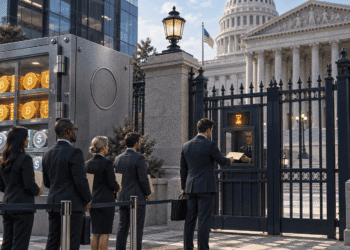
For most of the past decade, the relationship between traditional banks and cryptocurrency exchanges was cautious at best and adversarial at worst. Banks provided the real-name accounts that exchanges legally needed, but kept the crypto world at arm’s length. The two operated in separate universes, eyeing each other warily across a regulatory divide.
In South Korea, that divide is now collapsing, and one alliance is leading the way.


Hana Financial Group, one of Korea’s largest financial conglomerates, has expanded its partnership with Dunamu, the operator of Upbit, the country’s dominant crypto exchange. The relationship began with a landmark 1 trillion won investment (roughly $668 million), through which Hana Bank acquired a 6.55% stake in Dunamu, becoming its fourth-largest shareholder. It was Korea’s first major equity deal between a traditional financial group and a digital asset firm. But the stake was never the point. It was the foundation for something much broader: a joint effort to build a won-backed stablecoin ecosystem, blockchain-based remittances, tokenized securities, and digital asset wealth management.
The alliance is significant not just for its scale but for what it represents. Two institutions that would once have been competitors, a legacy bank and a crypto exchange, are now fusing their capabilities to define the future of digital finance in one of Asia’s most advanced markets. And in doing so, they’ve set off a scramble among Korea’s other banking giants to keep up.
What the Two Sides Bring
The logic of the partnership rests on a genuine complementarity, with each side contributing exactly what the other lacks.
Hana brings the traditional financial muscle: deep regulatory relationships, a vast global network for foreign exchange and remittances, wealth management expertise, and the institutional credibility that regulators want to see. Dunamu brings the crypto-native assets: Upbit, which handles more than 80% of South Korean virtual asset trading volume and has over 13 million cumulative users, and crucially, its own proprietary blockchain network called Giwa Chain.
Giwa Chain is the technical heart of the alliance. It gives Hana a foundation for on-chain transactions, where payment and transfer records are processed on blockchain infrastructure rather than only through traditional bank ledgers. This is the piece a bank cannot easily build itself, and access to it, as one Korean financial source put it, significantly increases Hana’s chances of taking a favorable position in the on-chain financial competition ahead.
The collaboration isn’t theoretical. The two firms have been working together since late 2024, when Upbit became the first platform to adopt Hana Bank’s digital certificate for identity verification. They’ve since built and tested a system to run foreign currency remittances on Giwa Chain, completing a proof of concept in February 2026 that validated the technology as a potential alternative to the SWIFT payment system. In April, they signed a three-way agreement with POSCO International, which processes around 40,000 overseas remittance transactions annually across 51 countries, to test the technology on real fund flows.
The Won Stablecoin at the Center
The centerpiece of the alliance, and the reason it matters most, is the plan to build a won-denominated stablecoin ecosystem.
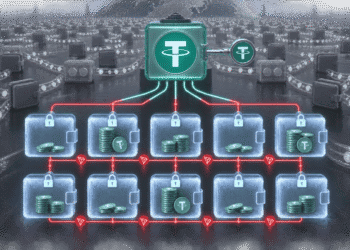
The two companies plan to cooperate across the entire lifecycle of a won-backed stablecoin: issuance, circulation, use, and redemption. A won stablecoin would allow digital payments and transfers denominated in Korean won to move on blockchain rails, combining the stability of the national currency with the speed and programmability of crypto infrastructure. For cross-border remittances and corporate settlement in particular, this could dramatically reduce the time and cost of moving money.
The model draws a clear parallel to JPMorgan’s Kinexys platform, which uses proprietary blockchain infrastructure to support inter-institutional settlements, cross-border remittances, and tokenized asset transactions, and has processed over $3 trillion in cumulative transactions. Hana is positioning itself to build a Korean equivalent, with Dunamu’s Giwa Chain as the underlying rail. Hana Card is already piloting live USDC payments for foreign visitors, showing the group is moving on both won-based and dollar-based stablecoin fronts simultaneously.
Chairman Ham Young-joo has been explicit about the strategic vision. “I believe new growth opportunities can be found in stablecoins,” he said during an earnings call, framing the Dunamu alliance as a strategic move to accelerate financial innovation in digital assets rather than a simple investment.
The Race It Has Ignited
Hana’s decisive move has forced the rest of Korea’s banking sector to respond, turning a single alliance into an industry-wide competition.
The logic is straightforward. Won stablecoins and tokenized finance ultimately come down to who controls issuance, custody, distribution, and use cases. Hana, by securing a material stake in the country’s largest exchange and access to its blockchain, has claimed an early lead. That has pushed rivals to pursue their own crypto partnerships. Industry observers expect other major groups like KB, Shinhan, and Woori to actively pursue exchange investments, equity stakes, or won-coin cooperation. Woori Bank has already partnered with MoonPay on stablecoin technology, while Mirae Asset has explored acquiring the exchange Korbit. NH Bank is working on stablecoin-based merchant settlement.
The competition reflects a broader recognition that whoever builds the dominant won stablecoin infrastructure first could secure a lasting advantage in Korea’s future digital economy. Hana’s alliance with Dunamu isn’t just about the two companies; it’s about staking a claim before the market solidifies.
The Big Variable
For all its momentum, the alliance faces one significant uncertainty that hangs over the entire Korean stablecoin push: regulation.
Korea’s Digital Asset Basic Act, the legislation that would govern won stablecoins, has faced repeated delays. The legal framework covering issuance, custody, and distribution of won-coins remains unsettled. As one Korean financial official noted, this alliance is likely to ignite behind-the-scenes competition across the industry, but the delay in legislation is a genuine variable. South Korea is also working to allow banks to hold controlling stakes in won-denominated stablecoin issuers, a move that could accelerate dealmaking once finalized, but it isn’t finalized yet.
There’s an additional complication specific to Dunamu. A proposed business combination between Dunamu and Naver Financial is under review by Korea’s Fair Trade Commission. If approved, it would reshape the competitive landscape further, potentially creating an even more powerful crypto-finance entity, but it also introduces uncertainty about Dunamu’s future structure.
What It Means
For the broader crypto industry, the Hana-Dunamu alliance is a compelling example of traditional finance and crypto genuinely merging rather than merely coexisting. It’s not a bank cautiously dabbling in digital assets; it’s a deep, structural integration where a major financial group and a leading exchange combine their infrastructure to build new financial rails together. This is the kind of institutional fusion that stablecoin advocates have long predicted, playing out in real time in a major economy.
For South Korea specifically, the alliance positions the country as a serious contender in Asia’s institutional blockchain race, alongside the moves by Japan’s SBI and others across the region. The combination of Upbit’s massive retail trading base with Hana’s banking infrastructure brings together two worlds, crypto trading and everyday consumer finance, that usually sit apart.
The honest caveat is that much of this remains a plan in progress. The won stablecoin doesn’t exist yet, the enabling legislation is still stalled, and the Dunamu-Naver combination is unresolved. What’s real is the strategic commitment, the working blockchain infrastructure, and the successful remittance pilots. Whether it all coalesces into a functioning won stablecoin ecosystem depends heavily on regulatory clarity that Korea has been slow to deliver. But the direction is unmistakable. Korea’s biggest bank and its biggest exchange have decided the future of finance is something they’ll build together, and the rest of the industry is racing to catch up.
Disclaimer: This article is for informational purposes only and does not constitute financial advice. Cryptocurrency investments carry significant risk. Always conduct your own research before making any investment decisions.