Bitcoin crossed $80,000 on Tuesday for the first time since May, printing an intraday high of $81,023 before settling back toward $79,268. The move capped a seven-day advance of roughly 25% and put bitcoin on track for its best August since 2017, in a month whose median return is negative 7%.
The futures market that would normally be powering a rally this size has been draining out instead.


Open interest, the total number of futures contracts still open, sits at approximately 587,584 BTC. That is the lowest reading in nearly five months, down from 645,760 BTC on 14 August, according to Glassnode. Prices went vertical. Positioning shrank.
Leverage fell while the price rose
That combination only works one way, and the denomination is what reveals it.
Aggregated open interest measured in dollars is up more than 15% over 30 days, sitting near $55.6 billion. That number climbs automatically as bitcoin climbs, because each existing contract is worth more in dollars than it was last week. No trader has to lift a finger for it to rise.
Count the contracts in bitcoin instead and the mechanical inflation disappears. On that basis, traders spent the biggest week in three years closing positions, not opening them.
Which leaves one explanation for who was buying. Short sellers close their positions by purchasing bitcoin. When open interest collapses during a rally, the bids came from traders exiting bearish bets, not from new leveraged money arriving.
$1.74 billion in shorts wiped out in a day
The 19 August session showed the mechanism running at full speed.
Roughly $1.74 billion in short positions were liquidated inside 24 hours, the second-largest short liquidation event on record according to CoinGlass, behind only the October 2025 crash. Shorts made up about 92% of all liquidations. Bitcoin gained 10% in the next session.
Once that cascade starts it feeds itself. A liquidated short becomes a forced buy order, the buy order lifts the price, the higher price triggers the next margin call, and the sequence repeats until the bearish side of the book is empty.
The catalyst came from Washington rather than crypto. The US Treasury said it would double the maximum size of its long-term bond buyback programme to $4 billion per session, dragging yields lower and pushing capital toward risk. Sentiment on crypto legislation improved alongside it after a White House meeting between President Trump and executives from Coinbase and Robinhood.
Traders positioned for six weeks of continued decline were caught by a macro shift they had not priced. Bitcoin has now risen 38% off its June low.
Cash collateral now backs 89% of the market
A second Glassnode figure describes something more durable than this week’s squeeze.
Crypto-margined open interest has fallen to an all-time low of roughly 52,000 BTC, just 11% of total futures activity. The other 89% is now backed by cash.
The difference matters enormously during selloffs. A crypto-margined position uses bitcoin as collateral, so when prices drop, the collateral loses value at exactly the moment the position does. That forces liquidations, which push prices lower, which erodes the remaining collateral further. It is the machinery behind every cascading crash the market has produced.
Cash collateral breaks the loop. A dollar posted as margin is still worth a dollar after bitcoin falls 20%.
That migration explains why bitcoin’s realised volatility has trended down for years, and it means the current rally sits on considerably less fragile ground than the raw percentage move implies.
Seven straight days of ETF inflows
Short squeezes have an expiry date. When the bearish positions are gone, the forced buying stops, and a rally that ran on nothing else stalls.
Spot ETFs are the reason this one might not. Bitcoin funds took $337.56 million on 24 August, extending an unbroken run to seven consecutive sessions. That is real spot demand arriving in parallel with the derivatives unwind, not as a consequence of it.
The distinction decides what happens next. A rally with two engines can survive losing one. A rally with a single engine cannot.
Options desks are treating the outcome as open. Laevitas data shows roughly $2.9 million spent on bets that bitcoin clears $82,000 in the near term, while demand for downside protection has stayed firm rather than evaporating.
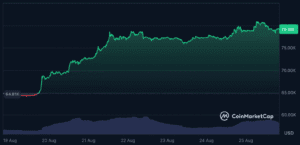
The 50-week average stopped it at $81,023
The rejection was not random. The 50-week moving average sits in that zone, and analysts have named it as the line separating a bear-market bounce from a confirmed reversal.
Bitcoin has not closed above it. Until it does, a 25% week remains a recovery inside a downtrend, whatever the headline number looks like.
Several desks have flagged overbought conditions, and the breadth now showing up is characteristic of a late-stage run. Ether traded at $2,477, solana at $98.20. Smaller animal-themed tokens have doubled in a week. Total market capitalisation reached $2.75 trillion on $125 billion of volume, with the Fear and Greed Index at 74.
Federal Reserve Chair Kevin Warsh delivers his first Jackson Hole keynote on Friday under a symposium theme covering financial innovation and payments. Given that this entire rally traces back to a Treasury intervention in the bond market, the macro channel that started it is the one most likely to end it.
FAQ
Why did open interest fall while bitcoin rose?
Traders were closing positions, not opening them. Since short sellers close by buying, the contraction points to short covering as the main driver behind the move rather than new leveraged demand.
Why do dollar and bitcoin measures of open interest disagree?
Dollar figures rise automatically when bitcoin’s price rises, because existing contracts become worth more without anyone trading. Measuring in bitcoin strips that out and shows actual positioning, which fell to a five-month low.
What does the drop in crypto-margined open interest mean?
Bitcoin-backed collateral loses value during selloffs, triggering liquidations that accelerate declines. With crypto-margined positions now at just 11% of the market, that cascade risk is at an all-time low.
Is the bear market over?
Not confirmed. Bitcoin was rejected at the 50-week moving average near $81,023 and has yet to close above it, which analysts treat as the threshold for a genuine trend reversal.
Disclaimer: This article is for informational purposes only and does not constitute financial advice. Cryptocurrency investments carry significant risk. Always conduct your own research before making any investment decisions.