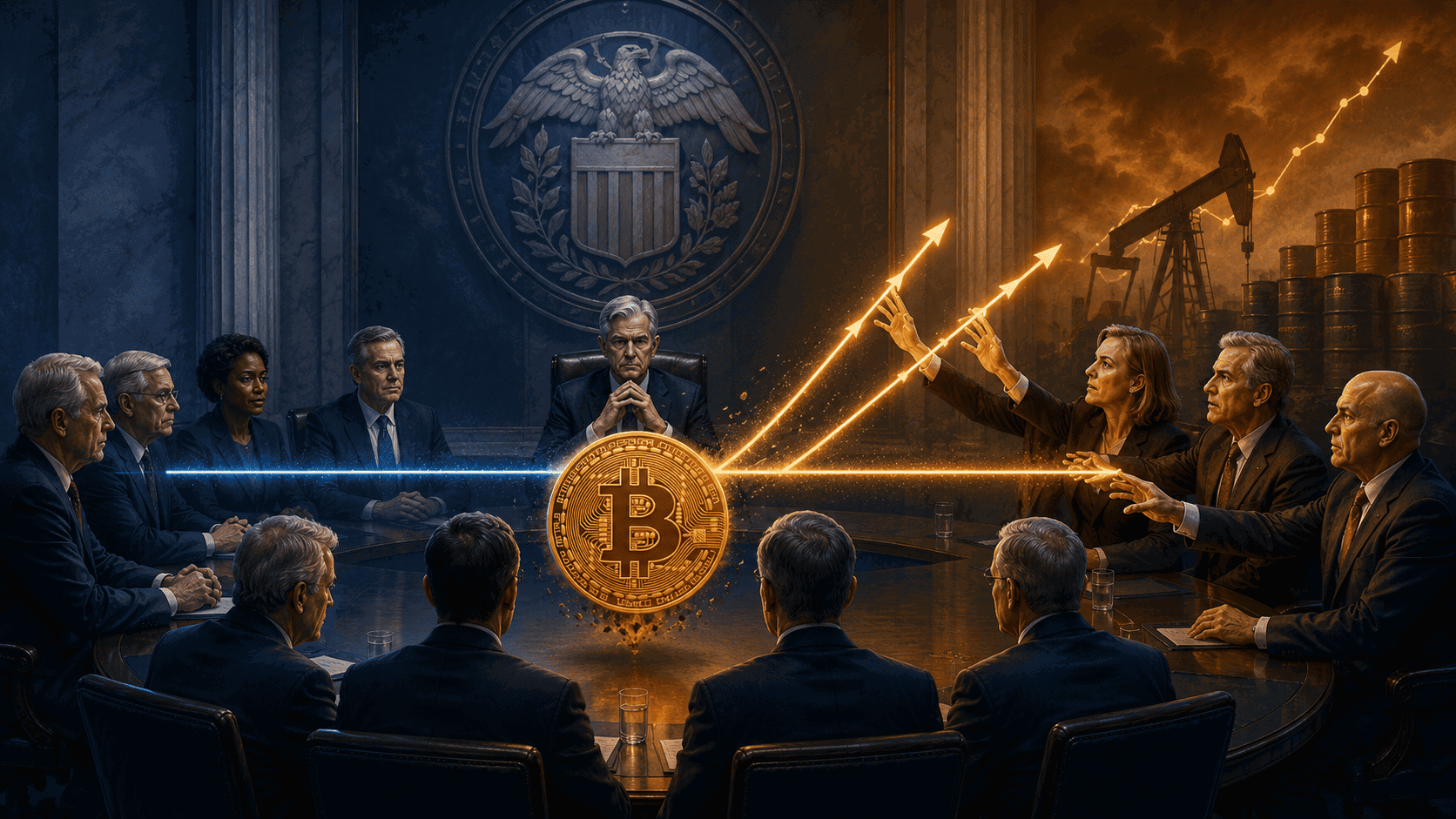
Markets spent the past week treating this Federal Reserve meeting as a genuine coin flip. Roughly a third of traders priced in a rate hike, Citadel publicly predicted one, and positioning in August fed funds futures hit a record 967,136 contracts. The uncertainty was unusual so close to a decision, when traders have normally converged on a clear expectation.
The Fed held. But the way it held is the story.

The Federal Open Market Committee voted 9–3 on Wednesday to keep the benchmark rate at 3.50% to 3.75%, the fifth consecutive meeting at the same level. Cleveland Fed President Beth Hammack, Minneapolis Fed President Neel Kashkari and Dallas Fed President Lorie Logan all dissented, each voting for a quarter-point increase. That is a reversal from last month’s unanimous hold and a rare configuration: three regional bank presidents breaking ranks in the same direction, all of them hawkish.
For crypto, which spent 2026 falling largely because of this committee’s stance, the dissent count matters more than the headline. A unanimous hold would have suggested the tightening debate was settled. Three votes for a hike says it very much isn’t.
Warsh Welcomed the Fight
Chair Kevin Warsh’s response to the split was, characteristically, to embrace it.
“I asked for a good family fight, and I got one. That’s the purpose. That’s the design feature,” he told reporters at the press conference. It was a deliberate framing from a Chair who has spent his brief tenure arguing that markets lean too heavily on Fed guidance and that visible internal disagreement is healthier than manufactured consensus.
He extended that philosophy to the question everyone wanted answered. Warsh declined to hint at where policy is heading, saying the Fed will not hesitate to take the steps necessary to reach its 2% inflation goal. “I understand the desire for rolling forecasts and commentary from this committee, but for our part, we need to observe market reaction to developments direct and unfiltered,” he said. He has previously told Congress the Fed has “no tolerance” for persistently elevated inflation and has repeatedly said that “inflation is a choice.”
The statement itself was terse, running roughly a third the length of announcements under Jerome Powell and nearly identical to June’s. It described economic activity as expanding at a solid pace despite conflict in the Middle East, noted that job gains have kept pace, and acknowledged inflation remains above target.
The Squeeze Warsh Is Sitting In
The decision lands in an unusually awkward political and economic position, which explains why three officials broke ranks.
Inflation has been stuck above the Fed’s 2% target for more than five years. The Iran war has driven energy prices sharply higher, with WTI crude climbing nearly 20% this month, feeding directly into inflation through transport and production costs. Ten-year and two-year Treasury yields have both broken above key trendlines. Every one of those factors argues for tightening, which is precisely the case Hammack, Kashkari and Logan made with their votes. Logan had been most explicit before the meeting, saying rates should be “modestly” higher.
Pushing the other way is President Trump, who appointed Warsh and has applied intense public pressure on the Fed to cut rates rather than raise them. Warsh is therefore holding a line that satisfies neither his own hawks nor the administration that installed him.
Analysts read the outcome as a holding pattern rather than a resolution. “We’re reading this as a Committee with vocal hawks, but the majority is siding with Warsh to keep rates stable until at least September, when policymakers will have the benefit of the July and August CPI reports,” wrote Ian Lyngen, head of US rates at BMO Capital Markets.
Not everyone was impressed. Chris Rupkey, chief economist at FWDBONDS, turned Warsh’s own phrase back on him: “If inflation is a choice, the Federal Reserve meeting today shows no sign of taking steps to bring it under control with its primary monetary tool, which is interest rates.”
What It Means for Crypto
Bitcoin traded around $64,300 into the decision, having opened at $63,853, while Ethereum sat near $1,905. The immediate reaction is still unfolding, but the medium-term read is clearer than the price action.
The good news for crypto is narrow but real: no hike happened, and the near-term pressure on risk assets from a tightening move has been avoided. Bitcoin’s decline from $126,000 to the low $60,000s this year was driven overwhelmingly by rates and the institutional flows that follow them, not by anything breaking inside crypto. A hike would have deepened that pressure immediately.
The bad news is that the dissent removes any comfortable assumption that easing is coming. Three officials voting to tighten, with an energy-driven inflation impulse still building, means the realistic range of outcomes for the rest of 2026 runs from “hold” to “hike,” with cuts looking remote. For an asset class that spent July rallying on the hope that Fed pressure was easing, that’s a meaningful recalibration.
The absence of forward guidance compounds the difficulty. There are no fresh economic projections until September, and Warsh has made clear he intends to keep it that way. Investors are left reading dissent counts and statement language rather than dot plots, which is exactly the environment he wants and exactly the one that makes positioning harder.
What Comes Next
September is now the pivotal meeting, and the path to it runs through two inflation reports.
The July and August CPI prints will determine whether the hawks gain allies or lose their argument. If energy-driven inflation keeps building, the three dissents become a plausible majority. If oil retreats and price pressures cool, the hold looks vindicated and the debate quiets. Governor Christopher Waller has also signalled support for tighter policy if inflation persists, though he did not dissent this time, which means the hawkish bloc has room to grow.
For crypto investors, the practical framework is straightforward. Watch oil, because it feeds inflation and inflation feeds the Fed. Watch the CPI reports in August and September. And watch ETF flows, which remain roughly $4.5 billion in the red for 2026 and which turned negative again last week after a brief seven-session recovery.
There is one useful historical parallel. The last time three Fed presidents dissented in favour of a hike against a hold was September 2016. The committee raised rates that December. That precedent doesn’t predict anything, but it is a reminder that visible hawkish dissent has, at least once, been a leading indicator rather than noise. Bitcoin’s 2026 has been a story about interest rates from beginning to end, and today confirmed that story isn’t over.
FAQ
What did the Fed decide?
The Federal Open Market Committee voted 9–3 on July 29, 2026, to keep the federal funds target range at 3.50% to 3.75%, the fifth consecutive meeting without a change. Cleveland Fed President Beth Hammack, Minneapolis Fed President Neel Kashkari and Dallas Fed President Lorie Logan each dissented in favour of a quarter-point rate hike, reversing June’s unanimous hold. The statement described economic activity as expanding at a solid pace while noting inflation remains above the 2% target.
Why do the dissents matter?
Three regional bank presidents voting for a hike signals that the tightening debate inside the Fed is far from settled, which removes any assumption that easing is imminent. A unanimous hold would have suggested consensus; this outcome suggests the realistic range for the rest of 2026 runs from hold to hike, with cuts looking remote. Chair Kevin Warsh welcomed the split, saying “I asked for a good family fight, and I got one,” consistent with his stated preference for visible disagreement over manufactured consensus.
What should crypto investors watch next?
September’s meeting is now pivotal, and the July and August CPI reports will shape it. If energy-driven inflation keeps building, the three dissenters could gain allies; Governor Christopher Waller has also signalled openness to tighter policy. Oil prices matter directly, with WTI up nearly 20% this month amid the Iran conflict. Warsh has removed forward guidance and there are no fresh Fed projections until September, so investors must read statement language and dissent counts rather than rate forecasts.
Disclaimer: This article is for informational purposes only and does not constitute financial advice. Cryptocurrency investments carry significant risk. Always conduct your own research before making any investment decisions.