• About Us
  • Advertise
AltcoinReporter
  • Home
  • News
    • Bitcoin
    • Ethereum
    • Blockchain
    • Altcoins
    • DeFi
    • NFT
  • Press Releases
  • Reviews
    • Exchanges
    • NFT Marketplaces
    • Wallets
  • Market Analysis
  • Contact Us
No Result
View All Result
  • Home
  • News
    • Bitcoin
    • Ethereum
    • Blockchain
    • Altcoins
    • DeFi
    • NFT
  • Press Releases
  • Reviews
    • Exchanges
    • NFT Marketplaces
    • Wallets
  • Market Analysis
  • Contact Us
No Result
View All Result
AltcoinReporter
No Result
View All Result
Home Blockchain

Thai investors sue Tether over $42.4 million USDT freeze as Schwartz defends issuer

Salar Salek by Salar Salek
September 3, 2026
in Blockchain
Thai investors sue Tether over $42.4 million USDT freeze as Schwartz defends issuer

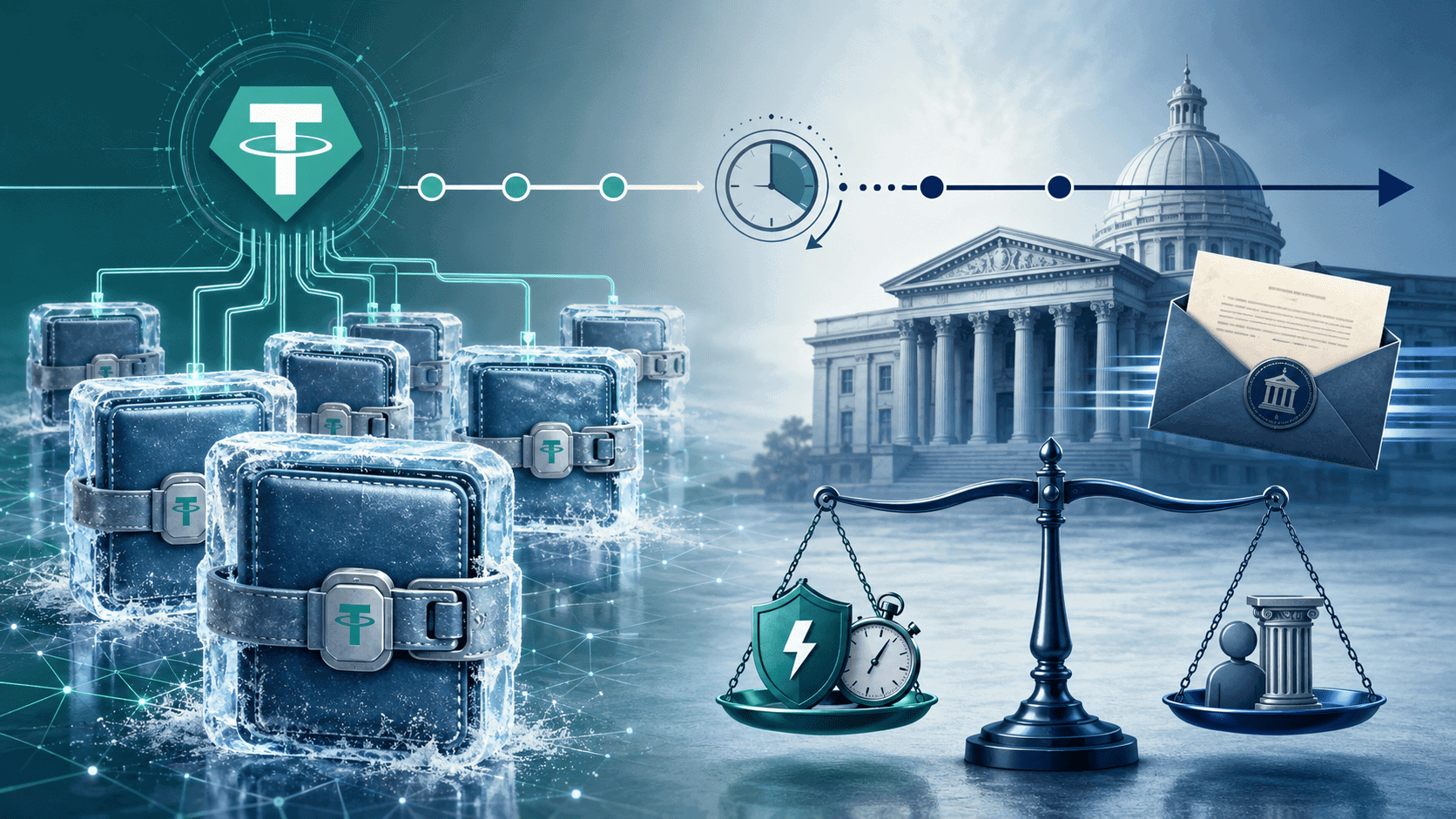
Two Thai businessmen have sued Tether in a US federal court over the freezing of $42.4 million in USDT, arguing the stablecoin issuer blacklisted their wallets nearly four months before any court authorised the seizure.

Nutthawat Rukthammachalern and Natthawat Kasamvilas filed the suit on 31 August in the US District Court for the Southern District of New York. According to the complaint, Tether blacklisted ten Ethereum addresses holding a combined 42,417,785.62 USDT on 30 October 2025, acting on an informal request from Homeland Security Investigations.


Related articles

Can Tether freeze your USDT? How stablecoin blacklisting works

Can Tether freeze your USDT? How stablecoin blacklisting works

September 3, 2026
US Treasury sanctions Iran-linked digital assets under Operation Economic Outcast

US Treasury sanctions Iran-linked digital assets under Operation Economic Outcast

September 3, 2026

No warrant, subpoena or court order directed the freeze at that time, the plaintiffs allege.

A magistrate judge in the Eastern District of North Carolina issued seizure warrant 5:26-MJ-1267-JG on 19 February 2026. That order instructed Tether to burn the frozen tokens and reissue equivalent amounts to a government-controlled wallet.

David Schwartz, the former Ripple chief technology officer and architect of the XRP Ledger, publicly backed Tether on 2 September, describing the company’s actions as administratively and legally justified.

The plaintiffs are not disputing the crime

The case turns on process rather than on whether the underlying funds were dirty, which is what makes it legally interesting.

The addresses formed part of a federal investigation into cryptocurrency investment fraud. US authorities ultimately seized more than $61 million in USDT traced to wallets allegedly used to receive and launder proceeds from pig-butchering scams, a category of long-con fraud in which victims are groomed over weeks before being persuaded to invest.

Tether assisted investigators with transferring the seized assets.

According to the reporting, the plaintiffs do not contest the criminal allegations connected to the funds. They say they acquired their USDT through legitimate secondary-market business transactions and are challenging the mechanism by which it was frozen and later moved.

Two questions sit at the centre. Whether Tether had legal authority to restrict the assets before judicial authorisation existed, and whether the February warrant actually authorised burning the USDT and reissuing equivalent tokens to a government wallet, or whether that exceeded its scope.

The plaintiffs are seeking the blacklist lifted, damages, and disgorgement of the interest income Tether earned managing the reserves backing the frozen tokens during the period they could not access them. They also allege Tether’s marketing does not adequately disclose that it retains the ability to freeze holdings at will.

Schwartz’s argument is about speed

The defence Schwartz offered addresses a practical problem rather than a legal one.

He argued that immediate freeze capability is critical to anti-money-laundering efforts, and that stripping issuers of the power to act quickly in suspected fraud cases would leave victims without fast recourse. Removing that capability, he warned, would allow stolen funds to be moved and laundered before any court could intervene, turning stablecoins into a magnet for criminal financial activity.

The timing evidence in this case supports his premise on its own terms. The gap between the informal HSI request in October 2025 and the warrant in February 2026 was almost four months. Funds sitting in an Ethereum wallet for four months while a warrant is prepared would not be sitting there at the end of it.

The counterargument is equally direct. A private company acting on an informal law enforcement request, without judicial oversight, over funds belonging to people who have not been charged with anything, is a considerable amount of discretion to hold. Schwartz’s argument establishes why the power is useful. It does not establish where its limits are.

Tether’s terms of service are the battleground

Tether is defending its policy of restricting accounts under its terms of service prior to any court order.

The contractual position is straightforward. USDT holders agree to terms permitting Tether to freeze tokens, and the freeze function is written into the contract itself. Tether can blacklist any address, after which the tokens in it become untransferable.

Whether a contractual right creates legal authority sufficient to withstand a challenge from a holder claiming legitimate ownership is precisely what the court will decide. That distinction matters well beyond this case.

The scale involved gives the question weight. Tether has frozen close to $6 billion during 2026 amid regulatory pressure from US authorities. In July, when OFAC added four cryptocurrency addresses to its Central Bank of Iran designation, Tether froze $131 million within hours of the update.

Those actions have generally been welcomed. Freezes tied to sanctions designations, exchange hacks and confirmed fraud have recovered funds that would otherwise have vanished. This case is testing what happens when a holder disputes their inclusion.

What a ruling would establish

A decision here would clarify how far stablecoin issuers can go in responding to regulatory and law enforcement requests before formal legal authorisation exists.

If the court finds Tether’s terms of service provide sufficient authority, issuers gain confidence to continue acting on informal requests, and the practical value of the freeze function as an anti-fraud tool is preserved. If it finds otherwise, issuers may require warrants before acting, which would slow response times considerably and change the calculation for law enforcement.

Either outcome affects USDC, PYUSD and every other centralised stablecoin with a comparable function, since the architecture is essentially identical across issuers.

There is a broader point underneath. Centralised stablecoins are frequently described as digital cash, and the comparison breaks down precisely here. Cash cannot be remotely disabled by its issuer. The freeze function is not a flaw in USDT’s design; it is a deliberate feature that makes the token compatible with regulated finance. This case asks what obligations come attached to it.

No hearing date has been reported, and Tether has not filed a public response.

Disclaimer: This article is for informational purposes only and does not constitute financial or legal advice. Cryptocurrency investments carry significant risk. Always conduct your own research before making any investment decisions.


Salar Salek

Salar Salek Verified AltcoinReporter Author

Salar covers cryptocurrency markets, blockchain technology, DeFi, and emerging digital asset trends for AltcoinReporter. With a background in technology and finance, he has been actively following and investing in the...

Read More
Tags: asset freezeslitigationStablecoinsTetherUSDT

Related Posts

Can Tether freeze your USDT? How stablecoin blacklisting works

Can Tether freeze your USDT? How stablecoin blacklisting works

by Salar Salek
September 3, 2026
0

Tether had blacklisted 9,597 USDT addresses and frozen $5.69 billion in value as of 26 July 2026, according to BlockSec's...

US Treasury sanctions Iran-linked digital assets under Operation Economic Outcast

US Treasury sanctions Iran-linked digital assets under Operation Economic Outcast

by Salar Salek
September 3, 2026
0

The US Treasury has sanctioned dozens of Iran-linked cryptocurrency addresses and designated digital assets as a sanctionable sector of Iran's...

Cronos rewrote canonical state after $75 million exploit in a week of blockchain halts

Cronos rewrote canonical state after $75 million exploit in a week of blockchain halts

by Salar Salek
September 2, 2026
0

Cronos validators halted the blockchain on Sunday 30 August after an attacker drained the lending protocol Tectonic, then restarted it...

Stablecoins are 71% of Argentine crypto purchases, Bitso data shows

Stablecoins are 71% of Argentine crypto purchases, Bitso data shows

by Salar Salek
August 26, 2026
0

USDT and USDC account for more than 70% of all cryptocurrency bought on Bitso in Argentina, the exchange's own data...

Monad proposal would let accounts rotate keys and adopt post-quantum signatures

Monad proposal would let accounts rotate keys and adopt post-quantum signatures

by Salar Salek
August 25, 2026
0

Lose your private key today and the money is gone. Not frozen, not recoverable through an appeal process, gone. It...

Load More
  • Trending
  • Comments
  • Latest
Solana Alpenglow Upgrade 2026: Launch Date, Features, and What It Means for SOL

Solana Alpenglow Upgrade 2026: Launch Date, Features, and What It Means for SOL

April 18, 2026
Pi Network Completes Protocol 23 and Sets June 2 Deadline for Node Operators

Pi Network Completes Protocol 23 and Sets June 2 Deadline for Node Operators

May 27, 2026
Dogecoin and Meme Coins

Dogecoin and Meme Coins Face a Reality Check as Speculative Demand Fades

June 14, 2026
Best Crypto News Apps 2026: CoinGecko vs TradingView vs CoinMarketCap

Best Crypto News Apps 2026: CoinGecko vs TradingView vs CoinMarketCap

May 6, 2026
North Korea’s Six-Month Con: How Hackers Stole $286M from Solana’s Drift Protocol

North Korea’s Six-Month Con: How Hackers Stole $286M from Solana’s Drift Protocol

0
Ethereum’s Glamsterdam Upgrade: What It Is and Why It Matters in 2026

Ethereum’s Glamsterdam Upgrade: What It Is and Why It Matters in 2026

0
Bitcoin’s Worst Q1 Since 2018: Can April Turn the Tide?

Bitcoin’s Worst Q1 Since 2018: Can April Turn the Tide?

0
Former UK Chancellor Kwarteng Leads Bitcoin Firm as Farage Backs BTC

Former UK Chancellor Kwarteng Leads Bitcoin Firm as Farage Backs BTC

0
Can Tether freeze your USDT? How stablecoin blacklisting works

Can Tether freeze your USDT? How stablecoin blacklisting works

September 3, 2026
BNB price analysis: $720 rejection leaves $663 as the level that matters

BNB price analysis: $720 rejection leaves $663 as the level that matters

September 3, 2026
Thai investors sue Tether over $42.4 million USDT freeze as Schwartz defends issuer

Thai investors sue Tether over $42.4 million USDT freeze as Schwartz defends issuer

September 3, 2026
US Treasury sanctions Iran-linked digital assets under Operation Economic Outcast

US Treasury sanctions Iran-linked digital assets under Operation Economic Outcast

September 3, 2026

About

AltcoinReporter

AltcoinReporter is an independent crypto news platform built to keep you ahead of the market. We cover everything from Bitcoin and altcoins to DeFi, NFTs, regulation, and emerging blockchain technology.


Our editorial team delivers accurate news, detailed market analysis, and expert insights, with every article written and reviewed by named contributors. We are committed to transparent, independent reporting our readers can trust.

News

  • Altcoins
  • Bitcoin
  • Blockchain
  • DeFi
  • Ethereum
  • NFT

Reviews

  • Exchanges
  • NFT Marketplaces
  • Wallets

Company

  • About Us
  • Advertise
  • Write for Us
  • Contact Us

Disclaimer: AltcoinReporter.com provides cryptocurrency news for informational purposes only, not financial, investment, or legal advice. Crypto markets carry significant risk. Always do your own research and consult a financial advisor before investing. We may earn compensation through affiliate links, ads, and sponsored content, which are clearly labelled. AltcoinReporter is not responsible for any financial losses resulting from information on this site.

  • Cookie Policy
  • Ethics
  • Corrections
  • Editorial Standards
  • Privacy Policy
  • Terms & Conditions

© 2026 AltcoinReporter. All rights reserved.

No Result
View All Result
  • Home
  • News
    • Altcoins
    • Bitcoin
    • Blockchain
    • DeFi
    • Ethereum
    • NFT
  • Press Releases
  • Reviews
    • Exchanges
    • NFT Marketplaces
    • Wallets
  • Market Analysis
  • Contact Us

© 2026 AltcoinReporter. All rights reserved.