
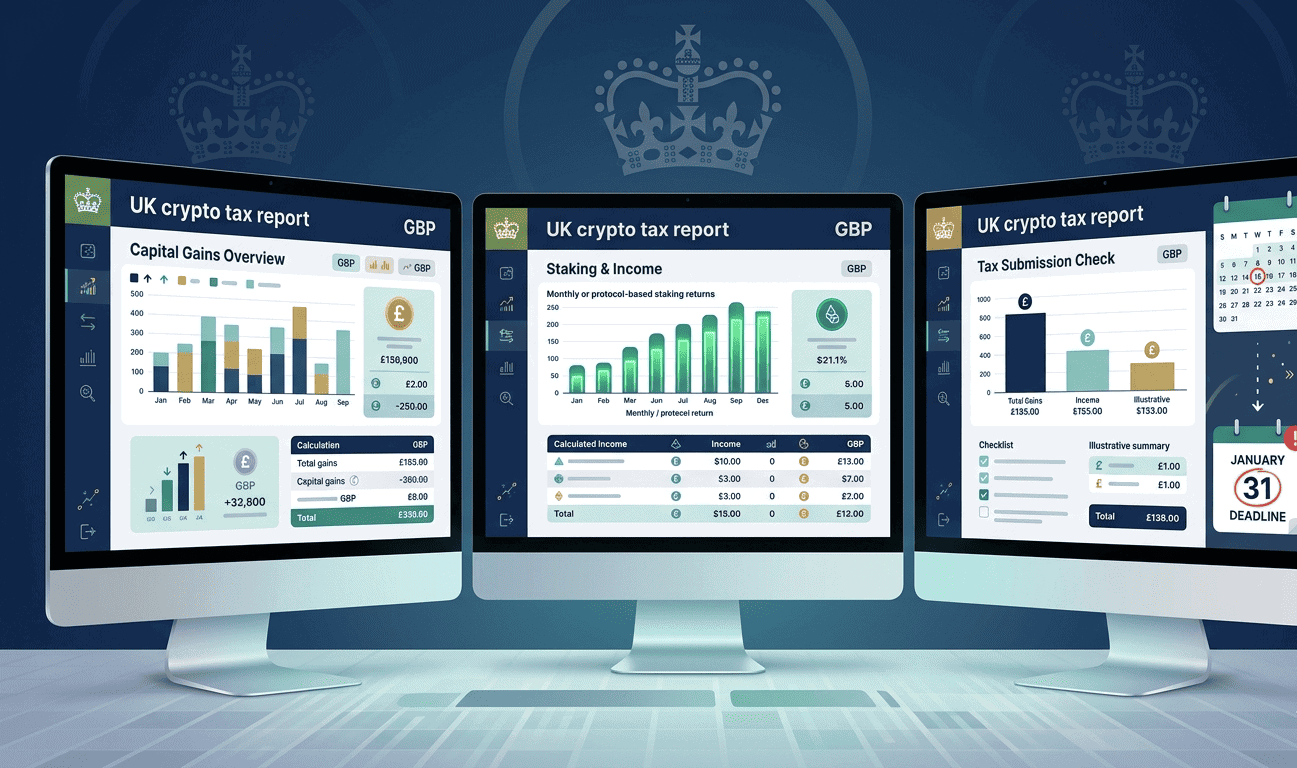
If you traded crypto in the UK this year, HMRC wants its cut. Every time you sold, swapped, or spent crypto, that was a taxable event. Staking rewards count as income. Airdrops count as income. Even swapping ETH for USDC counts as a disposal.
Calculating all of that by hand is painful. The UK uses a share pooling system under section 104, plus same-day and 30-day matching rules. Trying to do it in a spreadsheet across multiple exchanges and wallets is a recipe for mistakes and missed deadlines.


The good news is there are free tools that handle most of it automatically. We tested the three most popular options for UK users and compared them on the things that actually matter: HMRC compliance, free plan limits, DeFi support, and ease of use.
UK Crypto Tax Tool Comparison Table 2026
| Feature | Koinly | Recap | CoinTracking |
|---|---|---|---|
| Free plan limit | 10,000 transactions (preview only) | 50 transactions | 200 transactions |
| Free tax report download | No (paid plans from £39/year) | No (paid from £149/year) | No (paid from £49/year) |
| HMRC report format | Yes (SA108 compatible) | Yes (SA108 compatible) | Yes (SA108 compatible) |
| UK pooling rules | Automatic | Automatic | Automatic |
| Exchanges supported | 850+ | 60+ | 300+ |
| DeFi support | 7,200+ protocols | Limited | Moderate |
| NFT support | Yes | Limited | Yes |
| Staking/airdrop classification | Automatic | Automatic | Manual review needed |
| GBP conversion | Automatic | Automatic | Automatic |
| Trustpilot rating | 4.5/5 | 4.2/5 | 3.8/5 |
| Best for | Most UK users | Simple portfolios | Data-heavy traders |
Note: Free plans let you preview your tax liability but generally require a paid plan to download the final report. Prices and features change regularly.
Koinly: Best Overall for UK Crypto Taxes
Koinly is the most popular crypto tax tool in the UK and the one most crypto accountants recommend. It connects to over 850 exchanges and wallets, supports 7,200 DeFi protocols, and automatically applies UK-specific pooling rules.
The free plan is generous. You can import up to 10,000 transactions from any exchange, wallet, or blockchain. The dashboard shows your total capital gains, income from staking and airdrops, and estimated tax liability, all in GBP. You can see exactly what you owe before paying anything.
The catch is you need a paid plan (starting at £39 per year for up to 100 transactions) to actually download the HMRC-compatible tax report. But the free preview is detailed enough that some users with simple portfolios can manually transfer the numbers to their Self Assessment return without paying for the download.
Where Koinly excels is DeFi. If you have used Uniswap, Aave, Curve, or any lending or liquidity protocol, Koinly will automatically classify those transactions and calculate the correct tax treatment. Most other tools struggle with this. Koinly handles it out of the box.
The main complaint is that complex DeFi interactions sometimes need manual review. Bridging tokens between chains can occasionally be misclassified as a trade rather than a transfer, creating phantom tax events. But the error detection system flags these issues and lets you fix them with a few clicks.
Best for: Most UK crypto users, especially those with DeFi activity, multiple wallets, or staking income.
Recap: Best for Simple UK Portfolios
Recap is built specifically for UK users. While Koinly supports 20+ countries, Recap focuses entirely on HMRC compliance. That narrow focus means the UK-specific features are polished and the reports are exactly what your accountant expects to see.
The free plan covers up to 50 transactions. That is enough for someone who made a handful of trades on Coinbase or Kraken and held everything else. The interface is clean and walks you through the import process step by step. If you have never used a crypto tax tool before, Recap is the easiest starting point.
Paid plans start at £149 per year for up to 1,000 transactions. That is significantly more expensive than Koinly’s £39 entry price. For simple portfolios, the extra cost does not buy you much. For complex ones, Recap’s limited exchange support (60+ versus Koinly’s 850+) and minimal DeFi coverage mean you may end up importing data manually anyway.
Where Recap wins is clarity. The reports are designed specifically for UK Self Assessment. The SA108 output is clean and ready to paste into HMRC’s system. The support documentation is written in plain English with UK tax examples. If you just want to get your taxes done without thinking about it, Recap makes that straightforward.
Best for: UK beginners with simple portfolios on one or two major exchanges and fewer than 1,000 transactions.
CoinTracking: Best for Data-Heavy Traders
CoinTracking has been around since 2013, making it one of the oldest crypto tax tools in the market. It supports 300+ exchanges, produces HMRC-compatible reports, and offers the deepest analytics of any tool on this list.
The free plan covers 200 transactions. That sits between Recap’s 50 and Koinly’s 10,000, but CoinTracking’s free plan includes more analysis features. You get historical balance charts, realised versus unrealised gains per coin, and detailed trade statistics. If you want to understand your trading performance alongside your tax obligations, CoinTracking gives you more data than anyone else.
The interface is more complex than Koinly or Recap. CoinTracking was designed for power users, and it shows. The learning curve is steeper, the dashboard has more options, and the import process requires more manual configuration. If you have thousands of transactions across dozens of platforms, the depth pays off. If you have 50 trades on Coinbase, it is overkill.
DeFi support is moderate. It handles staking and basic DeFi interactions but does not match Koinly’s 7,200 protocol coverage. Complex LP positions and yield farming may need manual tagging. NFT support exists but is not as polished as Koinly’s.
Best for: Active UK traders who want deep portfolio analytics alongside HMRC tax reporting.
Which Tool Should You Choose?
For most UK crypto users, Koinly is the best option. It has the widest exchange support, the best DeFi coverage, and the most affordable paid plans. The free preview is detailed enough to give you a clear picture of your tax liability before you commit.
If you have a simple portfolio with fewer than 50 trades on one or two exchanges, Recap is the easiest choice. The UK-only focus means everything is tailored to HMRC and the interface is friendlier for beginners.
If you are an active trader who wants detailed analytics and performance data alongside your tax reports, CoinTracking offers the deepest feature set.
One tip for everyone: start importing early. Do not wait until January 30 to discover that half your exchanges need manual CSV uploads. Connect your accounts now, let the tool import your history, and fix any classification errors while you still have time. HMRC’s late filing penalties start at £100 and add £10 per day after three months. A few hours of setup now saves real money later.
Frequently Asked Questions
Do I need to pay for crypto tax software in the UK?
Free plans let you import transactions and preview your tax liability. But downloading the HMRC-compatible report for Self Assessment usually requires a paid plan. Koinly starts at £39 per year, CoinTracking at £49, and Recap at £149. If your portfolio is very simple, you may be able to transfer the numbers manually from the free preview.
Which crypto tax tool is best for HMRC compliance?
All three tools we reviewed produce SA108-compatible capital gains reports. Koinly and Recap both automatically apply UK share pooling rules. For most UK users, Koinly offers the best balance of HMRC compliance, exchange support, and price.
Is crypto staking taxed in the UK?
Yes. HMRC treats staking rewards as miscellaneous income at the time you receive them, taxed at your income tax rate. When you later sell the staked tokens, any gain is subject to Capital Gains Tax. All three tools we reviewed automatically classify staking income separately from capital gains.
Disclaimer: This article is for informational purposes only and does not constitute financial, investment, or legal advice. Tax treatment depends on individual circumstances and may change. Always consult a qualified tax professional before acting on any information. Fee data is based on publicly available pricing as of April 2026.