
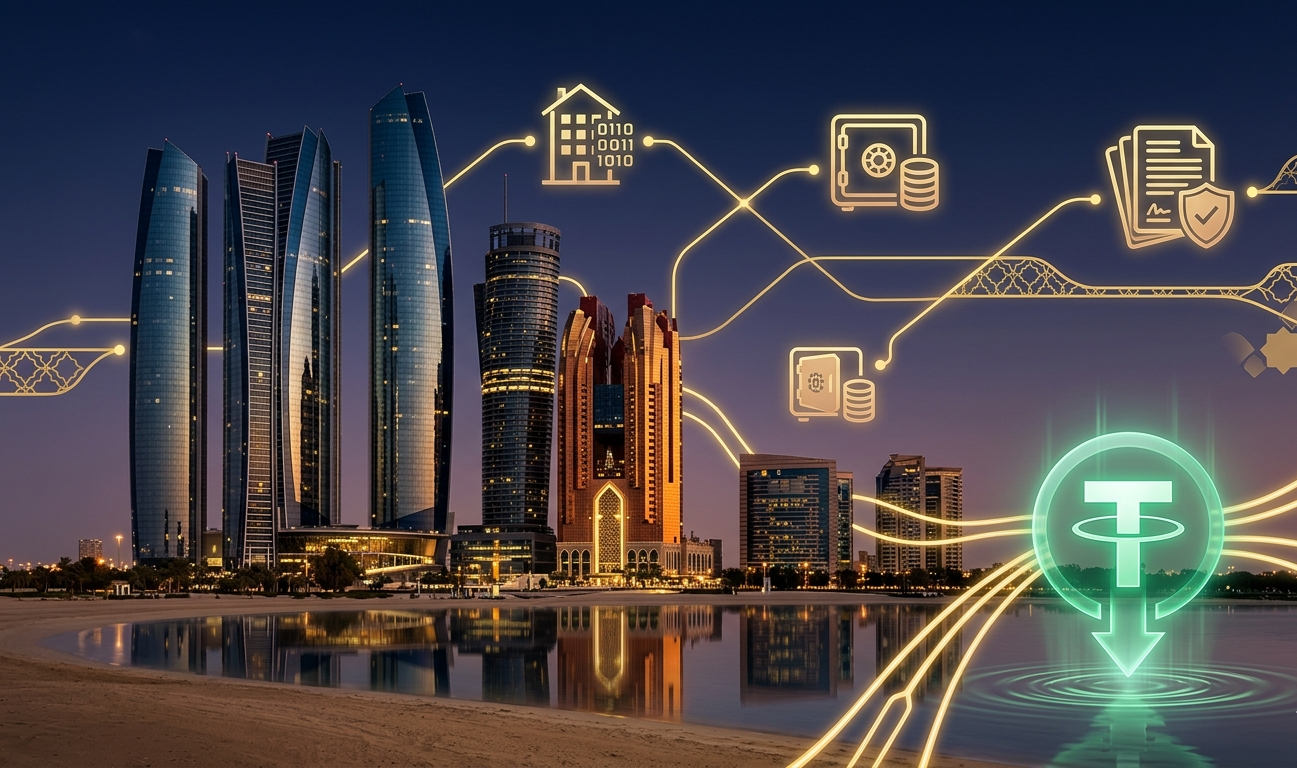
While most of the crypto world was watching Bitcoin whipsaw on Hormuz headlines and the Kelp DAO hack rattle DeFi, Tether quietly made a move that says a lot about where the real money in crypto is heading. The world’s largest stablecoin issuer led an $8 million strategic investment in KAIO, an Abu Dhabi-regulated tokenisation platform that is putting institutional funds on-chain.
Abu Dhabi-regulated tokenisation firm KAIO raised $8 million in a strategic round led by Tether and other crypto and institutional investors, bringing its total funding to $19 million.


The deal is not huge by crypto standards. But it connects three of the biggest trends in the industry right now: Tether’s expansion beyond stablecoins, the UAE’s emergence as a global crypto hub, and the race to put trillions of dollars in traditional assets onto blockchains.
What KAIO Actually Does
If you have ever wanted to invest in a BlackRock fund but did not have the $250,000 minimum, KAIO is built for you.
KAIO builds infrastructure that lets asset managers tokenise and distribute institutional funds on blockchains, packaging products from firms such as BlackRock, Brevan Howard, and Hamilton Lane with minimum investments starting at $100.
In plain terms, KAIO takes the same private equity, hedge fund, and credit products that are normally reserved for the ultra-wealthy and wraps them in digital tokens that anyone with $100 can buy. The tokens represent real ownership in the underlying fund. They settle on-chain. And because they are digital, they can be traded, transferred, or redeemed without the paperwork, waiting periods, and middlemen that make traditional fund investing slow and expensive.
The company manages about $100 million in assets and has processed more than $500 million in transactions.
Those are real numbers, not projections. KAIO is not a whitepaper or a testnet. It is a regulated, operational platform handling hundreds of millions of dollars in institutional capital.
Why Tether Cares
Tether makes most of its money from the reserves backing USDT. It holds US Treasuries, money market funds, and other short-term instruments that generate interest income. In 2025, Tether reported over $13 billion in profit. But the company has been diversifying aggressively, investing in everything from Bitcoin mining to AI infrastructure to agricultural technology.
The KAIO investment fits a specific part of Tether’s strategy: channelling USDT liquidity into regulated investment products. If KAIO’s platform gains traction, investors could use USDT to buy tokenised fund shares, creating a direct pipeline from Tether’s stablecoin into institutional-grade assets. That makes USDT more useful, stickier, and harder to replace with competing stablecoins.
The company plans to expand into credit, structured products, and ETFs, launch an on-chain fund with Mubadala Capital, and channel USDT stablecoin liquidity into regulated investment products.
The Mubadala detail is particularly significant. Mubadala is one of Abu Dhabi’s largest sovereign wealth funds, managing over $430 billion in assets. If KAIO launches a tokenised fund in partnership with Mubadala, it would be one of the first times a sovereign wealth fund has distributed investment products through blockchain rails. That is not a crypto experiment. That is traditional finance meeting crypto infrastructure at the highest level.
Why Abu Dhabi Keeps Winning
The UAE has spent the past three years building something that most countries are still talking about: a clear, functioning regulatory framework for digital assets. Abu Dhabi’s Global Market (ADGM) and Dubai’s Virtual Assets Regulatory Authority (VARA) have created licensing regimes that give crypto companies the legal clarity they need to operate, hire, and raise capital without wondering whether they will be shut down next month.
The results speak for themselves. Binance, Coinbase, and OKX all have UAE licences. Tether’s USDT received regulatory recognition in Abu Dhabi. Mubadala is exploring tokenised private markets. The Abu Dhabi Investment Council holds at least $500 million in BlackRock’s spot Bitcoin ETF. And now Tether is investing in Abu Dhabi-regulated infrastructure to bring institutional funds on-chain.
Compare that to the United States, where the CLARITY Act is stuck in the Senate over a stablecoin yield argument, and where the regulatory environment has driven multiple crypto companies to relocate overseas. Or to Europe, where MiCA provides a framework but implementation has been slow and uneven. The UAE is not waiting for anyone else to figure it out.
What It Means for the Market
Tokenised real-world assets are one of the fastest-growing segments in crypto. Tokenised US Treasuries alone grew from $3.9 billion to $8.6 billion in 2025, and the trend is accelerating in 2026. BlackRock, Apollo, Hamilton Lane, and Franklin Templeton all have tokenised fund products either live or in development.
KAIO sits at the intersection of all of this: Tether’s stablecoin liquidity, Mubadala’s sovereign capital, Abu Dhabi’s regulatory clarity, and the global demand for accessible institutional investment products. The $8 million investment is small. The opportunity it is positioning for is not.
For anyone watching from Dubai, this story is worth paying close attention to. The next phase of crypto is not just about trading tokens. It is about putting the world’s assets on-chain and giving everyone access to investment products that were previously locked behind wealth minimums and geographic barriers. That is what KAIO is building, and that is why Tether just wrote the cheque.