Corporate crypto treasuries are usually simple to describe. A company raises capital, buys one asset, and holds it. Strategy owns 843,775 Bitcoin and essentially nothing else. The model’s appeal is its clarity: you are buying leveraged exposure to a single token through an equity wrapper.
BitMine’s latest disclosure does not fit that description.


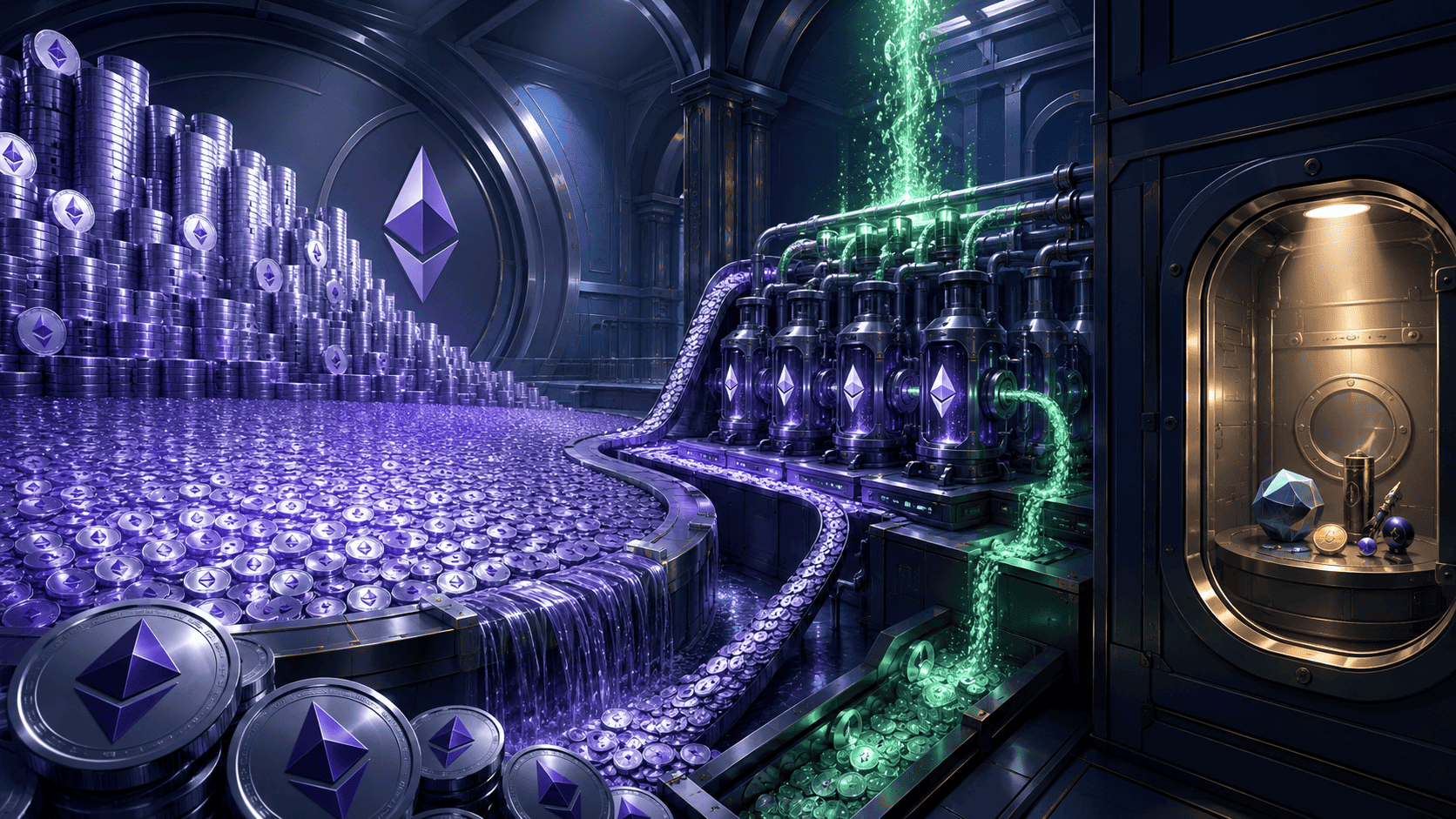
The company reported holdings totalling $11.8 billion as of July 26, comprising 5,787,414 ETH valued at $1,948 each, 208 Bitcoin, $268 million in cash and marketable securities, a $180 million stake in MrBeast’s Beast Industries, and $61 million in Eightco Holdings. The company files the last two under a category it calls “moonshots.”
The Ethereum position alone represents 4.8% of the total ETH supply of 120.7 million tokens, putting BitMine 96% of the way toward its stated goal of owning 5% of all Ethereum, a target it brands the “Alchemy of 5%.” It needs roughly 247,586 more ETH to get there. It has taken 13 months, with the company buying ETH every single week since the strategy began on June 30, 2025. Over the past week it added 9,946 ETH.
BitMine is now the largest Ethereum treasury in the world and the second-largest crypto treasury overall, behind only Strategy.
The Staking Operation Is the Real Business
The headline number obscures what may be the more consequential development. BitMine isn’t simply sitting on Ethereum; it is running one of the largest staking operations in existence.
As of July 26, the company had staked 4,917,189 ETH, worth roughly $9.6 billion and representing 85% of its total holdings. Chairman Tom Lee stated that BitMine has staked more ETH than any other entity in the world. Its own staking operation, called MAVAN, generated a seven-day yield of 2.65% on an annualised basis.
The revenue implications are substantial. Management projects annualised staking revenues of approximately $254 million at current levels, rising to about $299 million if the full 5.79 million ETH gets staked across MAVAN and its partners.
That distinction matters enormously when comparing BitMine to Strategy. Strategy’s Bitcoin generates no income, which is why the company has had to issue preferred stock, pay double-digit dividends and, this month, sell Bitcoin to cover them. BitMine’s Ethereum produces a genuine cash yield simply by existing. A quarter of a billion dollars in projected annual staking revenue is real operating income against which obligations can be serviced. Whether that proves durable depends on Ethereum’s staking rate holding up, but structurally it is a different proposition from a non-yielding asset.
The Moonshots Are Genuinely Odd
Then there are the positions that have nothing obvious to do with Ethereum.
BitMine holds $180 million in Beast Industries, the company behind YouTube creator MrBeast, and $61 million in Eightco Holdings, a Nasdaq-listed firm. The company groups these under “moonshots” and notes their stated values can shift with financing terms and market prices, meaning these are internal valuations rather than liquid marks.
The Eightco position creates an unusual layering effect. Eightco’s own treasury as of July 26 reportedly included $90 million in indirect OpenAI equity, $18 million in Beast Industries equity, 16,278 ETH, nearly 302 million Worldcoin tokens and $142 million in cash. So BitMine holds a direct stake in MrBeast’s company alongside an indirect one through Eightco, while also gaining second-hand exposure to OpenAI and Worldcoin.
For an investor buying BMNR expecting clean Ethereum exposure, that is a meaningfully more complicated picture than the ticker suggests. The moonshots represent roughly 2% of total holdings, so they don’t dominate the balance sheet, but they do complicate what the company actually is.
Buybacks and a Shrinking Cash Pile
BitMine has been aggressive on the equity side too, and the funding mechanics deserve attention.
The company repurchased 6.1 million shares in the past week, up from 5.5 million the week before, and 11.6 million shares since July 1 under a previously authorised $4 billion buyback programme. It joined the Russell 1000 large-cap index on June 26 and launched Series A preferred stock trading under the BMNP ticker. Average daily dollar volume in the common shares ran at $597 million over five sessions through July 24.
Cash and marketable securities fell to $268 million from $385 million the previous week, a $117 million decline in seven days. That money is going toward ETH purchases and share repurchases simultaneously. It is a rapid burn rate, and it raises the same question that has dogged every treasury company: what happens when the cash runs low and capital markets are unwilling?
BitMine’s staking revenue gives it a genuine answer Strategy lacks. Whether $254 million annualised is sufficient against its obligations and ambitions is the question worth watching over coming quarters.
What Investors Should Weigh
The valuation figures come with an important caveat. BitMine priced its Ethereum at $1,948 per token in the disclosure. ETH has since fallen to around $1,877 amid the broader pre-Fed selloff, meaning the $11.8 billion headline is already stale by several hundred million dollars. Treasury company disclosures are snapshots, and in a volatile market they age quickly.
The concentration risk is extreme by design. Nearly 96% of BitMine’s value sits in a single asset that remains roughly 60% below its 2025 high. Tom Lee has been publicly bullish, and advisor Tom DeMark has flagged $2,000 and $2,500 as near-term ETH targets, but those are forecasts rather than floors. BMNR shares rose 13% to close at $17 on July 27, and the stock’s volatility reflects its leverage to a single token.
The genuinely interesting question is what BitMine becomes if it hits 5%. Owning one-twentieth of Ethereum’s entire supply, with 85% of it staked, makes the company a structurally significant participant in the network itself rather than merely an investor in it. That concentration has implications for Ethereum’s validator distribution that the ecosystem has not fully reckoned with.
For now, the company is 247,586 ETH away from a target it set 13 months ago, funding purchases and buybacks from a cash pile that shrank by 30% in a week, and holding stakes in a YouTuber’s business empire alongside its Ethereum. It is a crypto treasury that has evolved into something considerably harder to categorise, and the staking machine underneath it is the part most worth understanding.
Disclaimer: This article is for informational purposes only and does not constitute financial advice. Cryptocurrency investments carry significant risk. Always conduct your own research before making any investment decisions.