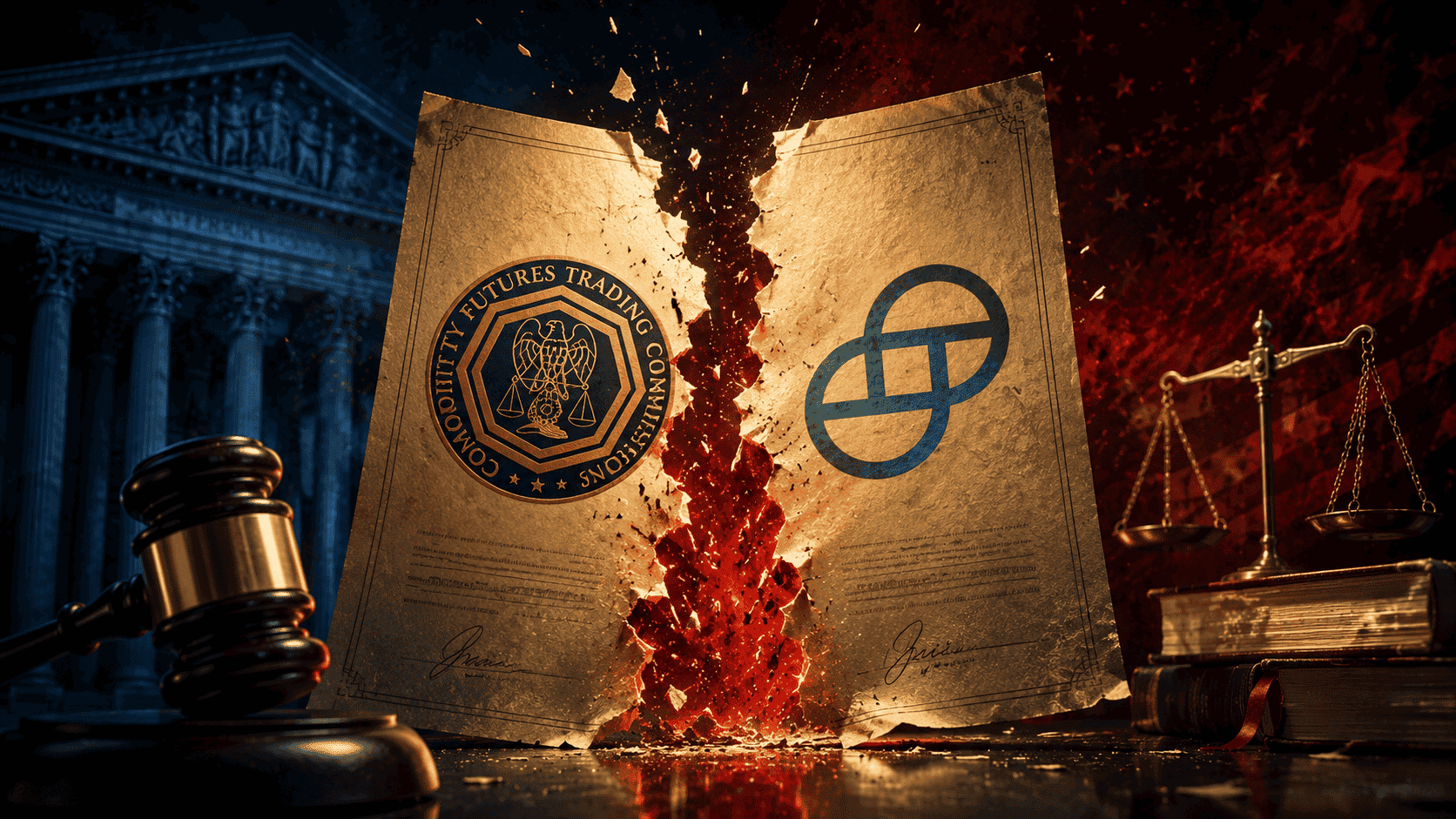
The US Commodity Futures Trading Commission just asked a federal court to throw out its own settlement with Gemini. The agency says the case should never have been filed in the first place.
On Wednesday, the CFTC and Gemini jointly filed a request in the US District Court for the Southern District of New York to vacate a January 2025 settlement that required Gemini to pay $5 million and submit to a permanent injunction barring the company from making false or misleading statements to the commission.


The CFTC’s reasoning was blunt. After reviewing the case, the agency “concluded the complaint should not have been filed and would not have been under current enforcement standards.”
That’s extraordinary language. A federal regulator is telling a court that its own enforcement division got it wrong. Not that the evidence was weak. Not that the fine was too large. That the entire case should never have existed.
If the court grants the request, every requirement Gemini agreed to in the settlement gets erased. The $5 million fine. The injunction. The restrictions. All of it. As if the enforcement action never happened.
The timing is what makes this story impossible to ignore.
The NYT Connection That Nobody Can Unsee
Five days ago, the New York Times published an investigation revealing that senior CFTC career officials were suspended and pushed out after raising concerns about three companies: Polymarket, Crypto.com, and Gemini’s affiliate Gemini Titan.
The officials who questioned whether Gemini Titan had completed the required regulatory review before operating were placed on administrative leave. They were investigated internally. They were eventually pushed out of the agency.
Then Brigitte Weyls, the senior counsel who reportedly sent staff a pre-written recommendation to approve Gemini Titan’s application before the career team had finished their own assessment, left the CFTC and became general counsel at Gemini Titan itself.
Now, days after that investigation made global headlines, the CFTC is filing to erase a separate Gemini enforcement action entirely. The agency that fired people for questioning Gemini is now actively undoing its own prior enforcement against the company.
The optics are devastating. Whether the legal reasoning is sound or not, the sequence of events creates an appearance of an agency working on behalf of the company it’s supposed to regulate rather than the public it’s supposed to protect.
The Original Case and Why It Mattered
The case the CFTC wants to erase dates back to 2017, when Gemini was seeking approval to launch a Bitcoin futures contract.
During meetings with CFTC staff, Gemini allegedly made false statements about the relative difficulty of manipulating Bitcoin futures on its platform. The regulator determined these statements were misleading and pursued an enforcement action in 2022. The case dragged on for three years before Gemini agreed to settle in January 2025 for $5 million plus a permanent injunction.
Gemini always maintained that the settlement was not an admission of guilt but a practical decision to avoid a lengthy trial. The company formally complained about the CFTC’s conduct in mid-2025, accusing the enforcement division of spending seven years targeting the exchange without producing concrete evidence of wrongdoing.
From Gemini’s perspective, the settlement was coerced and unfair. From the CFTC career staff’s perspective, the case protected market integrity by holding an exchange accountable for misleading regulators. From the current CFTC leadership’s perspective, it should never have happened.
The question of who’s right depends largely on whether you trust the career enforcement professionals who built the case over seven years or the political appointees who arrived in 2025 and decided it was all a mistake.
The Winklevoss Brothers and the White House
The political dimensions of this story are hard to separate from the regulatory ones.
Cameron and Tyler Winklevoss, Gemini’s co-founders, have been frequent guests at White House events since the current administration took office. They were photographed at the White House after the GENIUS Act signing ceremony. They have been vocal supporters of the administration’s pro-crypto agenda. And their business ties to the Trump family are documented.
Brian Quintenz, Trump’s earlier nominee to lead the CFTC before the role went to Mike Selig, revealed that the Winklevoss brothers asked him to review the Gemini settlement and expressed dissatisfaction when he declined to intervene. Quintenz left the nomination process. Selig, who took over, is now the acting chair overseeing the request to erase that very settlement.
None of this proves improper coordination. Business owners regularly advocate for themselves with regulators. Political appointees frequently disagree with the enforcement decisions of their predecessors. And reviewing old cases in light of new policy priorities is a normal part of any change in administration.
But the cumulative pattern, officials fired for questioning Gemini, the CFTC counsel who approved Gemini Titan joining the company, the Winklevoss brothers lobbying against the settlement, and the agency now filing to erase it, raises questions that normal regulatory process doesn’t typically produce.
What Erasing the Settlement Would Mean
If the Southern District of New York grants the joint request, the legal consequences are straightforward. Gemini’s $5 million penalty is nullified. The permanent injunction preventing the company from making false or misleading statements to the CFTC is lifted. Every obligation Gemini agreed to in January 2025 disappears.
The broader consequences are harder to measure. Erasing a settled enforcement action signals to every crypto company currently under investigation, in settlement negotiations, or considering whether to cooperate with the CFTC.
That signal is: if you can outlast the current enforcement team, the next one might erase whatever they did to you.
For companies with deep pockets and political connections, that’s empowering. For the career enforcement professionals who build cases over years, it’s demoralizing. And for retail investors who rely on regulators to hold companies accountable, it removes a layer of protection designed to ensure markets operate fairly.
The CFTC says the case was flawed from the start. Gemini says it was a political weapon used to unfairly target the company. The career staff who built it spent seven years doing so. Somewhere in that three-way disagreement is the truth. The court will now decide.
The Bigger Picture for Crypto Regulation
This is the third major CFTC story in a week. First, the NYT investigation exposed officials being fired. Then, Trump publicly defended Selig and praised the deregulation agenda. Now, the agency is actively erasing its own enforcement history.
Together, these stories paint a picture of a regulatory agency that has undergone the most dramatic transformation in its history over 18 months. The enforcement division that brought over 80 crypto-related cases under the previous administration has been replaced by a leadership that has brought two.
For the crypto industry, this creates an environment of maximum freedom and minimum oversight. Companies can launch products, expand into new markets, and operate with far less fear of enforcement action than at any point in the past decade.
The risk is that this freedom eventually leads to fraud, manipulation, or consumer harm that enforcement actions were designed to prevent. When that happens, and in crypto it always eventually does, the absence of an active regulator will be felt by the people who needed protection the most.
The CFTC was created to ensure that derivatives markets operate with integrity and transparency. Whether erasing a settled case against an exchange whose founders have White House access serves that mission is a question that won’t be answered by a court filing. It will be answered by what happens next.
Disclaimer: This article is for informational purposes only and does not constitute financial advice. Cryptocurrency investments carry significant risk. Always conduct your own research before making any investment decisions.