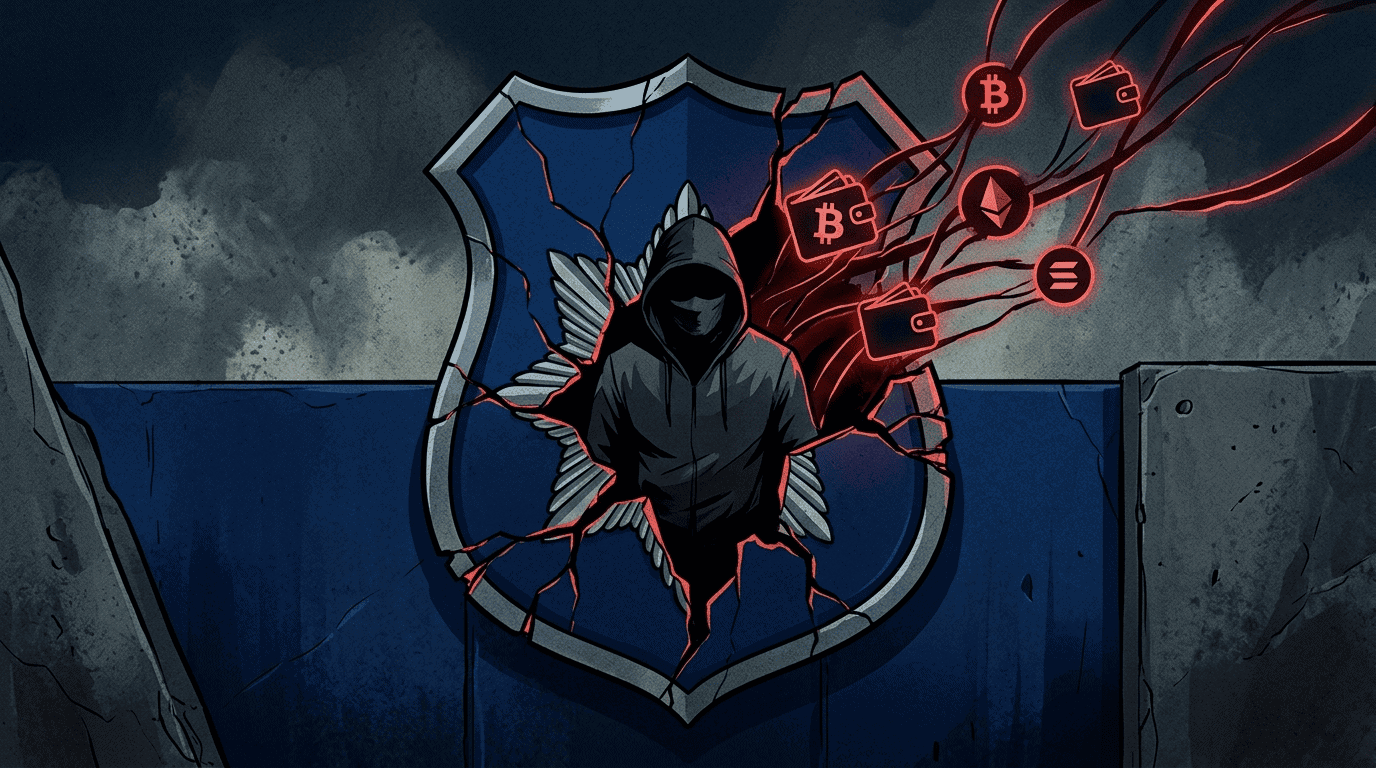
Imagine the police knocking on your door. Real police. With real uniforms, real credentials, and real authority. They tell you you’re under investigation. They take you somewhere. And then they demand your crypto.
That’s not a hypothetical scenario. It’s exactly what happened to at least four crypto entrepreneurs in Ukraine, and the people doing it held the rank of colonel.


The Kyiv Regional Prosecutor’s Office completed its pre-trial investigation into a criminal ring composed of four active-duty police officers and one civilian accomplice who allegedly kidnapped crypto business owners and extorted approximately $2.2 million through threats, violence, and fabricated legal claims.
Two of the officers held the rank of colonel. They weren’t rogue patrol cops running a side hustle. They were senior law enforcement officials who used the full weight of their positions to identify targets, gain access, and extract wealth from people who had no reason to question someone flashing a legitimate police badge.
The case has been referred to a court in the Kyiv region. All five suspects were dismissed from their positions following their arrest in November 2025. The Security Service of Ukraine (SSU) led the investigation.
How the Ring Operated
The operation was disturbingly professional.
The suspects were officers of the Main Police Department in the Autonomous Republic of Crimea and Sevastopol (Ukrainian territory under Russian occupation since 2014) and a Kyiv-based unit. Two colonels organized the group, recruiting fellow officers and a civilian with a prior criminal record to carry out the physical operations.
Their method exploited something that no hardware wallet or multi-signature setup can protect against: trust in authority. The officers impersonated police acting in an official capacity. They approached targets under the pretence of legitimate law enforcement activity, using their real credentials and the institutional weight of the Ukrainian police force to gain access.
Once they had their victims, the approach shifted from official to criminal. Prosecutors described a pattern of threats, physical violence, and fabricated debt claims designed to pressure victims into transferring crypto assets. The perpetrators didn’t need to hack wallets or crack passwords. They just needed their victims to be afraid enough to hand over the keys.
At least four victims have been documented, with total losses reaching approximately $2.2 million across the series of attacks. The criminal activities reportedly ran for an extended period before being halted in November 2025, when the SSU intervened, arrested the suspects, and removed them from their positions.
No names of suspects, victims, or associated companies have been publicly disclosed, as judicial proceedings remain ongoing.
Why Police-Led Crypto Crime Is the Most Dangerous Kind
Crypto kidnappings have been rising globally. France has recorded 41 incidents in 2026 alone. The wife of the Sandbox co-founder was targeted earlier this month. CertiK documented 72 verified “wrench attacks” globally in 2025, a 75% jump from the prior year, with confirmed losses exceeding $40.9 million.
But the Ukrainian case represents something qualitatively different from a group of masked criminals ambushing someone outside their home.
When the attackers are actual police officers, every defense mechanism that victims normally rely on breaks down completely. You can’t call the police because the police are the ones attacking you. You can’t refuse to cooperate because they have the legal authority to detain you. You can’t verify whether the encounter is legitimate because the credentials are real. And you can’t easily seek help afterward because reporting police corruption carries its own risks, especially in a country experiencing the institutional stress of a prolonged war.
Ari Redbord, VP and global head of Policy and Government Affairs at TRM Labs, provided context for the broader trend. He noted that Europe has several converging factors that make crypto crime attractive: dense urban environments, strong crypto adoption in certain corridors, and highly capable organized crime groups with experience in armed robbery and extortion.
“Crypto extortion fits logically into their existing toolkit,” he said. As digital theft becomes harder due to hardware wallets, multi-signature setups, and stronger exchange controls, “criminals may increasingly resort to coercion rather than hacking.”
When the criminals doing the coercing wear badges, the problem becomes exponentially harder to solve.
The War Factor Nobody Wants to Talk About
Ukraine has been fighting a full-scale war since February 2022. That context doesn’t excuse police corruption, but it helps explain how a scheme like this could operate for an extended period before being caught.
Wartime conditions create institutional stress, giving criminals more room to operate. Law enforcement resources are stretched thin. Oversight mechanisms weaken. Public attention is focused on the front lines rather than domestic crime. And the economic disruption caused by the conflict creates financial pressure that can push even formerly honest officials toward corruption.
Jameson Lopp, a well-known Bitcoin developer and security researcher who maintains a public database of physical crypto attacks, noted that war, corruption, and institutional stress create conditions where coercive schemes are harder to detect, giving criminals more room to operate behind “confusion, fear, and fake legal pressure.”
The two colonels in this case came from the police department covering Crimea and Sevastopol, a territory that has been under Russian occupation since 2014. Officers from that department have been displaced from their original jurisdictions and are operating in mainland Ukraine under unusual administrative circumstances. That displacement may have reduced the normal accountability structures that would typically catch this kind of abuse earlier.
None of this diminishes the severity of what happened. But it adds a layer of understanding that matters for anyone evaluating the risks of holding crypto in regions experiencing conflict or institutional instability.
The Global Wrench Attack Epidemic
The Ukrainian case is part of a global pattern that has been accelerating since 2024.
CertiK’s report documented 72 verified physical crypto attacks in 2025, up 75% from the prior year. Confirmed losses exceeded $40.9 million. And those numbers only count verified incidents. The actual total is almost certainly higher because many victims never report attacks out of fear, embarrassment, or concern about further targeting.
France leads Europe with 135 crypto-linked incidents since 2023 and 88 people charged across 12 active judicial investigations. The UK has seen growing numbers of crypto-motivated robberies. The United States recorded two teenagers in Florida charged with 22 felony counts over a $4 million crypto kidnapping. An American tourist was drugged during a fake Uber ride in London and woke up to find $123,000 in Bitcoin and XRP missing.
The geography spans continents, but the method is remarkably consistent. Identify someone who holds crypto through blockchain data, social media, conference attendance, or industry connections. Gain physical access through deception, ambush, or, in the Ukrainian case, legitimate authority. Apply enough pressure, whether that’s physical violence, threats against family, or fabricated legal claims, until the victim transfers their assets. And disappear with crypto that’s almost impossible to recover once it’s in the attacker’s wallet.
The Ukrainian case stands out because the attackers didn’t need to find their victims through blockchain analysis or social media research. As police officers, they had access to databases, surveillance tools, and intelligence networks that made it far easier to identify wealthy crypto holders than it would be for ordinary criminals.
That’s the nightmare scenario for the crypto security community. When the tools designed to protect citizens are turned against them by the people who control them, the attack surface expands beyond anything personal operational security can defend against.
What This Means for Crypto Holders in Conflict Zones
The Ukrainian case offers specific lessons for anyone holding significant crypto assets in regions experiencing war, political instability, or institutional weakness.
First, authority is not automatically trustworthy. In stable democracies, a police officer’s badge generally means safety. In conflict zones or countries with high levels of corruption, it can mean the opposite. If law enforcement contacts you about your crypto holdings in a country where institutional accountability is weakened, verify the interaction through independent channels before cooperating.
Second, geographic diversification of assets matters. Victims who held all their crypto in wallets accessible from a single location had no fallback when confronted by armed attackers. Distributing holdings across multiple wallets, jurisdictions, and custody arrangements makes it harder for any single attacker, even one with police authority, to access everything.
Third, minimize your visible footprint. The Ukrainian officers likely used professional databases and intelligence resources to identify targets. Ordinary criminals use social media, conference photos, and on-chain data. In either case, the less visible your crypto wealth is, the less likely you are to be targeted. Don’t discuss holdings publicly. Don’t post about transactions. Don’t display wealth that can be connected to blockchain addresses.
And fourth, have a duress protocol. Some hardware wallet users configure a separate “duress wallet” with a small amount of crypto that they can surrender under threat without revealing their main holdings. This isn’t a perfect defense, but it provides an option when physical resistance isn’t possible.
The crypto industry celebrates self-sovereignty and personal control over wealth. The Ukrainian kidnapping ring is a brutal reminder that personal control also means personal responsibility for security, and that the threats aren’t always digital.
Disclaimer: This article is for informational purposes only and does not constitute financial advice. Cryptocurrency investments carry significant risk. Always conduct your own research before making any investment decisions.