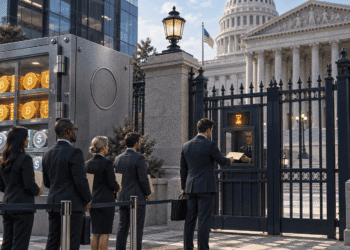


Sam Bankman-Fried formally applied for a presidential pardon from Donald Trump. The application, filed through the Department of Justice’s Office of the Pardon Attorney, is listed as pending on the DOJ’s website as a “pardon after completion of sentence.”
The 34-year-old is currently serving a 25-year sentence at a low-security federal prison in California after being convicted in 2024 on seven counts of fraud and conspiracy. The charges stemmed from the collapse of FTX, the crypto exchange he co-founded, which imploded in November 2022 after it was revealed that billions in customer deposits had been funnelled to affiliated trading firm Alameda Research. The hole in FTX’s accounts exceeded $8 billion.


In a phone interview with FOX Business published Monday, Bankman-Fried was asked directly whether he wanted a pardon. “Absolutely,” he responded. “It would be obviously, you know, ultimately up to the president, not up to me.”
Trump has said otherwise. In a January interview with The New York Times, the president named Bankman-Fried specifically among high-profile individuals he has no plans to grant clemency. A White House spokesperson declined to comment on the application but pointed reporters back to that interview.
The man who orchestrated the largest financial fraud in crypto history is asking the president of the United States for freedom. The president has already said no. And the application is pending anyway.
The Political Transformation That Nobody Believes
Before FTX collapsed, Bankman-Fried was one of the largest donors to Democratic campaigns and causes in America. He donated approximately $40 million to Democratic candidates and left-leaning PACs during the 2022 election cycle, making him one of the party’s most prolific individual contributors.
From a California prison cell, he has become a vocal Trump supporter.
Bankman-Fried now posts statements of support for the Trump administration through a proxy-managed social media account on X. When Trump pardoned former Honduran president Juan Orlando Hernández, who had been convicted of drug trafficking and sentenced to 45 years, Bankman-Fried wrote: “I’m so glad Juan Orlando is free — few are more deserving than him.”
The message was transparent in its intent. Bankman-Fried wasn’t commenting on Honduran politics. He was signalling to the Trump administration that he supports the president’s use of clemency power and would be grateful to receive the same treatment.
The political pivot from Democratic megadonor to Trump cheerleader has been widely mocked across social media and within the crypto community. Whether it’s a genuine conversion or a calculated strategy to improve his chances of clemency is ultimately irrelevant to the pardon process. What matters is whether Trump decides to grant it. And so far, the answer has been no.
Why Trump Has Already Said No
Trump’s January statement to The New York Times was specific. He named Bankman-Fried as someone he did not intend to pardon. That level of specificity is unusual. Presidents typically avoid commenting on individual clemency applications before they’re formally reviewed.
The political dynamics work against Bankman-Fried. FTX’s collapse destroyed the savings of over one million customers worldwide. The victims included retail investors, pension funds, and charitable organisations. Pardoning the person responsible for those losses would generate enormous bipartisan backlash.
Trump has used the pardon power aggressively during his second term, granting clemency to dozens of white-collar defendants and political allies. He pardoned Ross Ulbricht, the Silk Road founder who was serving a life sentence, in January 2025 — a move celebrated by the crypto community as a gesture of goodwill toward the industry.
But Ulbricht’s case and Bankman-Fried’s case are fundamentally different. Ulbricht was convicted for operating an illegal marketplace. Bankman-Fried was convicted for stealing billions from his own customers. Ulbricht had served 11 years and was widely viewed within the crypto community as having received a disproportionate sentence. Bankman-Fried has served two years and is widely viewed within the same community as having received a sentence that many thought was too lenient.
The crypto industry’s attitude toward the two cases illustrates the distinction. The community overwhelmingly supported Ulbricht’s release. It overwhelmingly opposes Bankman-Fried’s. A Trump pardon for Bankman-Fried would alienate the crypto voters the administration has spent two years cultivating.
The Legal Avenues That Haven’t Worked
The pardon application isn’t Bankman-Fried’s first attempt to escape his sentence. Every previous effort has failed.
In early 2026, his legal team filed a motion for a new trial, claiming that new evidence could undermine the government’s case. Judge Lewis Kaplan, who oversaw the original trial, denied the motion in April. Kaplan’s ruling was blunt, finding that the new evidence didn’t meet the standard required for a retrial.
An appeal of his conviction and sentence is pending before the Second Circuit Court of Appeals. His legal team has argued that procedural errors during the trial and the severity of the sentence warrant review. A ruling could come at any time in 2026, but legal observers have generally assessed the appeal as a long shot given the strength of the evidence presented at trial.
The pardon application represents a parallel track. Even if the appeal succeeds in reducing his sentence or securing a new trial, a presidential pardon would make all of it moot. And even if Trump has said he won’t grant one, formal applications create a public record and keep the conversation alive for future consideration.
Bankman-Fried’s parents, Stanford law professors Joseph Bankman and Barbara Fried, are reportedly supporting the clemency effort behind the scenes. Their legal expertise and academic connections give them access to the kind of networks that can influence presidential decision-making, even if the public statements say otherwise.
What the Crypto Community Thinks
The reaction from the crypto industry has been nearly unanimous: no.
FTX’s collapse wasn’t a regulatory grey area or a technical failure. It was deliberate fraud. Customer deposits that were supposed to be held safely were moved to Alameda Research and used for speculative trading, political donations, luxury real estate purchases, and venture investments. When the trades went wrong and customers tried to withdraw their money, it wasn’t there.
The victims included over one million users across more than 100 countries. Some lost their life savings. Some lost retirement funds. Some lost money they had borrowed to invest. The human cost of FTX’s collapse extended far beyond the $8 billion headline figure.
For the crypto community, which has spent years arguing that the industry can be trusted with financial responsibility, a presidential pardon for its most infamous fraudster would undermine that argument entirely. It would tell the world that in crypto, you can steal billions, serve two years, and walk free with a presidential signature.
That message would damage the industry’s credibility more than any hack, exploit, or market crash. The community knows it. And based on his January statement, Trump appears to know it too.
Will It Work?
Almost certainly not under current conditions.
Trump has said no. The political incentives point against it. The crypto industry opposes it. The victims oppose it. The bipartisan backlash would be severe. And Bankman-Fried has served only two of his 25 years.
But presidential pardons operate outside normal political logic. They’re unchecked executive power exercised at the president’s sole discretion. No court can review them. No Congress can block them. And the circumstances that make a pardon unthinkable today could change tomorrow.
If the Second Circuit appeal produces a surprise ruling that questions the fairness of the trial, it could soften political opposition to clemency. If FTX’s estate successfully repays all creditors (which is reportedly on track after asset liquidations), the “victims are made whole” argument becomes available. If the political landscape shifts in ways that make crypto industry support less important to the administration, the calculation changes.
None of those scenarios seem likely right now. All of them are possible over a four-year presidential term. Bankman-Fried has 23 years left on his sentence. He’s betting that something changes between now and then.
The application is pending. The answer, for now, is no. But in Washington, “no” is sometimes just a “not yet” that hasn’t found its moment.
Disclaimer: This article is for informational purposes only and does not constitute legal or financial advice. Always conduct your own research before making any investment decisions.