The clock is ticking for Injective holders. Governance voting on the Vulcan mainnet upgrade opened this weekend and closes on June 4. If approved, it would be the most significant upgrade to the Injective network since Volan launched in January 2024 and could fundamentally change how value flows back to INJ token holders.
The proposal, filed as a governance improvement proposal on-chain, gives every INJ staker a vote on whether to activate Vulcan. The upgrade doesn’t add one flashy feature. It rewires the economic engine underneath the entire network, tightening the connection between trading activity and token value in ways that previous upgrades didn’t.


INJ is trading near $3.50. The last time a major governance proposal was approved, the token rallied to approximately $3.65 before retracing. Whether Vulcan triggers a similar or larger move depends on whether the market believes the upgraded tokenomics can deliver sustained demand for INJ, not just a temporary speculative bump.
What Vulcan Actually Changes
The upgrade focuses on three areas that directly affect how INJ captures value from the network’s growing trading ecosystem.
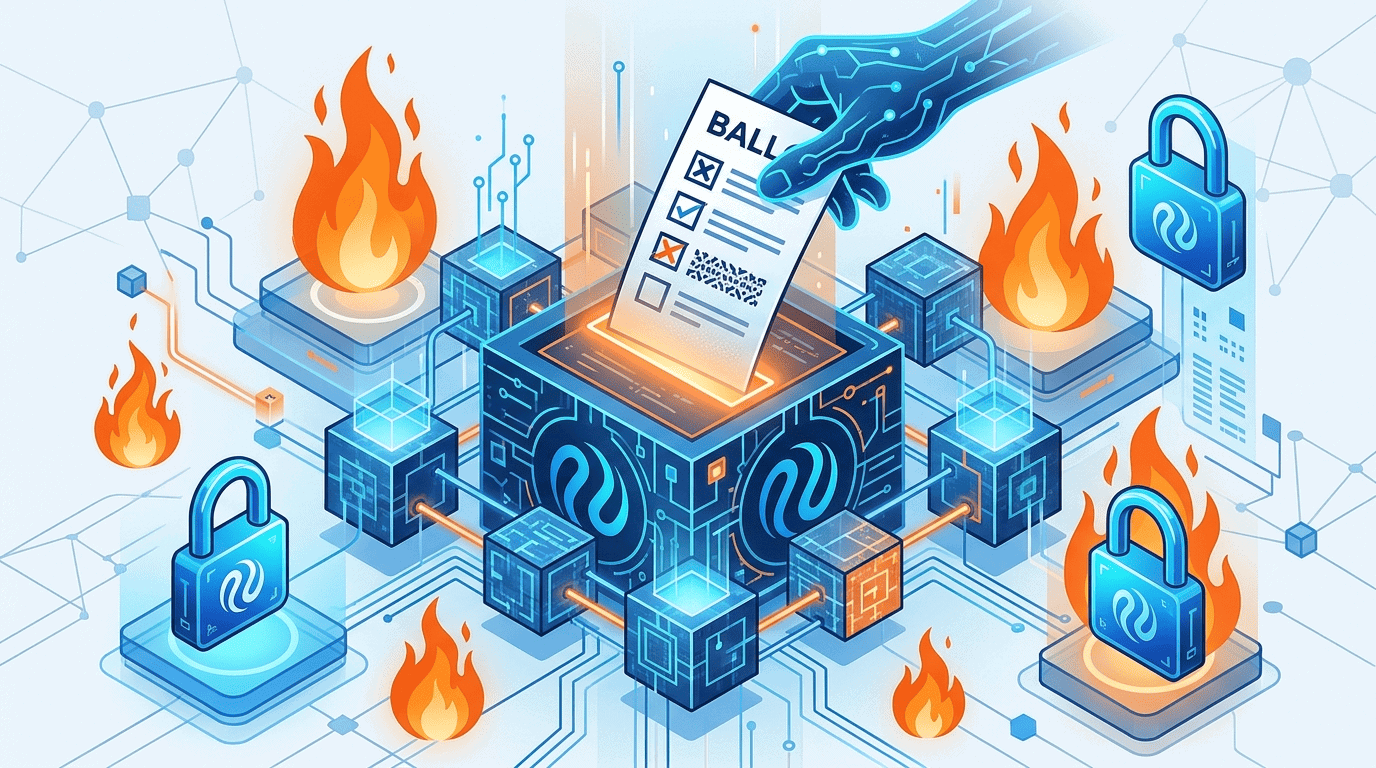
Enhanced token burns tied to trading volume. This is the centrepiece. Vulcan introduces buyback-and-burn mechanisms that are directly linked to trading activity on Injective’s exchange infrastructure. As more volume flows through the platform, more INJ gets purchased from the open market and permanently burned. The relationship between usage and scarcity becomes mechanical rather than theoretical.
Under previous tokenomics, burns happened, but the connection to real-time trading activity was looser. Vulcan tightens that link so that every dollar of trading volume on Injective directly reduces the token’s circulating supply. For holders, it means the network’s growth translates into a measurable reduction in supply rather than just higher TVL numbers on a dashboard.
Improved staking mechanics. Vulcan enhances the staking model to provide validators and delegators with stronger incentives for long-term participation. The specific changes include adjustments to reward distribution, commission structures, and delegation incentives designed to increase the percentage of INJ locked in staking and reduce the circulating supply available for trading.
Currently, staking participation on Injective is healthy but below the levels seen on comparable proof-of-stake networks. If Vulcan’s improved incentives push staking participation higher, it creates a double supply squeeze: more tokens burned through trading and more tokens locked through staking. Both reduce selling pressure.
Building on Volan’s RWA foundation. The Volan upgrade in January 2024 introduced the first native real-world asset module on Injective, giving developers tools to bring tokenized versions of traditional financial instruments on-chain. Vulcan builds on that foundation by improving the infrastructure supporting tokenized assets, thereby expanding the range of instruments that can be created and traded on the network.
Why the Burn Mechanism Matters More Than It Sounds
Token burns are one of the most misunderstood concepts in crypto. Many projects burn tokens as a marketing exercise without a meaningful impact on supply or price. Injective’s approach with Vulcan is structurally different because the burns are tied to real economic activity rather than arbitrary schedules.
Think of it like a business that buys back its own stock using profits from actual sales. The more products the business sells, the more stock it buys back, the fewer shares exist, and the more each remaining share is worth. That’s how corporate buybacks work in traditional finance, and it’s the model Vulcan implements for INJ.
The key variable is trading volume. Injective processed significant derivatives and spot volume through its exchange modules in 2025. As that volume grows, whether from organic adoption, new trading pairs, or the integration of tokenized real-world assets, the burn rate accelerates proportionally.
For INJ holders, the investment thesis becomes tied to a measurable metric: Is trading volume on Injective growing? If yes, more INJ gets burned, supply shrinks, and the token becomes scarcer. If volume declines, burn rates slow, and deflationary pressure eases.
That transparency is what separates Vulcan’s burn mechanism from the vague “deflationary tokenomics” promises that plague dozens of other projects. You can verify the burns on-chain. You can track trading volume in real time. And you can calculate exactly how much INJ is being removed from circulation each week.
The Governance Vote Process
Injective uses an on-chain governance model where any INJ staker can vote on protocol upgrades. The Vulcan proposal is live now, and voting closes on June 4.
Stakers can vote “Yes,” “No,” “No with Veto,” or “Abstain.” A proposal passes if it reaches the required quorum of participating stakeholders and more than 50% of votes are in favor, excluding abstentions. A “No with Veto” vote above 33% kills the proposal entirely, regardless of how many “Yes” votes it receives.
Previous governance proposals on Injective have passed with strong margins. The Volan upgrade was approved with overwhelming support. Community sentiment around Vulcan appears similarly positive based on forum discussions and social media activity, though nothing is guaranteed until the votes are counted.
For INJ holders who haven’t voted yet, the deadline is June 4. Voting requires staked INJ. If your tokens are sitting unstaked on an exchange, you can’t participate. That’s a design choice that ensures the people voting on the network’s future are the ones with skin in the game.
Where INJ Stands in the Market
Injective occupies an interesting niche in the Layer 1 landscape. It’s not trying to be the next Ethereum or Solana. It’s built specifically for financial applications: decentralized exchanges, derivatives, tokenized assets, and institutional-grade trading infrastructure.
That focus has attracted a dedicated user base but hasn’t produced the kind of headline-grabbing TVL or market cap numbers that broader Layer 1s generate. INJ’s current price near $3.50 places it well outside the top 20 by market capitalization.
The last governance upgrade provided a useful precedent. Following Volan’s approval in January 2024, INJ rallied to approximately $3.65, a modest but real positive reaction. The rally then retraced as the broader market weakened.
Vulcan’s impact could be greater because it directly addresses the value-accretion problem that has held INJ back. Previous upgrades added features and capabilities. Vulcan changes the economics. If the upgraded burn mechanism demonstrably removes more INJ from circulation as trading volume grows, it creates a fundamental reason for the token to appreciate that didn’t exist before.
Staking availability through platforms like Binance US has also expanded the range of participants who can earn rewards on their INJ holdings, broadening the demand base beyond crypto-native users.
The Risks Worth Considering
Governance votes are not guaranteed to pass. While community sentiment appears supportive, a coordinated “No with Veto” campaign by large stakers could theoretically block the upgrade. That scenario is unlikely but not impossible, particularly if concerns emerge about the burn mechanism’s impact on network economics.
Even if Vulcan passes, the impact on INJ’s price depends on whether trading volume actually grows. The burn mechanism creates deflationary pressure only when people are trading on the platform. If volume stagnates or declines, the upgraded tokenomics don’t produce outcomes meaningfully different from the current model.
Competition from other derivatives-focused platforms is intensifying. Hyperliquid now captures over 50% of all decentralized perpetual futures volume and generates $620 million in annualized revenue. dYdX, GMX, and Jupiter all compete for the same trading activity that Injective’s burn mechanism depends on. Winning volume in that competitive landscape is harder than designing the tokenomics to reward it.
And the broader market environment remains challenging. With Bitcoin below $74,000, Ethereum clinging to $2,000, and the Fear and Greed Index at 25, smaller altcoins like INJ face headwinds that no governance upgrade can overcome on its own. Vulcan could be the right upgrade at the wrong time.
That said, protocol upgrades that improve fundamental tokenomics tend to produce their strongest effects over months and years rather than days. If Vulcan passes on June 4 and Injective’s trading volume grows through the second half of 2026, the compounding impact of enhanced burns could make INJ one of the more interesting accumulation opportunities in the current downturn.
FAQ
What is the Injective Vulcan upgrade?
Vulcan is a proposed mainnet upgrade for the Injective network that introduces enhanced token burn mechanisms tied directly to trading volume, improved staking incentives, and expanded infrastructure for tokenized real-world assets. It builds on the Volan upgrade from January 2024, which introduced the network’s first native RWA module. Governance voting is live and closes June 4.
How do the new token burns work?
Vulcan introduces buyback-and-burn mechanics that are directly linked to trading activity on Injective’s exchange infrastructure. As trading volume increases, more INJ is purchased from the open market and permanently destroyed. This creates a mechanical relationship between network usage and token scarcity that strengthens as the platform grows.
How can INJ holders vote on the upgrade?
Any INJ holder with staked tokens can vote on-chain before the June 4 deadline. Options are “Yes,” “No,” “No with Veto,” or “Abstain.” The proposal passes if it reaches quorum and more than 50% of non-abstaining votes are in favor. Tokens must be staked to vote; INJ sitting on exchanges cannot participate in governance.
Disclaimer: This article is for informational purposes only and does not constitute financial advice. Cryptocurrency investments carry significant risk. Always conduct your own research before making any investment decisions.