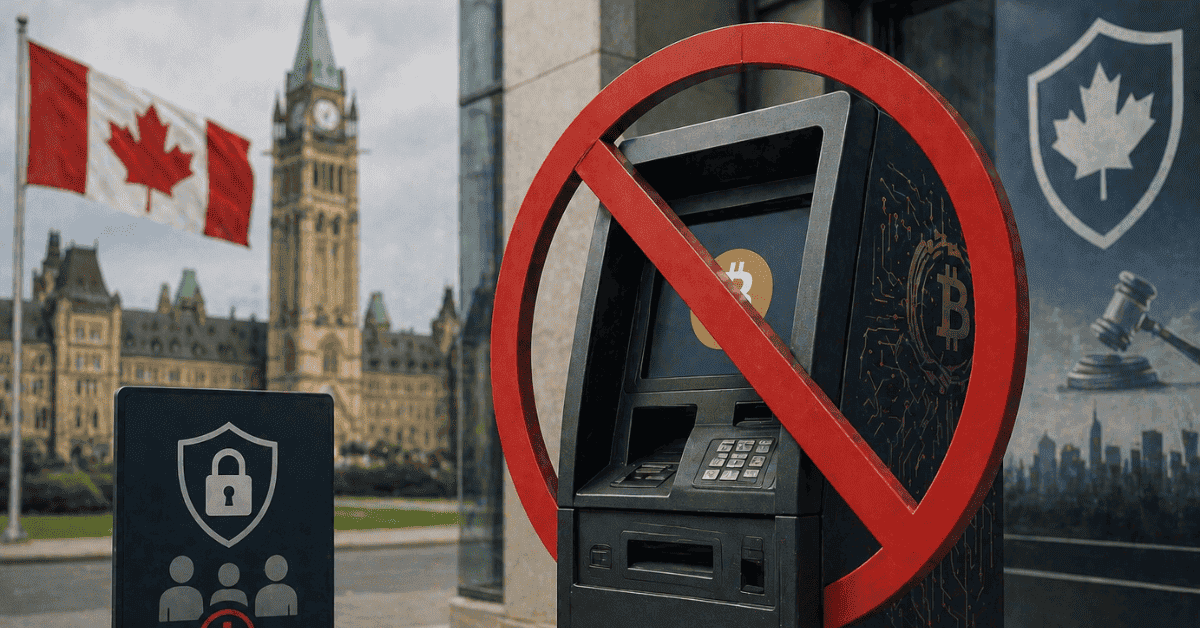


Canada is moving to ban cryptocurrency ATMs nationwide as part of a broader crackdown on fraud, money laundering and illicit cash movement.
The proposal was included in Canada’s Spring Economic Update 2026, released on April 28. The government said crypto ATMs have become “a primary method” for scammers to defraud victims and for criminals to place cash proceeds of crime into the financial system.
That wording is important. Canada is not simply tightening disclosure rules or asking operators for more compliance checks. The federal government is proposing to make operating a cryptocurrency automated teller machine a criminal offence.
For a country with one of the world’s densest crypto ATM markets, that would be a major shift.
Why Canada Wants Crypto ATMs Gone
Crypto ATMs let users buy Bitcoin and other digital assets with cash. In theory, they offer a simple bridge between physical money and crypto wallets. In practice, regulators say they are increasingly being used by scammers and money launderers.
The Canadian government says fraudsters use the machines to extract money from victims, while criminals use them to place illicit cash into the financial system. The Spring Economic Update says the ban is meant to “protect Canadians” by shutting down that channel.
The concern is not hard to understand. Crypto ATM transactions can move quickly, and once a victim sends funds to a scam wallet, recovery is often difficult. Scammers may pressure victims to withdraw cash, visit a nearby machine and send crypto to a wallet controlled by the fraudster.
That makes crypto ATMs especially attractive for social engineering scams, fake investment schemes, romance scams and impersonation fraud.
Canada Has Nearly 4,000 Crypto ATMs
The scale of Canada’s ATM market makes the proposal especially significant.
The Guardian reported that Canada has nearly 4,000 cryptocurrency ATMs, the most per capita in the world. TheStreet similarly reported that the planned ban would target a network of nearly 4,000 machines across the country.
That means this is not a symbolic move against a tiny corner of the market. If implemented, the ban could remove thousands of physical crypto access points from Canadian cities.
For everyday users, the impact would be clearest for people who rely on cash to buy digital assets. The government says Canadians would still be able to buy virtual currencies through brick-and-mortar money services businesses, but with stronger controls to reduce illicit activity.
The Ban Is Part of a Bigger Financial Crime Push
The crypto ATM proposal is only one piece of Canada’s wider financial crime strategy.
The Spring Economic Update also proposes tougher rules for money services businesses, including stronger FINTRAC powers to refuse or revoke registrations, more criminal record checks and measures to prevent non-compliant businesses from re-registering.
Canada is also creating a new Financial Crimes Agency, designed to investigate serious and complex financial crimes such as money laundering, major fraud and capital markets crime. The Guardian reported that the new agency will have powers to investigate and prosecute financial crimes, addressing a long-standing criticism that Canada’s anti-money-laundering system has been fragmented.
That context matters. The ATM ban is not being presented as a crypto policy in isolation. It is being framed as part of a national response to fraud, extortion, money laundering and organized financial crime.
Why the Crypto Industry May Push Back
The crypto industry is likely to argue that a full ban goes too far.
Crypto ATM operators could say the problem is not the machines themselves, but weak compliance and poor enforcement. A stricter licensing regime, stronger know-your-customer checks, lower transaction limits, fraud warnings and real-time monitoring could reduce abuse without removing legal cash access to crypto entirely.
That argument has some force. Many financial tools can be abused by criminals, including bank accounts, wire transfers, prepaid cards and cash itself. A ban removes the bad use cases, but it also removes legitimate ones.
The government appears to have made a different judgment. It sees crypto ATMs as a high-risk channel where the consumer harm and money-laundering risk outweigh the benefits.
What This Means for Bitcoin Buyers in Canada
If the ban is implemented, Canadians would not be banned from buying Bitcoin or other cryptocurrencies.
The proposal targets crypto ATMs, not crypto ownership itself. Users would still be able to use registered exchanges and other compliant money services businesses. The Spring Economic Update specifically says the measures are meant to ensure Canadians can still benefit from money services businesses, including buying virtual currencies from brick-and-mortar providers.
The practical change would be access. Buying crypto with cash at a machine would become much harder or unavailable. Users would likely be pushed toward regulated online exchanges, bank-connected platforms and other providers with more formal compliance controls.
For scammers, that could make one common playbook harder. For privacy-focused users and cash-based buyers, it could feel like another step away from crypto’s original open-access ethos.
Canada Is Joining a Global Crackdown
Canada is not alone in scrutinizing crypto ATMs.
Other countries have already restricted or targeted the sector. Australia’s AUSTRAC launched a cryptocurrency task force in 2024 aimed at non-compliant crypto ATM providers, citing money laundering and scam concerns. The United Kingdom has also taken a hard line against unregistered crypto ATMs.
The trend is clear. Regulators are becoming less tolerant of physical crypto cash ramps that they believe are difficult to police.
That could reshape how crypto is accessed in developed markets. Instead of corner-store Bitcoin machines, governments appear to prefer registered platforms, bank-linked accounts and providers that can be monitored through formal anti-money-laundering systems.
The Bottom Line
Canada’s proposed crypto ATM ban is a major escalation in the fight against crypto-enabled fraud.
Supporters will see it as a necessary consumer protection measure, especially given the role crypto ATMs can play in scams. Critics will see it as a blunt instrument that punishes legitimate users and operators instead of improving enforcement.
Either way, the direction is clear. Canada wants crypto access to move away from lightly supervised cash machines and toward more regulated channels.
For the crypto industry, the message is uncomfortable but direct: if a product becomes a preferred tool for scammers, regulators may not wait for better compliance. They may simply shut the door.
Disclaimer: This article is for informational purposes only and does not constitute financial, investment, or legal advice. Always conduct your own research before making any investment decisions.