A Green Beret bet $33,000 on a raid he was about to carry out. He made $409,000. Everyone assumed it was an isolated case. A new report says it was not.
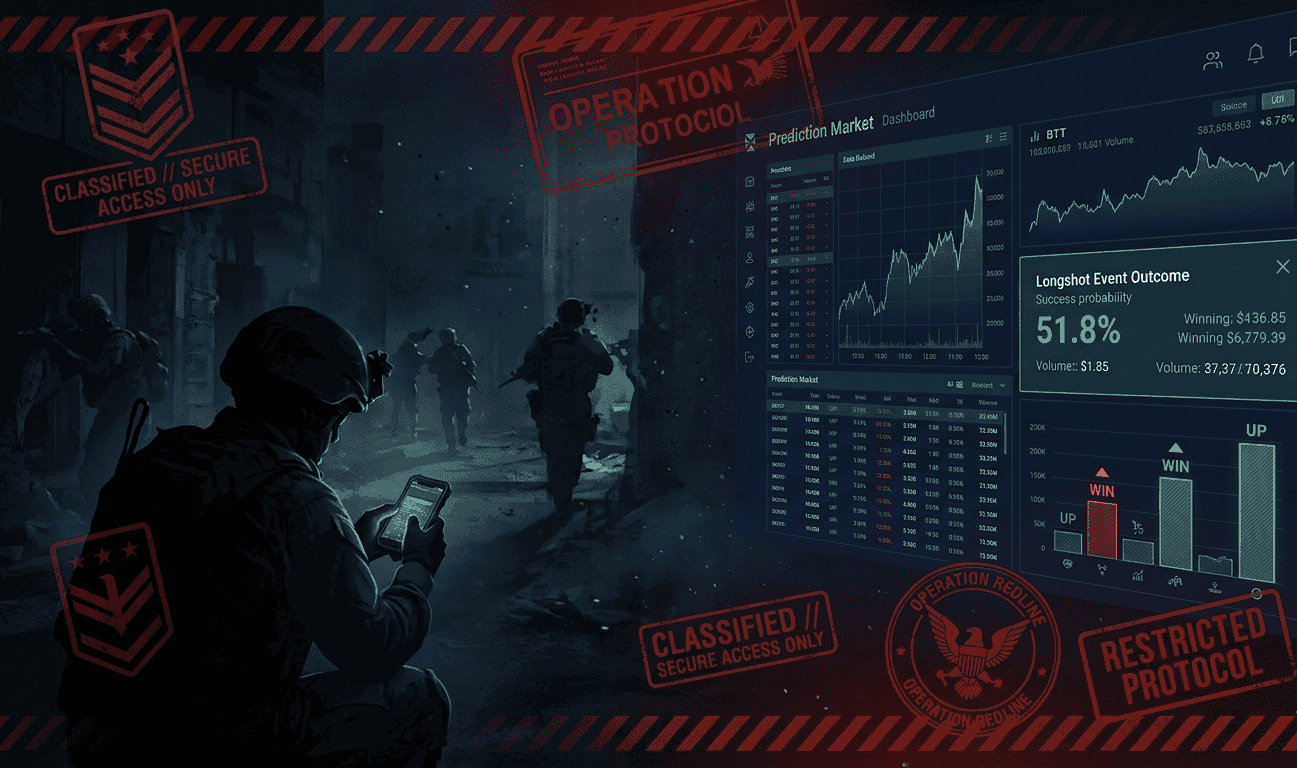
The Anti-Corruption Data Collective analysed every settled market on Polymarket from January 2021 through mid-March 2026. That is 435,672 markets and $54.4 billion in total wagers. What they found is alarming. Longshot bets on military and defence outcomes win 51.8% of the time. Across all political markets, the same type of bet wins just 14%.


That gap is not explainable by luck or skill. Someone knows what is going to happen before it happens, and they are betting on it.
What Did the Green Beret Actually Do?
Master Sergeant Gannon Ken Van Dyke was a US Army Special Forces communications specialist based at Fort Bragg. He helped plan and execute Operation Absolute Resolve, the January 2026 mission that captured former Venezuelan President Nicolas Maduro in Caracas.
On December 8, 2025, the same day he signed a nondisclosure agreement about the operation, he was read into the classified details. Eighteen days later, on December 26, he created a Polymarket account using a VPN routed through a foreign server and started placing bets under the alias “Burdensome-Mix.”
Over 13 transactions between December 27 and January 2, Van Dyke bet $33,034 on contracts like “Maduro out by January 31” and “US Forces in Venezuela by January 31.” The shares were trading at 7 to 13 cents each. Nobody outside the military knew the raid was coming.
In the early hours of January 3, US forces captured Maduro. Polymarket resolved the contracts to YES at $1 per share. Van Dyke’s profit: roughly $409,881. He moved $437,859 to a foreign crypto vault the same day. When news reports flagged the suspicious trading, he asked Polymarket to delete his account and changed his email. It did not work. Polymarket had already flagged the activity and referred it to the DOJ.
Van Dyke pleaded not guilty on April 28. He faces up to 60 years in prison on five federal charges. It is the first insider trading prosecution involving prediction market event contracts in US history.
How Widespread Is the Problem?
Van Dyke was not alone. The ACDC report found patterns of suspicious betting across Polymarket’s entire military and defence category that go far beyond one Green Beret.
Take the June 2025 US strikes on Iran. Polymarket listed date-specific contracts on whether the strike would happen. Markets tied to June 19 and June 20 expired without incident. No unusual betting. The strike came at 6:40 PM ET on June 21. In the hours before it, 19 longshot bets totalling $164,292 were placed on the contracts that resolved YES. Eight wallets shared $1.8 million in profits. One took nearly $500,000. Four of those wallets had win rates above 99% and sold less than 3% of their positions before resolution.
The Pentagon designed that operation to be invisible. Decoy bombers. Long-range stealth aircraft. No public signals. Yet someone placed six-figure bets hours before it happened.
In February 2026, Israeli authorities arrested a military reservist and a civilian for using classified intelligence to bet on the timing of Israeli strikes. Another Polymarket user netted approximately $550,000 on well-timed bets related to US strikes on Iran and the removal of Ayatollah Khamenei.
Across the full dataset, ACDC found that in five of the six two-hour windows before military market resolution, winning longshot bets outnumbered losing ones. That pattern is the opposite of what random chance would produce.
Why Are Military Markets So Vulnerable?
The answer is simple. Military decisions are made by a small number of people with classified information. Unlike elections, where polling data, public statements, and media analysis provide genuine informational edges, military operations are designed to be secret. The only way to consistently predict them is to know about them in advance.
“Markets tied to specific government policies, such as military and defence and foreign affairs, are harder to forecast using public information alone,” the ACDC report stated. That makes them “more susceptible to information asymmetries.”
Making it worse, Polymarket’s offshore platform does not require government ID. Anyone with a crypto wallet and a VPN can bet anonymously. Van Dyke used a foreign exit node to mask his location. The Israeli reservist used similar methods. The infrastructure is built for anonymity, which is exactly what insider traders need.
Meanwhile, AI bots are scanning Polymarket for patterns of suspicious trading and front-running the insiders. When a bot detects a cluster of longshot bets appearing on a military contract, it follows the trade. That means insiders are not just profiting from classified information. They are creating signals that algorithms amplify, compounding the market distortion.
What Is Being Done About It?
Not enough. Polymarket says it flagged Van Dyke’s activity and cooperated with the DOJ. Founder Shayne Coplan called the arrest “proof the system works.” But the ACDC report suggests the system caught one person while a broader pattern continues.
ACDC’s recommendations include mandatory ID verification for all bettors, conditional payouts on suspicious wagers, restrictions on markets whose outcomes are decided by small groups, and limits on how specific contracts can get. The report also backs the BETS OFF Act, which would ban wagers on war and government actions entirely.
The CFTC invoked the “Eddie Murphy Rule” for the first time in the Van Dyke case, a provision named after the 1983 film Trading Places that prohibits federal employees from trading on nonpublic government information. Manhattan prosecutors have met with Polymarket to discuss whether Iran strike trades may have violated federal insider trading laws.
Trump, when asked about it, gave a mixed response: “The whole world, unfortunately, has become somewhat of a casino. I don’t like it conceptually, but it is what it is now.” His son Donald Trump Jr. is an adviser to both Kalshi and Polymarket.
The prediction market industry is worth over $1 billion in annual volume and growing fast. Roundhill is launching election ETFs next week. Gemini just got a CFTC derivatives licence. The bigger prediction markets get, the bigger the incentive for insiders to trade on them. And right now, military markets are where the biggest edge exists.