When Donald Trump launched his official memecoin three days before his January 2025 inauguration, he framed it as a celebration. “It’s time to celebrate everything we stand for: WINNING!” he posted on social media. “Join my very special Trump community. GET YOUR $TRUMP NOW!” The token surged from under $1 to more than $70 within days, minting fortunes for the earliest buyers and generating enormous trading volume.
Eighteen months later, the scoreboard tells a very different story.


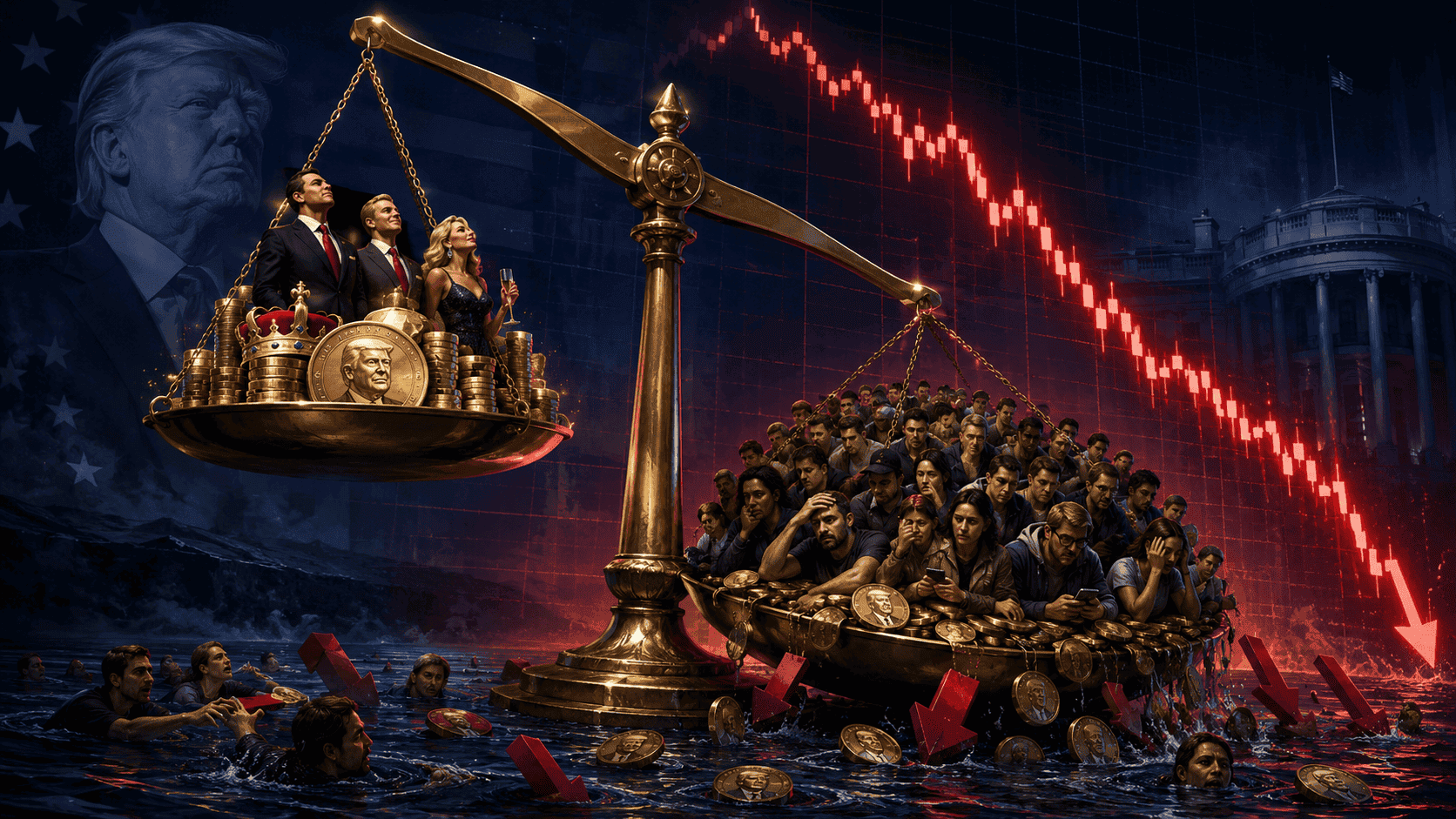
Nearly a million people who bought the TRUMP memecoin have collectively lost $3.81 billion, according to analysis from blockchain analytics firm Nansen shared with CoinDesk. The data, covering all transactions through the end of June, found that 988,905 of the token’s buyers are underwater. That’s roughly two out of every three wallets that ever bought in.
Trump, meanwhile, earned $636 million from the same coin. His 927-page financial disclosure, released by the Office of Government Ethics on June 30, listed the payout as royalties from a Trump Organisation affiliate, part of at least $1.4 billion in total crypto-related income for 2025.
The contrast is stark. As the president collected royalties that flowed regardless of price direction, the retail buyers who followed him into the token watched most of their money evaporate. The story captures something uncomfortable about celebrity-linked tokens at the intersection of political power and speculation.
How the Losses Break Down
The Nansen data reveals a classic pattern of concentrated winners and widespread losers.
Since the January 2025 launch, 1.48 million wallets have bought the TRUMP token. Of those, 492,285 wallets are in profit, up a combined $4.04 billion. But those gains are heavily concentrated among buyers who got in during the first hours of the launch, when the token traded under $1 before it exploded past $70. These were often sophisticated traders using automated programs, who understand that memecoins spike fast and crash hard as early buyers sell to slower retail investors.
The 988,905 wallets in the red represent the people who bought later, chasing the momentum after the price had already run up. They collectively lost $3.81 billion. TRUMP trades near $1.79 today, down about 96% from its peak. Its market value is $425 million, against nearly $15 billion at the January 2025 high. Of the 722,000 wallets still holding the token, positions are worth just $465 million combined.
The World Liberty Financial token, WLFI, tells a similar story. Of the 26,663 wallets Nansen tracks buying WLFI on secondary markets, 22,715 are underwater, about 85%, with combined losses of $83 million. WLFI now trades around $0.056, down more than 80% from its peak, with a $1.8 billion market capitalization. Etherscan data shows 99.3% of WLFI’s valuation is held by whales.
Why Trump Profited Either Way
The mechanics of how Trump earned money reveal why his position was fundamentally different from that of his buyers.
The royalty structure meant Trump profited regardless of whether the token went up or down. His earnings came primarily from transaction fees and ongoing trading activity rather than from holding the token and hoping it appreciated. The TRUMP coin could lose 98% of its value, and the royalty checks would keep clearing. Promotion on Truth Social amplified trading volumes, which generated more fees.
The broader World Liberty Financial venture reinforced this. The Trump family controls around 60% of the company. A Trump business entity collected a 75% cut of WLFI sales after certain expenses, guaranteeing profit even if the coin crashed. Trump’s total profits from World Liberty reached $799 million last year, including hundreds of millions tied to a United Arab Emirates entity that moved to buy nearly half the company in early 2025.
Some buyers expressed real disappointment. Morten Christensen, founder of AirdropAlert.com and a WLFI holder who attended a Trump dinner event, told the Wall Street Journal he had hoped gains would help fund his retirement. Instead he suffered significant losses while Trump profited from the token sale.
World Liberty defended itself. Spokesperson David Wachsman blamed WLFI’s decline on broader market conditions that have pushed down Bitcoin and other cryptocurrencies. “No one can control the markets,” he said, adding that World Liberty stands behind the WLFI governance token and its “increasing utility in a growing ecosystem.” Trump himself has said there is nothing wrong with the income he made from his crypto businesses.
The Political Fallout
The timing of the disclosure could hardly be worse for crypto’s legislative prospects. The revelation of Trump’s $1.4 billion in crypto income landed just as the Senate was wrestling with the CLARITY Act, the market-structure bill that stalled before the July 4 recess.
The disclosure added fuel to Democratic concerns about conflicts of interest. It put a concrete, billion-dollar number on exactly the worry ethics-focused senators had raised: that Congress is being asked to regulate an industry from which the sitting president profits directly. Senator Kirsten Gillibrand called for a prohibition on the creation and promotion of cryptocurrency memecoins by government officials and their spouses. She had pushed for similar provisions during GENIUS Act negotiations, but those restrictions were stripped from the final bill.
The proposal faces long odds in a Congress that has largely embraced the industry. But the political friction is real, and it has become a harder sticking point for Senate negotiators who need 60 votes to advance the CLARITY Act. The ethics language that Trump’s disclosure inflamed is now one of the obstacles keeping the bill from a floor vote.
What This Says About Celebrity Tokens
The TRUMP episode is an extreme example of a dynamic that plays out across the memecoin sector repeatedly. Tokens launched by celebrities and public figures tend to enrich the launchers and early insiders while leaving later retail buyers holding losses.
The pattern is structural. A high-profile launch generates enormous initial hype. Early sophisticated buyers accumulate cheaply and sell into the momentum. The price peaks as retail buyers pile in, then collapses as the early money exits. Royalty and fee structures ensure the creators profit regardless. The losers are almost always the last people through the door, the retail investors who trusted the name attached to the token.
The broader crypto downturn amplified the damage. Bitcoin is down roughly 50% from its October 2025 record, and the sector has spent the first half of 2026 in a slump. Trump Media & Technology Group itself reported a $405.9 million loss in the first quarter of 2026, driven almost entirely by markdowns on Bitcoin it had accumulated near market peaks. The retail memecoin market suffered even worse, with the Nansen data showing just how concentrated the pain has become.
For crypto buyers, the lesson is old but keeps needing repeating. A famous name attached to a token doesn’t protect your investment. It often does the opposite, drawing in enthusiastic retail money that becomes exit liquidity for insiders. The TRUMP token generated $71 billion in trading volume since launch and made its namesake $636 million. Nearly a million of the people who believed in it are collectively $3.81 billion poorer.
FAQ
How much have TRUMP token buyers lost?
According to Nansen data covering transactions through the end of June, 988,905 buyers of the TRUMP memecoin are underwater, having collectively lost $3.81 billion. That represents roughly two-thirds of the 1.48 million wallets that have bought the token since its January 2025 launch. The 492,285 profitable wallets, up a combined $4.04 billion, are concentrated among buyers who got in during the first hours when the token traded under $1.
How much did Trump earn?
Trump earned $636 million in royalties from the TRUMP memecoin, part of at least $1.4 billion in total crypto-related income for 2025 disclosed in his June 30 financial filing. The single largest contributor was World Liberty Financial, which generated around $800 million. The royalty structure meant Trump profited from transaction fees and trading activity regardless of whether the token’s price rose or fell.
How does this affect crypto regulation?
The disclosure intensified Democratic concerns about conflicts of interest just as the Senate was considering the CLARITY Act market-structure bill. It put a concrete figure on worries that Congress is regulating an industry from which the president profits directly. Senator Kirsten Gillibrand called for banning government officials and their spouses from creating or promoting memecoins. The ethics friction has become a harder sticking point for negotiators needing 60 votes, contributing to the bill’s stall before the July 4 recess.
Disclaimer: This article is for informational purposes only and does not constitute financial advice. Cryptocurrency investments carry significant risk. Always conduct your own research before making any investment decisions.