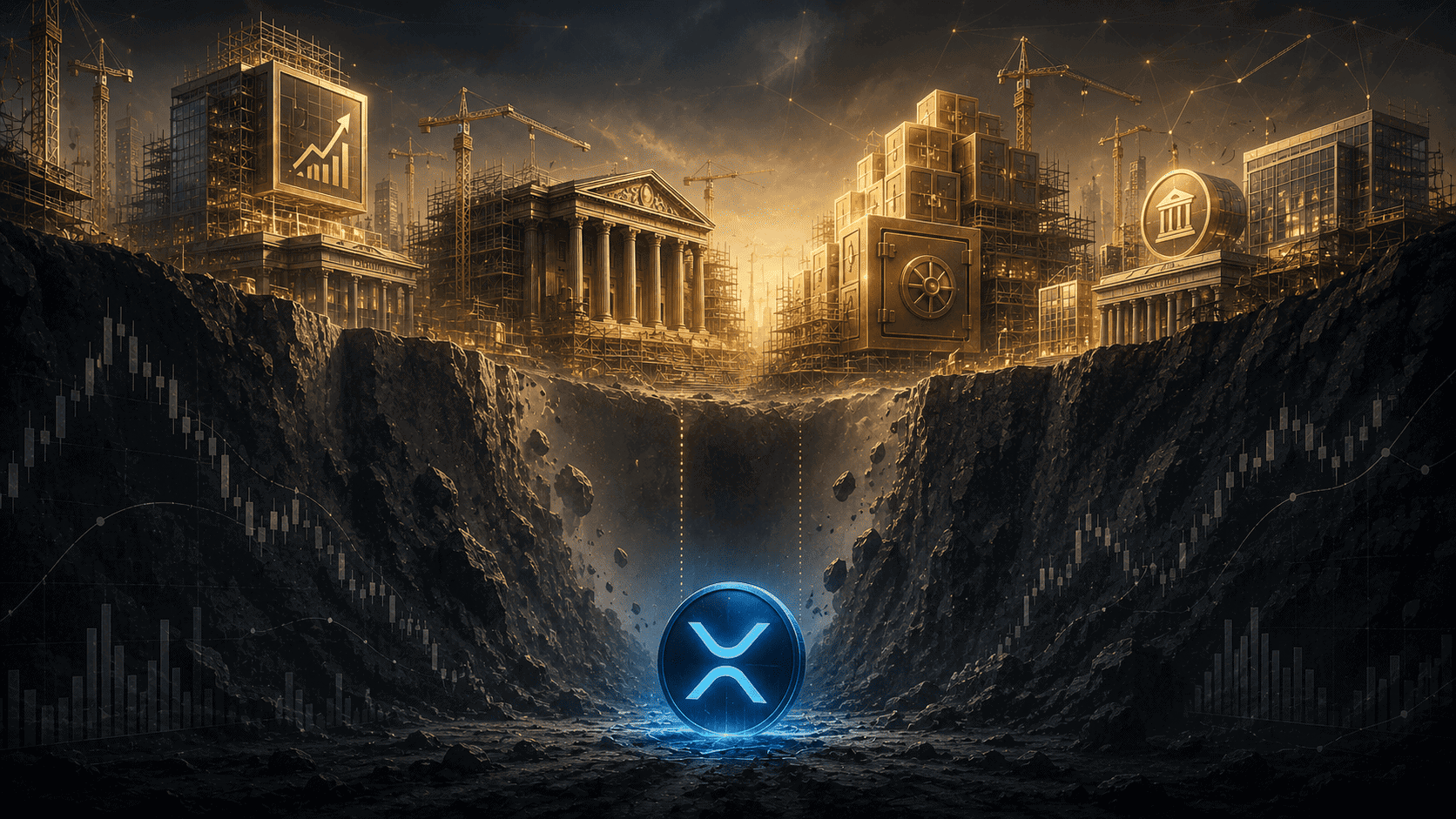
Every measurable institutional metric for XRP is pointing higher. Every measurable price metric is pointing lower. The gap between the two has reached a level where the only honest question is whether the market has badly misjudged XRP’s value or whether the institutions are wasting their money.
XRP is trading at approximately $1.10 on June 10, down to multi-month lows after dropping below its 200-week simple moving average for the first time. The post-CLARITY Act rally that took XRP to $1.55 has been completely erased. The token is now 70% below its September 2025 high of $3.65 and below both its 50-day and 200-day EMAs.


The price action suggests a token in serious trouble. But the institutional picture tells a completely different story. ETF products have attracted over $1.5 billion in cumulative inflows. A $1 billion XRP treasury company is preparing to list on Nasdaq. JPMorgan has settled tokenised Treasuries on the XRP Ledger. The Coinbase-EY survey shows institutional investors plan to increase XRP allocations from 18% to 25% this year.
Two narratives. One asset. Only one can be right. Either XRP is the most mispriced token in crypto at $1.10, or the institutional infrastructure being built around it represents the largest collective misjudgment in recent finance.
The Institutional Case That Keeps Getting Stronger
The institutional pipeline for XRP has expanded faster in 2026 than for any token outside Bitcoin and Ethereum.
ETF inflows have surpassed $1.5 billion cumulatively since spot XRP ETFs launched. May alone saw $131.94 million in net inflows, ranking among the strongest months for the products. The funds have continued attracting capital even during the broader market crash, with last week posting $20.3 million in inflows while diversified crypto funds bled $1.5 billion. That counter-cyclical pattern indicates institutional buyers view XRP differently from the broader crypto market.
Evernorth Holdings filed an amended SEC registration for its $1 billion XRP treasury company. The company holds over 473 million XRP and plans to list on Nasdaq under the ticker XRPM through a SPAC merger with Armada Acquisition Corp. II. Backers include Ripple, SBI Holdings, Pantera Capital, and Kraken. The company’s model is different from passive ETFs because it actively deploys XRP through institutional lending, liquidity provisioning, and DeFi yield strategies on the XRP Ledger.
JPMorgan settled the first cross-border tokenised Treasury transaction on XRPL in under five seconds in partnership with Ripple and Mastercard. The transaction demonstrated that the XRP Ledger can handle institutional-grade tokenised asset settlement with speed and finality that traditional banking infrastructure can’t match. JPMorgan doesn’t conduct settlement tests on networks it considers experimental. The bank’s involvement signals XRPL has moved into serious institutional consideration.
Tokenised real-world assets on XRPL surged from $24.7 million at the start of 2025 to over $2 billion by March 2026. Daily transaction counts recently hit an all-time high of 4 million. Multi-purpose tokens enable institutional asset issuance with built-in compliance controls. The TokenEscrow amendment extended escrow capabilities beyond XRP to stablecoins and IOUs. Native lending is being built at the protocol level.
Institutional allocation surveys show growing demand. A Coinbase and EY survey of major institutional investors revealed plans to increase XRP allocations from 18% to 25% this year. That’s a 39% relative increase in target allocation from sophisticated investors who don’t make decisions based on Twitter narratives or price momentum.
The picture is consistent. Across every measurable category of institutional adoption, XRP is gaining ground rapidly. ETF flows, corporate treasury structures, banking partnerships, on-chain real-world asset deployment, and allocation surveys all point in the same direction: more institutional money is committing to XRP than at any point in the token’s 13-year history.
The Price Case That Tells a Different Story
If you only looked at the chart, you’d conclude that XRP is one of the worst-performing major tokens of the cycle.
The decline from $3.65 in September 2025 to $1.10 today represents a 70% drawdown. That’s significantly worse than Bitcoin’s 51% decline from its peak. It’s worse than Ethereum’s 62% decline. XRP has underperformed even the broader altcoin market during the recent selloff.
The technical picture has deteriorated past the point where any individual indicator matters. The break below the 200-week simple moving average is particularly significant. That long-term trend line has historically functioned as a floor across multiple market cycles. XRP has now lost that level while Bitcoin is still defending its own 200-week SMA. The relative weakness suggests XRP has structural issues that even Bitcoin doesn’t face.
The 200-week SMA break opens a path toward $0.95, the level XRP last visited in July 2023. Below that, $0.80 represents the next major support, and a decline to that level would put XRP at its lowest price since early 2023, erasing essentially all of the gains from the post-election crypto rally.
The derivatives market is positioned for further decline. Short positions outnumber longs by roughly 9-to-1 in XRP derivatives. That extreme imbalance reflects deep bearish positioning by sophisticated traders. Funding rates have stayed negative for weeks. The smart money is actively betting against XRP at current levels.
The disconnect between institutional flows and price action has become extreme. ETF buying continues. Whale wallets are at record highs. But the price keeps falling. Something has to give. Either the institutional flows are inadequate to overcome the structural bearish pressure, or the bearish pressure is unsustainable in the face of growing institutional demand.
Why the Disconnect Exists
Understanding why XRP keeps falling despite improving fundamentals requires recognising that price is driven by short-term flows while fundamentals operate on longer timeframes.
The institutional accumulation through ETFs, whale wallets, and treasury companies happens on multi-year horizons. These buyers don’t care whether XRP is at $1.10 or $1.30 next month. They’re building positions for 2027, 2028, and beyond when they expect tokenised assets, cross-border payment infrastructure, and institutional DeFi to be significantly larger markets.
The price pressure comes from completely different sources. Short-term traders responding to Bitcoin’s decline. Leveraged positions getting liquidated as the broader market crashes. Retail holders selling because the chart looks broken. ETF outflows in correlated crypto products triggering algorithmic selling of XRP alongside everything else.
These two flows operate independently in the short term but eventually converge. Either the institutional accumulation overwhelms the short-term selling and XRP rallies sharply, or the short-term selling exhausts the institutional appetite and XRP enters a prolonged underperformance period.
The CLARITY Act vote, expected June 15-18, is the catalyst that could tip the balance. If the bill passes, formal classification of XRP as a commodity unlocks additional institutional flows that current ETF demand has only partially anticipated. Standard Chartered projected $4 to $8 billion in additional XRP ETF inflows on successful passage. That would be a transformational shift in demand.
If the bill stalls or fails, the institutional thesis weakens significantly. The flows that have been arriving in anticipation of regulatory clarity would slow or reverse. Short-term traders would extend the bearish pattern. XRP could break $1.00 and continue toward $0.85.
What Would Need to Happen for the Mispricing Thesis to Play Out
Three conditions need to align for XRP to recover from its current price disconnect.
The CLARITY Act needs to pass. This is the most important variable. The bill provides the formal regulatory framework that institutional capital has been waiting for. Without it, the existing institutional flows are operating in a grey zone that limits how aggressively pension funds, sovereign wealth funds, and large asset managers can allocate. With it, the floodgates open.
Bitcoin needs to stabilise. XRP can’t rally independently while Bitcoin is in freefall. The correlation between altcoins and Bitcoin tightens during crashes, meaning XRP gets dragged lower regardless of its own catalysts. Once Bitcoin establishes a floor, altcoins like XRP gain space to respond to their individual fundamentals.
The short positioning needs to unwind. The 9-to-1 short ratio in XRP derivatives represents a coiled spring. Any positive catalyst strong enough to push XRP higher would trigger forced covering as those short positions get liquidated. A sharp rally is mechanically possible if the catalysts align. The Evernorth Nasdaq listing, the CLARITY Act passage, the FOMC meeting outcome could each individually trigger a squeeze.
If all three conditions align in the same window (June 15-18), XRP could move significantly higher in a short period. The target range from analyst models with successful CLARITY Act passage runs from $1.50 (immediate technical resistance) to $2.20 (upper bull case scenarios).
If none of the conditions materialise, XRP likely continues lower toward $0.95 and potentially $0.80. The mispricing thesis fails. The institutional flows continue but at a slower pace as buyers wait for a clearer environment.
The Bottom Line
XRP at $1.10 with $1.5 billion in ETF inflows, a $1 billion treasury company preparing to list, JPMorgan settling on its blockchain, and a 9-to-1 short ratio sits at the most extreme disconnect between fundamentals and price action in recent crypto history.
The bull case argues this is the most mispriced token in crypto. The institutional infrastructure being built around XRP is unprecedented. The technical setup is deeply oversold. The catalyst timeline is identifiable and arriving within two weeks. The risk-reward favours patient accumulation.
The bear case argues the price is correct and the institutional flows are inadequate. The 200-week SMA broke for a reason. The CLARITY Act might fail or get delayed. The short positioning could prove justified rather than excessive. The disconnect could extend for months.
Both cases have merit. The CLARITY Act vote and the FOMC meeting in the same week will likely determine which case wins. For investors willing to accept the binary nature of the setup, XRP at $1.10 offers one of the cleaner asymmetric trades in crypto right now. For investors who prefer more certainty, waiting for the catalysts to play out before committing capital is the more conservative approach.
The market has rarely created a clearer divergence between institutional adoption and price action. Whether that gap closes through price rising to meet the fundamentals or fundamentals deteriorating to match the price is the question every XRP holder is waiting to answer.
FAQ
Why has XRP fallen to $1.10 despite institutional inflows?
Short-term price action is driven by Bitcoin’s decline, leverage liquidations, and correlated selling across crypto markets. The institutional flows through ETFs and treasury companies operate on multi-year horizons. The two are temporarily disconnected, with short-term selling overwhelming the institutional accumulation. Either condition could persist or reverse, and the CLARITY Act vote in mid-June is the most likely catalyst to resolve the disconnect.
Could XRP fall below $1.00?
Yes. XRP broke its 200-week simple moving average, opening a path toward $0.95 (the July 2023 level) and potentially $0.80. Short positions outnumber longs 9-to-1, indicating institutional traders are actively betting on further decline. If the CLARITY Act stalls or fails, the bearish scenario becomes more likely.
What would trigger an XRP recovery?
Three conditions need to align: the CLARITY Act passing the Senate (expected vote June 15-18), Bitcoin stabilising rather than continuing lower, and the 9-to-1 short positioning unwinding through forced covering. If all three happen in the same window, XRP could rally significantly to $1.50 or higher. Standard Chartered projects $4 to $8 billion in additional ETF inflows if the bill passes.
Disclaimer: This article is for informational purposes only and does not constitute financial advice. Cryptocurrency investments carry significant risk. Always conduct your own research before making any investment decisions.