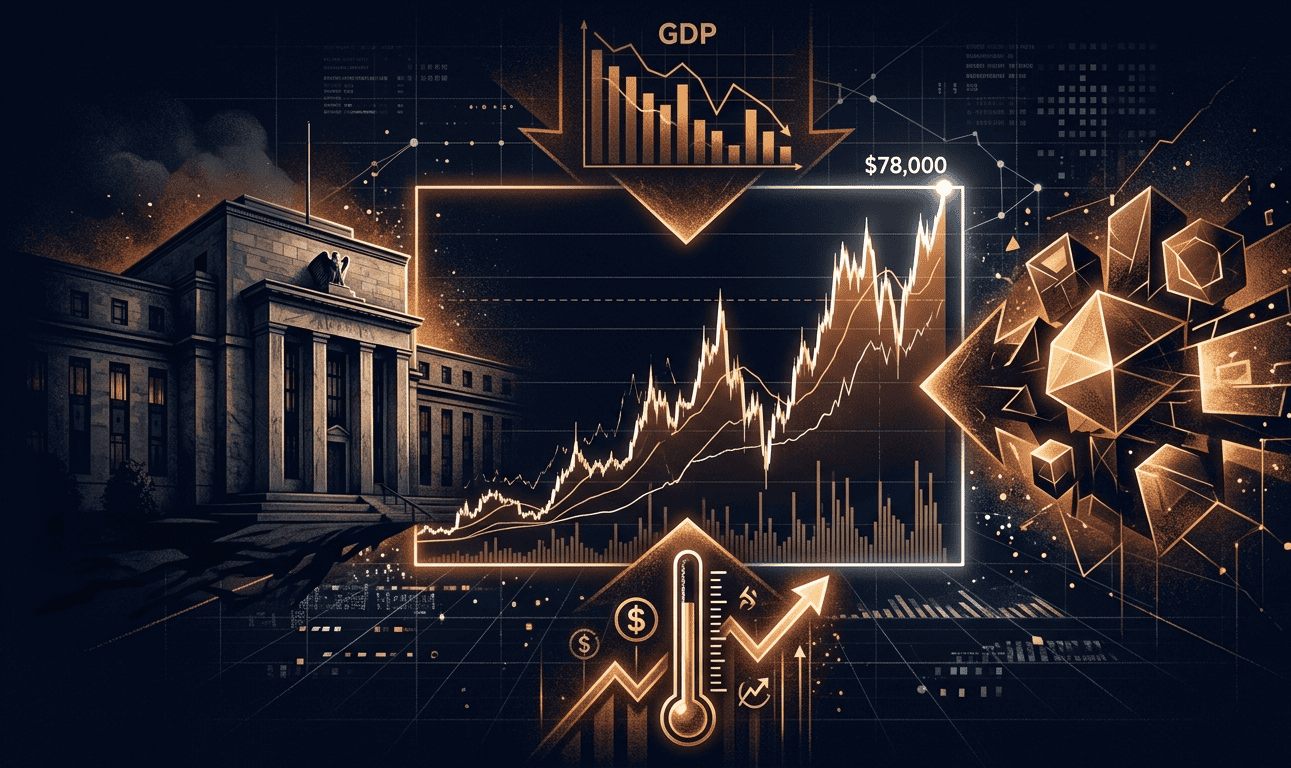
Everything that matters to Bitcoin is landing in the same 72-hour window. The Fed announces its rate decision on Wednesday afternoon. Microsoft, Amazon, Meta, and Google report earnings the same evening. Apple reports Thursday morning. Q1 GDP data drops Thursday. March PCE inflation data drops Thursday. And 20% of the S&P 500 reports results this week.
If you are holding crypto, this is the week that sets the direction for May and possibly the rest of the summer. Bitcoin is sitting at $78,000 after failing to break $80,000 last week. Whether it pushes through or falls back likely gets decided in the next five days.


What Will the Fed Do on Wednesday?
Almost certainly nothing. Markets are pricing in a near-certain hold at 3.50% to 3.75%. Nobody expects a rate cut this week. The decision itself is not the story.
The story is what Jerome Powell says afterwards. This is Powell’s final meeting as Fed Chair before Kevin Warsh takes over. Every word in the statement and the press conference will be picked apart for clues about whether rate cuts are still on the table for later this year.
April is not a projections meeting. No dot plot. No updated economic forecasts. That means the tone of the statement carries even more weight than usual because there is no data to fall back on. If Powell sounds concerned about inflation from the oil spike, markets will price out rate cuts and Bitcoin will likely pull back. If he sounds more focused on slowing growth and leaves the door open for easing, risk assets rally and Bitcoin gets a shot at $80,000.
The Fed has to navigate a tricky environment. Headline inflation has risen because of energy prices. Core PCE is still above the 2% target. Q4 2025 GDP came in at just 0.5%, revised down from 1.4%. The economy is slowing while inflation is rising. That is the worst combination for a central bank, and how Powell acknowledges that reality will move markets.
Why Do Big Tech Earnings Matter for Bitcoin?
Because Bitcoin trades like a risk asset, and risk appetite is set by what happens in equities. Four of the five largest companies in the world report on the same day as the Fed decision. If their results are strong, equities rally, risk appetite improves, and Bitcoin benefits from the mood. If they disappoint, equities sell off and Bitcoin goes with them.
Morgan Stanley projects that Magnificent Seven earnings will grow 25% in 2026 versus 11% for the rest of the S&P 500. The gap matters. If the big tech companies deliver on those expectations, the equity rally continues and Bitcoin’s correlation with the Nasdaq keeps it in the slipstream.
The key theme across all four Wednesday reports is AI spending. Microsoft, Amazon, Meta, and Google have all committed billions to AI infrastructure. Investors want to know whether that spending is generating revenue or just burning cash. If AI budgets are growing and revenue is following, the market stays bullish. If spending is growing and revenue is not, the “AI bubble” narrative comes back and risk assets get hit.
Apple on Thursday adds another layer. New CEO John Ternus takes over from Tim Cook. Any commentary about Apple’s plans for crypto, payments, or blockchain integration would be significant given the company’s 1.5 billion device install base.
What About GDP and PCE on Thursday?
Thursday is the data dump. Q1 2026 GDP and March PCE inflation release on the same morning, the day after the Fed decision. Traders will interpret both through whatever framework Powell established the afternoon before.
Q4 2025 GDP was revised down to 0.5% from an initial estimate of 1.4%. That was a significant deterioration. Q1 2026 sat in a worse environment: oil near $100 through most of the quarter, the Iran conflict rattling business confidence from late February, and consumer spending softening.
If Q1 GDP comes in weak (below 1%), it strengthens the case that the economy needs rate cuts and supports risk assets including Bitcoin. If it comes in stronger than expected, it reduces urgency for cuts and keeps the dollar strong, which historically weighs on BTC.
PCE inflation is the Fed’s preferred measure. Consensus expects core PCE around 3.0% to 3.1% year-over-year, driven by energy. A reading above that range would reinforce the “higher for longer” rate narrative and pressure crypto. A softer print would be relief for every risk asset in the market.
What Is Bitcoin’s Setup Going Into the Week?
Bitcoin failed at $80,000 last week and pulled back to $77,800. The nine-day ETF inflow streak is the longest since October. Whales on Hyperliquid are building aggressively long positions while funding rates remain deeply negative, meaning shorts are paying to bet against the rally. That is the classic “most hated rally” setup where bears keep shorting and getting squeezed.
But the $79,000 to $80,000 resistance is real. The short-term holder cost basis sits right at $79,200. That means recent buyers are at breakeven and many of them will sell to get their money back rather than hold. Breaking through that level requires either a macro catalyst (dovish Fed, strong earnings) or sustained institutional buying that overwhelms the sellers.
Iran adds another variable. The Iranian delegation left Pakistan talks over the weekend without meeting US counterparts. Trump cancelled the American delegation’s trip. Oil spiked on reports the US seized Iranian tankers in Asian waters. If the war escalates this week while the Fed is meeting and tech is reporting, the volatility could be extreme in both directions.
How Should You Prepare?
This is not a week for aggressive positioning unless you are comfortable with the volatility. The sequencing matters. Powell’s tone on Wednesday afternoon sets up the market’s reaction to Thursday’s data. A dovish Fed followed by soft inflation would be the best-case scenario for crypto. A hawkish Fed followed by hot inflation would be the worst.
The most likely outcome is somewhere in between. The Fed holds, Powell stays neutral, earnings are mixed, and GDP comes in slightly weak. In that scenario, Bitcoin probably stays in the $76,000 to $80,000 range it has been trading in all month. The breakout or breakdown comes when one of these catalysts surprises the market in a direction it was not expecting.
By Friday, we will know what the Fed is thinking, how the biggest companies in the world are performing, whether the economy is contracting, and where inflation is headed. That is more clarity in 72 hours than the market has had in months.