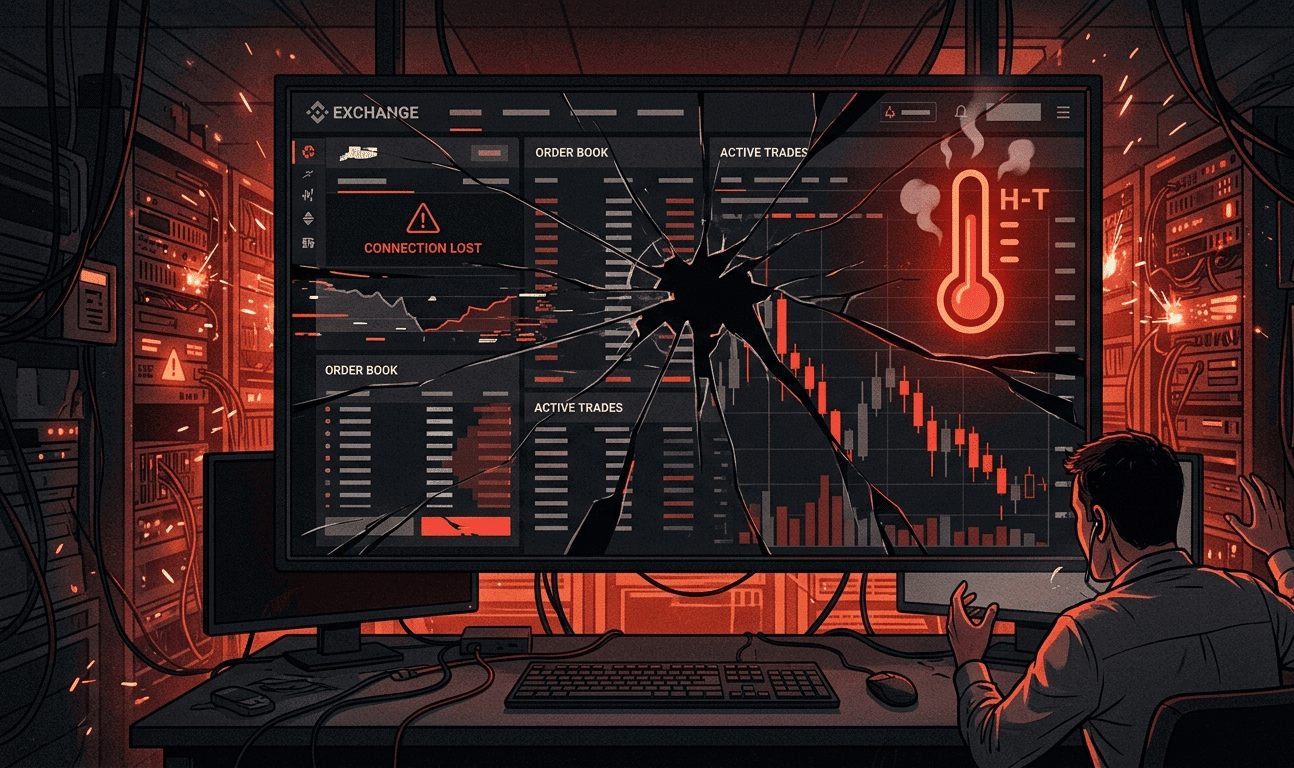
If you tried to trade on Coinbase on Thursday, you already know what happened. The largest crypto exchange in the United States went completely dark for more than six hours, leaving millions of users unable to buy, sell, or even check their balances during one of the busiest market periods in weeks.
The culprit wasn’t a hack. It wasn’t a software bug. It was heat.


A thermal failure at an Amazon Web Services data centre in Northern Virginia caused a cascading hardware breakdown that took down critical infrastructure powering Coinbase’s trading systems. The exchange was forced into “cancel only” mode, meaning users could cancel existing orders but couldn’t place new ones. For hours, the platform was essentially frozen.
The timing could not have been worse. The outage hit on the same day Coinbase reported a $394 million net loss for Q1 2026, a 14% workforce reduction, and a 5% drop in its share price after missing analyst expectations on both revenue and earnings.
What Actually Happened?
At approximately 5:25 PM Pacific time on Wednesday, AWS engineers detected problems in a single availability zone within the US-EAST-1 region, Amazon’s largest and most heavily used data centre cluster located in Northern Virginia.
The issue was physical, not digital. Temperatures inside the facility spiked, causing hardware damage that knocked out servers and networking equipment. The failure cascaded across multiple systems, and Coinbase’s trading infrastructure, which runs heavily on AWS, went down with it.
Coinbase said its systems are designed to withstand a single availability zone failure. But this outage affected multiple zones within the same region, overwhelming the exchange’s redundancy measures. That’s a critical detail. It means Coinbase’s backup systems weren’t enough to handle a multi-zone failure in its primary data centre region.
The exchange moved through several phases of recovery. First came “cancel only” mode, where all trading was paused but users could withdraw pending orders. Then came “auction mode,” where limit orders were accepted and an indicative opening price was calculated. Finally, after more than six hours, full trading was restored at around 1:00 AM Pacific time.
We experienced an outage at Coinbase last night, which is never acceptable. The root cause was a room overheating in an AWS datacenter when multiple chillers failed. We design our services to be redundant to downtime in any one AWS Availability Zone (AZ), and most of our systems…
— Brian Armstrong (@brian_armstrong) May 8, 2026
Real Money Was Lost
For retail traders, a six-hour outage during active market hours carries real financial consequences. When crypto assets are moving sharply, even 30 minutes of inaccessibility can mean missed entries, failed stop-losses, and unintended portfolio exposure.
Social media lit up with users reporting they couldn’t access their accounts, couldn’t execute trades on open positions, and couldn’t manage risk during a volatile period. Some users reported that stop-loss orders they’d placed for protection simply didn’t execute because the system was down.
The frustration was amplified by the fact that this isn’t the first time it’s happened. Coinbase experienced a similar AWS-driven outage in October 2025. Two major outages caused by the same third-party dependency in less than a year raises serious questions about the exchange’s infrastructure strategy.
Coinbase wasn’t the only platform affected. CME Group, the world’s largest derivatives marketplace, also confirmed disruptions tied to the same AWS failure. But Coinbase appeared to be the hardest hit among crypto-specific platforms, with competitors like Kraken and Binance continuing to operate normally throughout the incident.
The Worst Possible Timing
The outage landed during what was already one of the worst weeks in Coinbase’s recent history.
Just hours before the systems went down, Coinbase had reported its Q1 2026 earnings. The numbers were ugly. Revenue came in at $1.41 billion, below analyst estimates of $1.52 billion. The company posted a GAAP net loss of $394 million and missed earnings expectations by a wide margin, reporting a loss of $1.49 per share versus the $0.27 profit that analysts had predicted.
Trading volume, which drives the bulk of Coinbase’s revenue, dropped significantly as lower crypto prices in early 2026 suppressed activity across the market. Transaction revenue fell 40% year-over-year.
And all of this came just three days after CEO Brian Armstrong announced 700 layoffs, roughly 14% of the workforce, as part of the company’s AI-driven restructuring. Severance costs are expected to hit $50 to $60 million in Q2.
So in the span of a single week, Coinbase announced mass layoffs, reported a $394 million loss, missed analyst expectations, saw its stock drop, and then went offline for six hours because a data centre got too hot. It’s the kind of week that tests investor confidence.
The Centralisation Problem
This incident highlights a vulnerability that affects the entire crypto industry, not just Coinbase.
Crypto was built on the promise of decentralisation. No single point of failure. No central authority that can shut things down. But the exchanges where most people actually buy and sell crypto are anything but decentralised. They run on centralised servers, hosted by centralised cloud providers, in centralised data centres.
When one AWS facility in Virginia overheats, the largest crypto exchange in America goes offline. That’s a centralisation risk that no amount of blockchain technology can fix, because the problem isn’t on the blockchain. It’s in the infrastructure that sits between users and the blockchain.
Some in the crypto community used the outage to make a familiar argument: this is why self-custody matters. If your crypto is in your own wallet, no exchange outage can prevent you from accessing it. If your crypto is sitting on Coinbase when the servers go down, you’re locked out until they come back online.
That argument has limits. Self-custody requires technical knowledge and carries its own risks (losing your seed phrase, for example). But after two major outages in less than a year, the case for keeping at least some of your holdings in a personal wallet has gotten stronger.
What Coinbase Is Doing About It
Coinbase said it will investigate the incident fully and work with AWS to prevent similar disruptions in the future. The company noted that its systems are built to handle single-zone failures but acknowledged that the multi-zone nature of this outage exceeded its current redundancy capabilities.
That’s an honest assessment, but it’s also a concern. AWS outages affecting multiple zones in the same region aren’t common, but they’re not unheard of either. If Coinbase’s architecture can’t survive them, the company needs to either build better redundancy or diversify its cloud infrastructure across multiple providers and regions.
For a publicly traded company managing billions in customer assets, exchange reliability isn’t just a technical issue. It’s a trust issue. Every hour of downtime erodes confidence among both retail users and institutional clients. And in a market where competitors like Kraken are aggressively building regulated infrastructure and preparing for IPOs, Coinbase can’t afford to keep having weeks like this one.
FAQ
Why did Coinbase go down on May 8, 2026?
A thermal failure at an Amazon Web Services data centre in Northern Virginia caused cascading hardware damage that took down Coinbase’s trading systems for over six hours. The outage affected multiple availability zones within AWS’s US-EAST-1 region, overwhelming Coinbase’s built-in redundancy measures.
Could users access their funds during the outage?
No. During the outage, users could not execute trades, access accounts, or manage portfolios. Coinbase moved into “cancel only” mode, allowing cancellation of existing orders but not placement of new ones. Full trading was restored after approximately six hours.
Has this happened before?
Yes. Coinbase experienced a similar AWS-driven outage in October 2025. Two major outages caused by the same third-party dependency in less than a year has raised questions about the exchange’s infrastructure strategy and its reliance on a single cloud provider.
Disclaimer: This article is for informational purposes only and does not constitute financial advice. Cryptocurrency investments carry significant risk. Always conduct your own research before making any investment decisions.