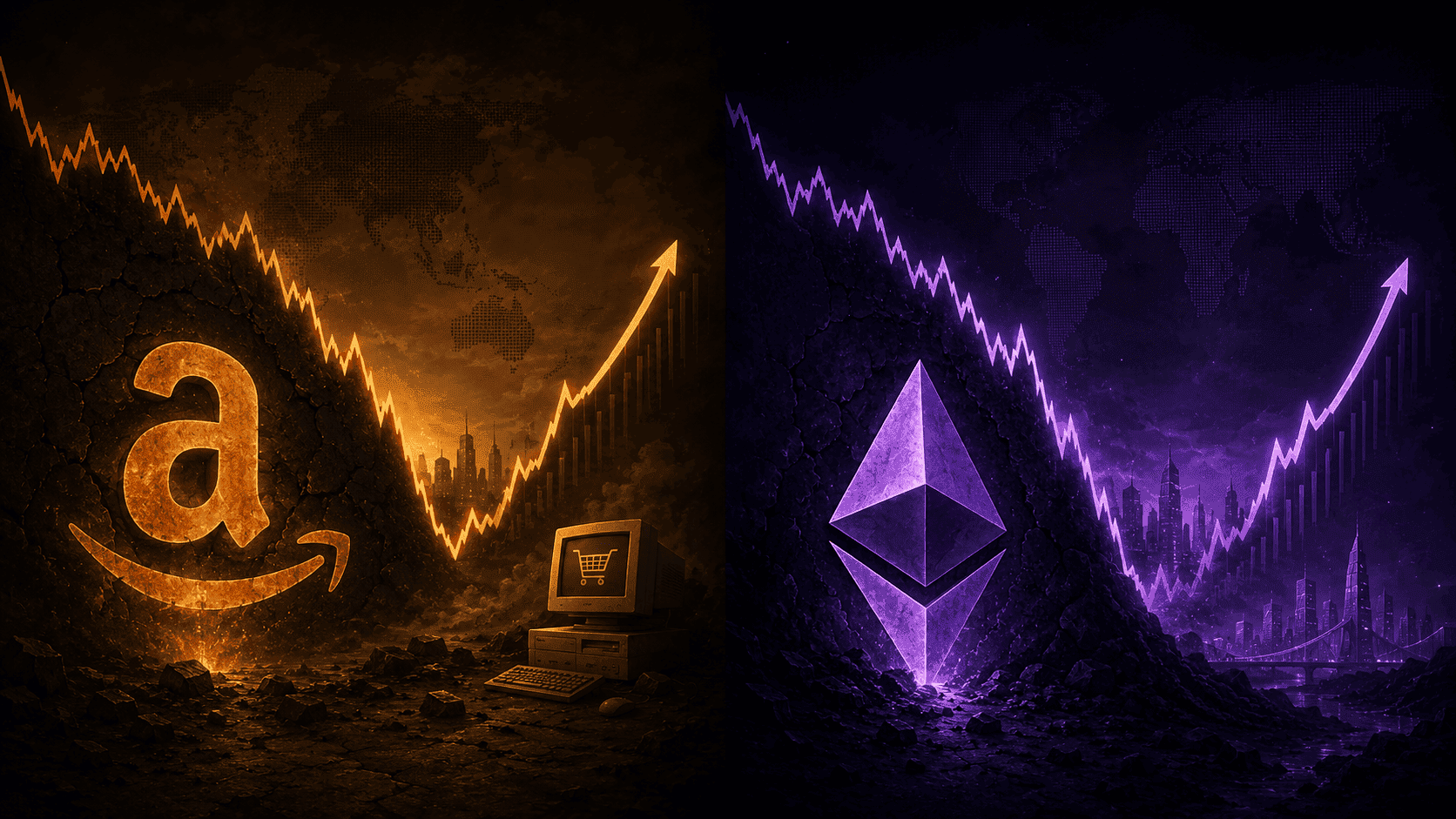
Ethereum is trading at $2,006. It’s down 57% from its all-time high. It just broke below $2,000 for the first time since March. ETF outflows have been relentless. Eight senior researchers have quit the Foundation. And the prediction markets are pricing a 54% chance that ETH ends the year below $1,500.
Into that storm walks Geoffrey Kendrick, Standard Chartered’s Global Head of Digital Assets Research, with a note to clients that reads as if it were written on a different planet.


His targets: $4,000 by the end of 2026. $40,000 by the end of 2030. That’s a 2x from current levels in seven months. A 20x over four years. And he’s not blinking.
His argument rests on a comparison that’s either brilliant or delusional, depending on who you ask. Kendrick says Ethereum right now looks exactly like Amazon during the 2001 dot-com crash. The stock price collapsed. Everyone wrote it off. But inside the company, every metric was improving. The stock eventually caught up. Amazon went on to multiply 1,000 times from its 2001 low.
Kendrick thinks Ethereum is in the same position. The token price is cratering. But the network underneath is quietly getting stronger. And sooner or later, the market will notice.
The Bezos Quote at the Heart of the Thesis
Kendrick anchored his entire analysis around a specific Jeff Bezos quote from a 2018 speech about Amazon’s darkest period.
“The stock is not the company. And the company is not the stock. And so, as I watched the stock fall from $113 to $6, I was also watching all of our internal business metrics. Every single thing about the business was getting better. And so, while the stock price was going the wrong way, everything inside the company was going the right way.”
Kendrick’s argument is that Ethereum is living through its own version of that moment right now. The token has fallen 57% from its high. The ETH/BTC ratio is at multi-year lows. Headlines are dominated by departing researchers, ETF outflows, and competition from Solana and Layer 2 networks.
But the network’s internal metrics tell a completely different story. Transaction counts are near all-time highs in ETH terms. Total value locked across DeFi protocols is near record levels. The stablecoin supply on Ethereum represents 54% of the global market. Tokenized real-world assets on Ethereum account for 62% of the global RWA market. BlackRock is building tokenized fund products on the network.
The price is going the wrong way. Everything inside the network is going the right way. That’s the Amazon parallel Kendrick is drawing.
The Numbers Behind Standard Chartered’s Conviction
Kendrick didn’t just drop an analogy and walk away. The research note outlined specific growth drivers he believes will close the gap between Ethereum’s network metrics and its token price.
Stablecoins are the centerpiece. Standard Chartered estimates that stablecoin market capitalization will climb nearly sixfold from approximately $321 billion today to $2 trillion by the end of 2028. Since 54% of all stablecoins live on Ethereum, that growth flows directly into demand for ETH block space, fee revenue, and network usage.
Tokenized real-world assets are the second pillar. Ethereum holds 62% of the global RWA market. Standard Chartered expects that market to expand 50-fold over the coming years. If Ethereum maintains even a fraction of its current market share as that expansion unfolds, the volume of institutional activity on the network grows dramatically.
The recovery of the ETH/BTC ratio is the third element. Kendrick expects the ratio to climb back toward 0.08 by the end of the decade, roughly where it peaked in 2021. It currently sits near 0.027. That kind of recovery would mean ETH outperforming Bitcoin by approximately 3x over the next four years.
The bank also pointed to Ethereum’s supply dynamics. Over 66% of ETH is locked in staking, reducing the circulating supply available for trading. Exchange reserves are at yearly lows. When demand increases relative to constrained supply, the price responds disproportionately.
The Bear Case That Standard Chartered Is Ignoring
Kendrick’s thesis is coherent. But so are the arguments against it, and they’re coming from equally credible sources.
10x Research published a note this week explicitly warning investors against treating Ethereum’s low price as a buying opportunity. The firm argued that ETH’s declining price reflects structural problems that network metrics alone can’t fix: value is accruing to applications and Layer 2 networks rather than to the base layer token itself.
That critique goes to the heart of Ethereum’s challenge. When DeFi protocols, NFT platforms, and tokenized asset issuers build on Ethereum but capture most of the economic value within their own tokens and fee structures, the ETH token doesn’t necessarily benefit even as the network thrives. It’s the equivalent of Amazon’s web hosting division (AWS) making money while Amazon’s stock doesn’t move. The infrastructure gets used. The token doesn’t get rewarded.
David Hoffman, co-founder of Bankless and one of Ethereum’s most prominent advocates, has been making a similar argument. He acknowledged that value is currently accruing to apps and Layer 2s, not to ETH itself. For a network advocate to concede that point publicly tells you how real the concern has become.
Polymarket bettors are the most bearish of all. The prediction market currently prices in a 54% chance that ETH will close the year below $1,500. That’s not $4,000. That’s not $2,000. That’s $1,500. The people putting real money on Ethereum’s future are more likely to bet on a 25% decline than a 100% rally.
Santiment data adds another caution flag. Retail traders have been flooding social media with “buy the dip” calls since ETH broke below $2,000. Santiment’s bullish-bearish sentiment ratio spiked to 2.4-to-1, deep in what the firm calls the “FOMO zone.” Historically, when retail gets this excited about buying a dip, the price tends to keep falling. “The crowd usually gets calls wrong,” Santiment warned.
The Short Squeeze That Could Prove Kendrick Right Overnight
Here’s the detail that makes this story more than just an academic debate about valuations.
ETH futures open interest has surged to a record high during the sell-off. Funding rates remain flat, which means the new open interest is heavily skewed toward short positions. Traders are betting aggressively that ETH will keep falling.
Standard Chartered and on-chain analysts estimate that roughly $2 billion in short-squeeze exposure exists at current levels. If ETH reclaims $2,000 and holds it convincingly, the traders who sold short would face mounting losses. As the price rises, their positions are liquidated, forcing buying, pushing the price higher, and triggering more liquidations.
That cascade could produce a violent move higher in a very short timeframe. The same dynamic that crashed ETH from $2,075 to below $2,000 on the way down (long liquidations forcing selling) could reverse and crash it back above $2,200 on the way up (short liquidations forcing buying).
The catalyst for that squeeze could be anything. A positive CPI reading. A Fed rate cut signal from Warsh. A resolution to the Iran conflict that sends oil prices crashing. Even a single large institutional buy breaks the pattern of ETF outflows.
Kendrick doesn’t need every element of his thesis to play out perfectly for ETH to rally significantly from $2,000. He just needs one catalyst strong enough to trigger the short squeeze. The $2 billion in exposed short positions would do the rest.
Is the Amazon Comparison Fair?
The honest answer is: it’s imperfect but not unreasonable.
Amazon in 2001 had a clear business model (e-commerce) that was growing rapidly, even as the stock collapsed. The company knew exactly what it was building and why. The market simply mispriced how long it would take for that vision to generate returns.
Ethereum in 2026 is more complicated. The network is being used for stablecoins, tokenization, DeFi, NFTs, and institutional settlement. But the economic model for how those activities translate into value for ETH holders is still being debated. The “value accrual” problem that critics raise, where apps and Layer 2s capture the upside while ETH stays flat, didn’t exist for Amazon because Amazon directly monetized its own platform growth.
The comparison works at a high level: a transformative technology whose internal metrics are improving while the market price declines. It breaks down at the specifics: Amazon had a single, clear revenue model. Ethereum has a distributed, evolving economic model that may or may not reward token holders proportionally to network growth.
Standard Chartered is betting that the economic model will resolve in ETH holders’ favor. The bears are betting it won’t. At $2,006 with a $40,000 target from a major bank and 54% Polymarket odds of going below $1,500, Ethereum has never been a more polarising investment.
One side is going to be spectacularly wrong.
FAQ
What is Standard Chartered predicting for Ethereum?
The bank reaffirmed targets of $4,000 by the end of 2026 and $40,000 by the end of 2030. It compared Ethereum’s current price decline to Amazon’s stock crash during the 2001 dot-com bust, arguing that the network’s improving internal metrics will eventually drive the token price higher. The bank also expects the ETH/BTC ratio to recover to 0.08 by the end of the decade.
Why did Standard Chartered compare Ethereum to Amazon?
The bank’s Geoffrey Kendrick used Jeff Bezos’s 2018 description of watching Amazon’s stock fall from $113 to $6 while every internal metric improved. Kendrick argues that Ethereum is experiencing the same dynamic: transaction counts and TVL are near all-time highs, with 54% of stablecoins and 62% of RWAs on Ethereum, yet the token price is down 57% from its peak.
What do the prediction markets say about Ethereum’s price?
Polymarket bettors currently price in a 54% chance that ETH will close the year below $1,500, directly contradicting Standard Chartered’s $4,000 target. 10x Research has warned against treating the low price as a buying opportunity, and Santiment data show retail “buy the dip” sentiment at elevated levels that have historically preceded further declines.
Disclaimer: This article is for informational purposes only and does not constitute financial advice. Cryptocurrency investments carry significant risk. Always conduct your own research before making any investment decisions.