The sequence of events over the past 48 hours should have moved Bitcoin in opposite directions, violently, twice. Instead, it barely budged.
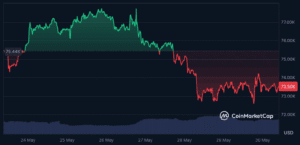
On Wednesday, US Central Command struck an Iranian military site near the Strait of Hormuz and shot down four Iranian drones targeting a commercial ship. Bitcoin dropped from $75,700 to $72,978. Nearly $1 billion in leveraged positions were liquidated. The ceasefire that had been extended “indefinitely” just days earlier was shattered.


On Thursday, Axios reported that American and Iranian negotiators had drafted a 60-day memorandum of understanding to extend the ceasefire, reopen the Strait of Hormuz, and begin formal nuclear talks. Stocks surged. Bonds rallied. Oil dropped. The Nasdaq pushed toward all-time highs.
Bitcoin stayed below $73,000.
That non-reaction is the most important signal in the market right now. It tells you something has fundamentally changed in how crypto responds to geopolitical events. And it isn’t good news for bulls counting on a peace deal to rescue the price.
What the Draft Deal Actually Contains
The proposed memorandum of understanding is a single page with 14 points. It reads more like a diplomatic term sheet than a comprehensive peace agreement, but the contents are significant.
The core provisions include an immediate 60-day extension of the ceasefire, during which both sides would negotiate more permanent arrangements. Iran would restore shipping traffic through the Strait of Hormuz to pre-conflict levels within 30 days of signing, including the removal of naval mines from the waterway. In exchange, Iran would be allowed to sell oil freely for the duration of the 60-day window.
Nuclear discussions are part of the framework. US envoys Steve Witkoff and Jared Kushner have been leading the American side of the talks, with Pakistan serving as mediator.
The biggest caveat is that President Trump has not yet signed off on the agreement. Vice President JD Vance said it remains unclear whether a final deal will be reached. The draft exists. The commitment to ink it does not.
That gap between “draft” and “done” is exactly why Bitcoin isn’t moving.
Why Bitcoin Used to Rally on This Kind of News
To understand why the non-reaction matters, look at what happened earlier in this conflict cycle.
In early April, when the first ceasefire was announced after weeks of military escalation, Bitcoin jumped past $72,700 almost instantly. Traders priced in reduced geopolitical risk, lower oil prices, and improved conditions for eventual rate cuts. The move was sharp and sustained.
In early May, when the draft MOU was first reported, and peace talks appeared to be making real progress, Bitcoin surged to $82,000, hitting a three-month high. The market bought the peace narrative aggressively, pricing in a world where the Strait of Hormuz reopens, oil drops below $90, inflation eases, and the Fed has room to cut.
Each time, the pattern was the same. Peace headline arrives. Bitcoin rallies. Hope builds.
Then the peace fell apart. The ceasefire that was supposed to be permanent lasted two weeks. The one that was extended “indefinitely” survived less than a week. And now, one day after bombing an Iranian military installation, the US is drafting yet another agreement.
The market has learned its lesson. Each successive peace announcement elicits a smaller reaction because each previous one proved temporary. The first ceasefire moved Bitcoin $5,000. The second moved it by $10,000. This one moved it approximately zero.
That’s ceasefire fatigue. And it’s a real phenomenon that analysts are now tracking as a distinct market dynamic.
Stocks Rallied. Bitcoin Didn’t. That Divergence Is the Story
Here’s what makes this moment genuinely unusual. Traditional markets reacted to the ceasefire draft exactly the way textbooks say they should. Stocks climbed. Bonds rallied. Oil dropped on expectations that Iranian supply would return to the market. The Nasdaq pushed toward all-time highs above 27,000.
Bitcoin did nothing.
For most of 2026, Bitcoin traded with an 80%+ correlation to the S&P 500 and Nasdaq. When stocks went up, Bitcoin went up. When stocks fell, Bitcoin fell. That relationship was so consistent that many analysts treated Bitcoin as effectively a high-beta tech stock.
That correlation just broke. Stocks are at record highs. Bitcoin is at a six-week low. The two markets are moving in opposite directions for the first time this year.
The divergence suggests that Bitcoin’s problems extend beyond geopolitics. Even when the macro environment improves, even when stocks rally, even when oil drops, Bitcoin keeps falling. That means the selling pressure is crypto-specific. ETF outflows, Strategy’s cost basis break, whale exits, and the rotation into AI stocks are all forces hitting Bitcoin from inside the crypto market, not from the outside world.
A peace deal can fix geopolitical risk. It can’t fix record ETF outflows. It can’t reverse the institutional rotation from Bitcoin into Nvidia. And it can’t convince the portfolio managers who’ve been selling for nine straight days to suddenly start buying again.
The Prediction Market Tells the Real Story
While Bitcoin’s price stayed flat, the prediction markets were anything but quiet.
Polymarket recorded over $280 million in trading volume on contracts tied to ceasefire timing. Traders were actively betting on whether the deal would be signed, how long it would last, and whether nuclear talks would produce results.
The odds are revealing. Polymarket puts meaningful probability on the ceasefire holding through July but significantly lower odds on a permanent peace agreement emerging from the 60-day window. The market’s collective judgment is that this deal, like the ones before it, buys time without solving the underlying conflict.
That assessment aligns with what’s happening on the ground. The US struck Iran on Wednesday. Iran retaliated by targeting the American airbase. Kuwait activated its air defenses to intercept incoming missiles. And then, 24 hours later, both sides sat down and drafted a ceasefire extension.
The cycle of violence followed by diplomacy, then more violence, has recurred enough times that prediction market bettors are pricing it as the default outcome rather than the exception. Peace is being treated as a temporary interruption of conflict, not the other way around.
What Actually Needs to Happen for Bitcoin to React
The market isn’t going to rally on another ceasefire announcement. It’s been made clear to you over the past 48 hours. The question is what would actually move Bitcoin higher at this point.
The answer isn’t a draft. It’s a signature. Trump needs to actually sign the MOU. The Strait of Hormuz needs to be physically reopened. Ships need to transit without being stopped, mined, or charged Bitcoin tolls. Oil needs to drop below $90 and stay there. And inflation data needs to soften enough for the Fed to credibly signal rate cuts.
Each of those steps builds on the previous one. A signed deal leads to shipping being reopened. Reopened shipping leads to lower oil. Lower oil prices lead to softer inflation. Softer inflation leads to rate cut expectations. Rate-cut expectations lead institutional capital to flow back into risk assets, including Bitcoin.
That chain is long. Each link has to hold. And the market has watched several previous attempts at the first link snap within days or weeks.
Until the chain progresses past the first few links, Bitcoin will continue trading on its own internal dynamics: ETF flows, whale positioning, leverage liquidations, and the rotation into AI equities. The geopolitical premium has been priced out. What’s left is a market that needs to find buyers on its own merits, not on diplomatic press releases.
The $6 Billion Options Expiry Adds Another Layer
Adding to the complexity, roughly $6.1 billion in Bitcoin options contracts expired on Deribit today. The maximum pain price, the level where the most options contracts expire worthless, sits near $75,000.
With 83,660 Bitcoin options contracts settling, market makers had strong incentives to keep the price pinned near $75,000 through the expiry window. The largest cluster of call options sat at $80,000 (bets on higher prices) while the biggest concentration of puts sat at $75,000 (bets on lower prices).
The options expiry creates a temporary gravitational pull that can suppress volatility during the settlement window and then release it once the contracts clear. With the expiry now behind us, Bitcoin’s price is free to move based on actual supply and demand rather than options market mechanics.
Whether that move is up or down depends entirely on what happens next with the Iran deal and whether next week’s ETF flow data breaks the nine-day outflow streak.
Disclaimer: This article is for informational purposes only and does not constitute financial advice. Cryptocurrency investments carry significant risk. Always conduct your own research before making any investment decisions.