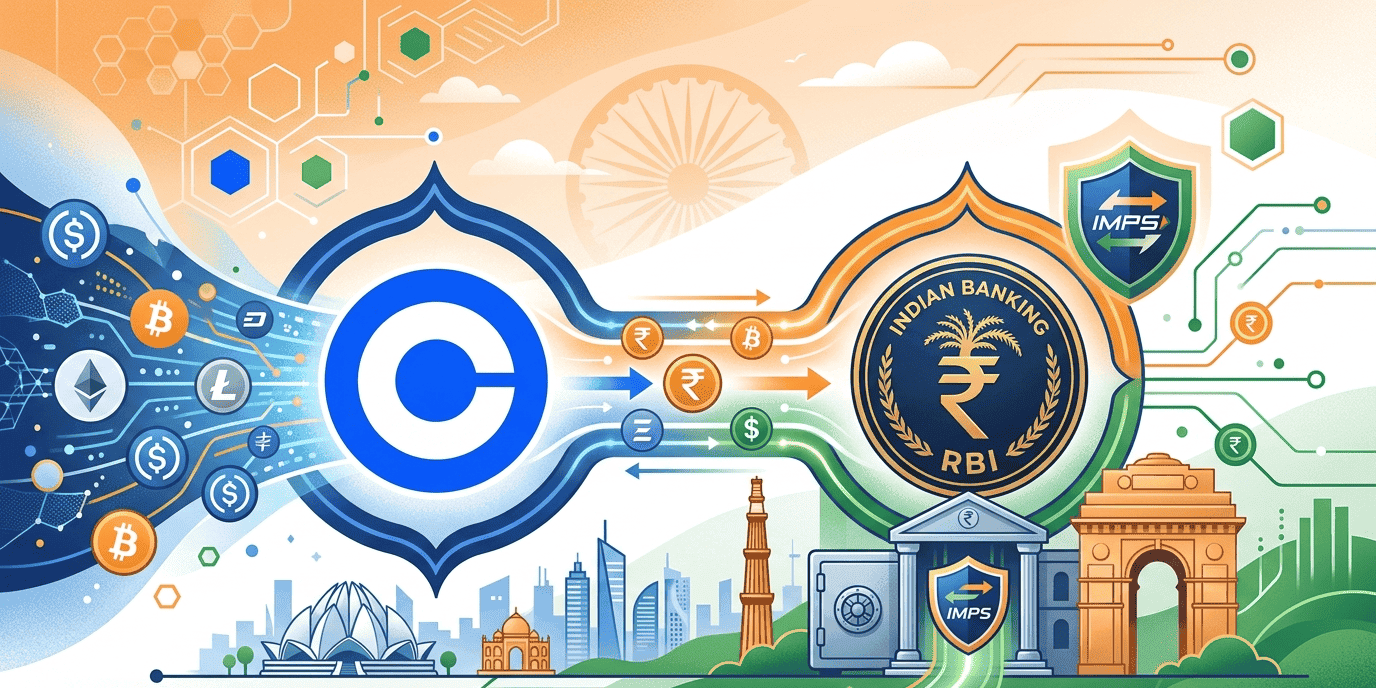
After four years of regulatory roadblocks, false starts, and a complete withdrawal of services, Coinbase is back in India. And this time, it came with everything.
Starting June 1, Indian users can deposit and withdraw Indian rupees directly from their bank accounts through the Immediate Payment Service (IMPS), India’s real-time interbank transfer system. No P2P workarounds. No third-party intermediaries. No frozen bank accounts from suspicious fund trails. Just a direct connection between your bank and the largest US crypto exchange.


The launch includes spot trading across major cryptocurrencies, perpetual futures contracts, dedicated INR order books with local liquidity, and access to the same institutional-grade trading infrastructure that Coinbase offers globally.
India ranks first on Chainalysis’s Global Crypto Adoption Index. The country’s crypto market reached $3.04 billion in 2025 and is projected to grow to $14.21 billion by 2034. Over 4,000 Indian developers are already building on Base, Coinbase’s Ethereum Layer 2 network. The demand was always there. The infrastructure wasn’t. Now it is.
Why This Launch Took Four Years
Coinbase’s history in India reads like a cautionary tale about how regulatory uncertainty can paralyse even the largest companies in crypto.
The exchange first entered India in April 2022 with a high-profile launch that included UPI (Unified Payments Interface) integration. Within days, the National Payments Corporation of India publicly declined to acknowledge Coinbase’s use of UPI, effectively killing the payment rail before it started. Coinbase was forced to disable rupee deposits almost immediately after launch.
What followed was a painful retreat. By 2023, Coinbase had suspended all services in India and instructed customers to withdraw their funds. The exchange that processes over $1 trillion in annual global trading volume had been shut out of the world’s most populous country due to a payment infrastructure dispute.
The comeback took two years of quiet regulatory work. Coinbase registered with India’s Financial Intelligence Unit (FIU-IND) in 2025, thereby satisfying tax and anti-money-laundering compliance mandates. It invested in CoinDCX, one of India’s leading domestic exchanges. It poured over $1 million into the Indian developer community through Base hackathons, grants, and fellowships. And it waited until the regulatory environment was ready.
John O’Loghlen, Coinbase’s Head of Asia-Pacific, framed the June 1 launch as the culmination of that multi-year investment. “India has long been one of the most important markets in crypto, in terms of developer talent, trading activity, and the broader adoption of blockchain technology. We’re registered with FIU-IND and here for the long term.”
The emphasis on “long term” is deliberate. Coinbase isn’t treating India as an experiment this time. It’s treating it as a core market.
What Indian Traders Actually Get
The feature set Coinbase is bringing to India goes well beyond basic buy-and-sell functionality.
Direct INR deposits and withdrawals are processed via IMPS, which processes transfers in real time, 24 hours a day, seven days a week. Indian users can move rupees between their bank account and Coinbase without waiting for business hours or dealing with the delays that plagued P2P methods.
Dedicated INR order books provide local liquidity for major trading pairs. Instead of converting rupees to dollars and then trading against USD pairs, Indian users can trade directly against INR. That eliminates a conversion step, reduces friction, and typically results in tighter spreads for local traders.
Spot trading covers all major cryptocurrencies available on Coinbase’s global platform. Perpetual futures contracts give Indian traders access to leveraged derivatives for the first time through a US-listed exchange. Previously, Indian users who wanted perps had to use offshore platforms with no regulatory protections.
Advanced charting tools, real-time market data, and the full Coinbase trading interface are all included. The experience is identical to that of institutional traders and retail users in the US, the UK, and Europe. India isn’t getting a stripped-down version. It’s getting the full platform.
Why P2P Was a Disaster for Indian Users
To appreciate why direct INR rails matter so much, you need to understand what Indian crypto users have been dealing with for years.
Without direct bank integration, the only way for most Indians to fund their crypto accounts was through peer-to-peer trading. P2P works by matching buyers and sellers directly. You transfer rupees to another person’s bank account, and they release crypto to your exchange wallet. The exchange acts as an escrow service rather than handling the money itself.
The problems with this system were extensive. Payment disputes were common. Scammers would receive the rupee transfer and then refuse to release the crypto. Bank accounts got frozen when banks flagged incoming transfers from unknown counterparties as suspicious activity. Settlement times were unpredictable. And the entire process felt like a workaround rather than a real financial service.
For casual users, P2P was intimidating enough to keep them away from crypto entirely. For active traders, it was a constant source of friction that added cost, delay, and risk to every funding cycle.
Coinbase’s IMPS integration eliminates all of those problems. The transfer goes directly from your bank to Coinbase’s regulated account. No counterparty risk. No frozen accounts. No disputes with strangers. The same straightforward experience that users in the US and Europe have had for years.
The Competitive Landscape Just Got Crowded
Coinbase isn’t entering an empty market. India has a well-established domestic exchange ecosystem led by CoinDCX, WazirX, and ZebPay. Binance previously had a significant presence in India through its partnership with WazirX, but regulatory disputes forced a messy separation.
Coinbase’s competitive advantages in India center on three things that domestic exchanges can’t easily match.
Global liquidity is the biggest. Coinbase’s order books draw from a worldwide user base, which means tighter spreads, deeper liquidity, and better execution on large orders than any India-only exchange can provide. For institutional traders and high-volume retail users, that liquidity depth matters.
Perpetual futures access is the second. Coinbase is offering Perps to Indian retail traders through a platform registered with the FIU. Most domestic Indian exchanges don’t offer derivatives at all, or offer them through structures that lack the regulatory clarity that Coinbase provides.
The institutional credibility of a Nasdaq-listed S&P 500 company is the third. India’s regulators, particularly the FIU and the Securities and Exchange Board, are more likely to engage constructively with a publicly traded US company than with offshore platforms operating in regulatory grey zones. That institutional trust translates into stability for users who want confidence that their exchange won’t suddenly become unable to operate.
The risk for Coinbase is India’s tax regime. The country imposes a 30% flat tax on all crypto gains and a 1% TDS (tax deducted at source) on every transaction. Those rates are among the highest in the world and have significantly dampened trading volumes on domestic platforms since their introduction. Coinbase will face the same headwinds.
The Developer Connection That Makes This Different
Coinbase isn’t just launching trading services in India. It’s tapping into the country’s massive developer talent pool through Base, its Ethereum Layer 2 network.
Over 4,000 Indian developers have already built on Base. Around 150 of those projects have grown into real startups. Coinbase has invested more than $1 million in the Indian builder community through hackathons, direct grants, and fellowships.
That developer base creates a flywheel that most exchange launches don’t have. When thousands of developers are building applications on your infrastructure, they create the tools, protocols, and services that attract users. Those users generate trading volume. That volume generates revenue. And that revenue funds more developer support.
India produces more software engineers annually than any country except China. By combining exchange services with developer infrastructure, Coinbase is positioning itself not just as a trading platform for Indian crypto users but as the foundation of India’s blockchain development ecosystem. That’s a longer-term play than simply capturing trading volume, and potentially a much more valuable one.
What This Means for India’s $14 Billion Crypto Future
India’s crypto market is projected to grow from $3.04 billion in 2025 to $14.21 billion by 2034, a compound annual growth rate of 18.66%. Coinbase’s entry accelerates that timeline by bringing world-class infrastructure to a market underserved by domestic exchanges.
The timing aligns with a broader global pattern. This week alone, SoFi launched the first bank-issued stablecoin inside a consumer app. Cash App rolled out USDC to 60 million users. Mastercard secured a BitLicense. And now Coinbase has gone live in the country that leads the world in crypto adoption.
The friction that kept hundreds of millions of Indians on the sidelines of the crypto economy, clunky P2P funding, offshore exchanges with no local currency support, and regulatory uncertainty about which platforms are legal, is being removed piece by piece. Coinbase’s IMPS integration is the largest single piece removed so far.
For Indian crypto users, June 1, 2026, marks the day that the world’s most prominent crypto exchange finally showed up with the full toolkit. For Coinbase, it marks the beginning of what could become one of its most important markets globally.
The front door is open. The question now is how many of India’s 1.4 billion people walk through it.
Disclaimer: This article is for informational purposes only and does not constitute financial advice. Cryptocurrency investments carry significant risk. Always conduct your own research before making any investment decisions.