The haystack teaser. The “Hey Stock” decoded image. CZ’s “announcement of an announcement.” After days of speculation that sent BNB surging 10% past $700, Binance finally revealed what it had been building.
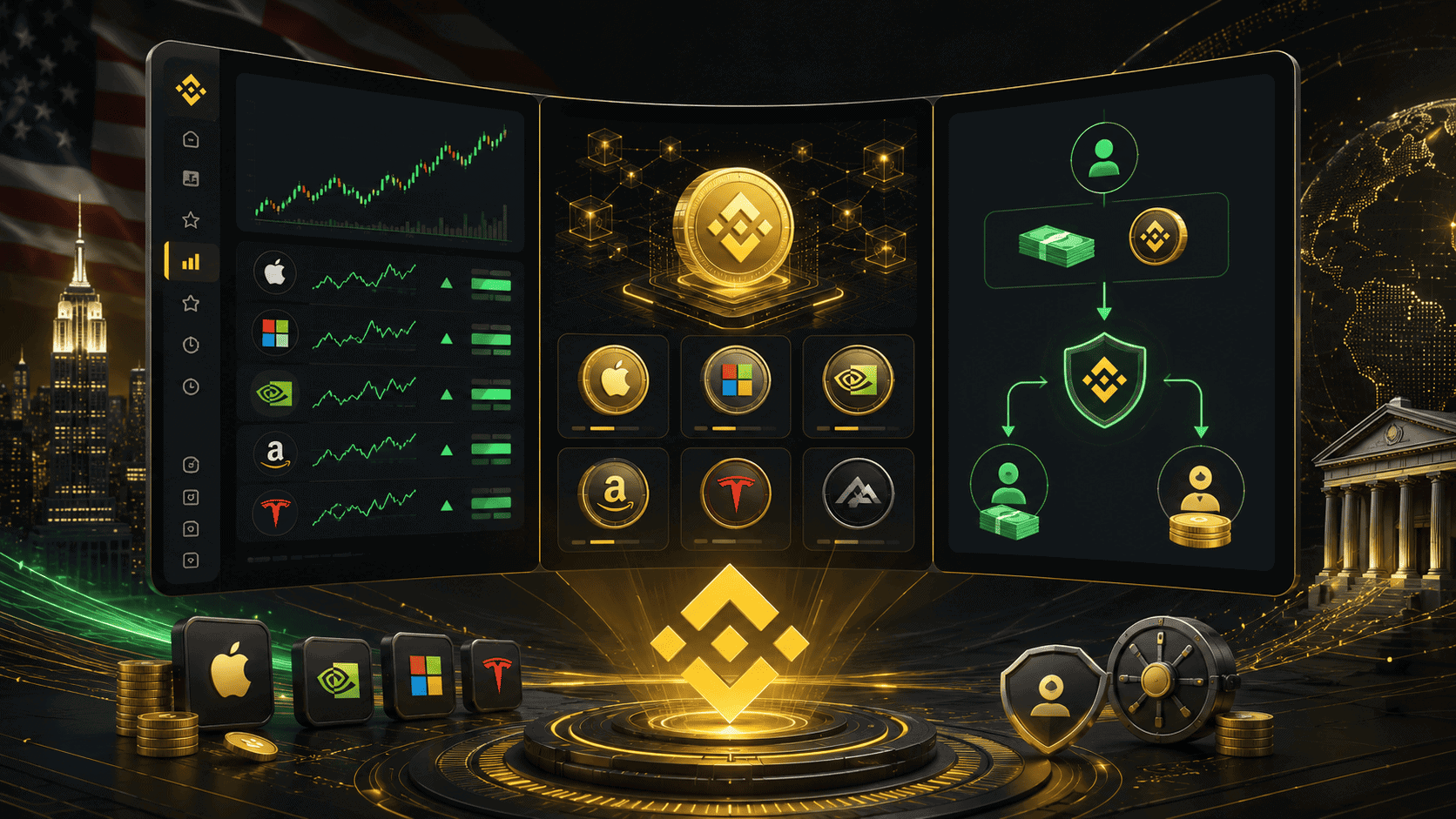
The world’s largest crypto exchange is launching US stock and ETF trading for eligible global users, with access to approximately 7,000 instruments. Alongside that, Binance plans to roll out tokenized equities called bStocks on BNB Chain. And on June 4, it will introduce Fully Paid Securities Lending, allowing users to earn yield by lending their stock holdings to other market participants.


Three products in one announcement. Each individual would have been a major development. Together, they represent Binance’s most aggressive expansion beyond crypto in the company’s eight-year history.
The exchange that built its empire on altcoin trading is now going head-to-head with Robinhood, E*Trade, Interactive Brokers, and traditional brokerages. For the 200 million registered Binance users worldwide, the days of needing a separate app for stocks are over.
How the Stock Trading Works
Binance partnered with two companies to make stock trading possible without building a brokerage from scratch.
Nest Trading provides the brokerage infrastructure that handles order routing, execution, and regulatory compliance. Alpaca manages custody services, dividend distributions, and corporate actions like stock splits and mergers. Binance provides the front-end interface, the user base, and the liquidity.
The setup allows eligible users to buy and sell shares of US-listed stocks and ETFs directly within the Binance app. Apple, Tesla, Nvidia, Amazon, the S&P 500 ETF, semiconductor ETFs, AI-focused funds — all accessible from the same platform where users already trade Bitcoin and Ethereum.
Trading follows standard US market hours. Orders can be placed as market orders or limit orders. Dividends are distributed automatically through Alpaca’s infrastructure. Corporate actions are handled without requiring users to take any manual steps.
The critical word in the announcement is “eligible.” Binance has not specified which countries or user tiers will have access at launch. US residents are unlikely to be included initially, given Binance’s ongoing regulatory complications in America. The primary target appears to be international users who want access to US equities without opening a separate US brokerage account.
For a trader in Lagos, Jakarta, or Istanbul who currently uses Binance for crypto, adding stock trading within the same platform eliminates one of the last reasons to maintain a separate financial app. That consolidation of financial services into a single interface is the strategic play behind the entire announcement.
bStocks: Tokenized Equities on BNB Chain
The stock trading announcement came with a second layer that pushes further into new territory.
Binance plans to launch bStocks, tokenized versions of US stocks and ETFs that live on BNB Chain. Eligible users will be able to convert supported equities into blockchain-based assets, bridging traditional stock ownership and on-chain infrastructure.
The mechanics work like this. A user buys shares of, say, Apple through Binance’s stock trading service. Those shares are held in custody by Alpaca. The user can then convert those shares into bStock tokens on BNB Chain, which represent the underlying equity position in tokenized form.
Once tokenized, the bStocks can move through BNB Chain’s DeFi ecosystem. That opens possibilities that don’t exist in traditional finance: 24/7 transferability, potential use as collateral in lending protocols, fractional ownership down to tiny amounts, and programmable financial logic through smart contracts.
Binance made an important distinction in the announcement. The tokenized instruments do not represent direct ownership of the underlying shares. They are synthetic blockchain representations. That legal structure avoids some of the regulatory complications that killed Binance’s previous attempt at tokenized stocks in 2021, when regulators in multiple countries objected to the product.
The full list of eligible assets for bStocks hasn’t been disclosed yet. Binance indicated the feature will roll out in phases, starting with a limited set of popular equities before expanding.
Securities Lending Launches June 4
The third product in the announcement is Fully Paid Securities Lending (FPSL), scheduled to go live on June 4.
Securities lending is a standard practice in traditional finance. It works by allowing investors who hold shares to lend them to other market participants, typically short sellers, market makers, or arbitrage traders, in exchange for a fee. The lender retains economic ownership of the shares (including dividend rights) while earning additional income from the lending fee.
Binance’s FPSL service applies this concept to both crypto assets and the newly available stock holdings. Users can lend eligible securities from their portfolio and earn passive yield without selling their positions.
The service addresses a specific need that active traders have been requesting for years. In traditional brokerages, securities lending is available but often requires high minimum balances or is restricted to premium account tiers. Binance appears to be offering it to a broader user base, though specific eligibility requirements haven’t been fully detailed.
For Binance, securities lending generates revenue through a share of the lending fees. For users, it creates a new income stream from assets that would otherwise sit idle. And for the broader market, it improves liquidity by making more shares available for short selling and market-making activities.
The June 4 launch date places FPSL just three days after the stock trading reveal, suggesting Binance has been preparing both features in parallel for months.
Why Binance Tried This Before and Failed
This isn’t Binance’s first attempt at stock trading. Understanding what went wrong last time explains why the current approach is structured differently.
In April 2021, Binance launched tokenized versions of Tesla, Coinbase, Apple, and MicroStrategy shares. The product was built in partnership with digital securities firm CM-Equity and was available to Binance users in most countries.
The rollout lasted less than four months. Germany’s financial regulator BaFin warned that the tokens might violate securities regulations. The UK’s Financial Conduct Authority expressed concerns. Hong Kong’s SFC raised objections. By October 2021, Binance had pulled the product entirely, citing regulatory complexity.
The 2021 version failed because Binance tried to create and distribute tokenized stocks itself, putting the exchange directly in the crosshairs of securities regulators in every jurisdiction where its users lived.
The 2026 version avoids that trap by separating responsibilities. Nest Trading handles the brokerage license and regulatory compliance. Alpaca handles custody and corporate actions. Binance handles the user interface and distribution. No single entity is responsible for everything, and the regulatory burden falls on partners with existing securities licenses rather than on Binance itself.
The bStocks tokenization layer adds blockchain functionality on top of this regulated structure rather than replacing it. Users first buy real shares through a licensed brokerage. Then they optionally convert those shares into tokens. The underlying regulatory compliance exists regardless of whether the token layer is used.
Whether regulators accept this structure remains to be seen. The 2021 experience demonstrated that securities regulators in multiple countries are willing to challenge crypto exchanges that offer stock-like products. The 2026 structure is more carefully designed, but regulatory risk hasn’t disappeared. It’s been managed, not eliminated.
What This Means for Traditional Brokerages
Binance’s entry into the stock trading market, with 200 million registered users, poses a competitive threat that traditional brokerages can’t ignore.
Robinhood has approximately 24 million funded accounts. E*Trade serves 8.6 million clients. Interactive Brokers has around 3 million accounts. Binance’s registered user base is larger than the combined total of the other three by a factor of five.
Not every Binance user will trade stocks. Many are in jurisdictions where access may be restricted. Others have no interest in equities. But even if 5% of Binance’s users activate stock trading, that’s 10 million new equity market participants arriving through a single platform.
The fee structure will determine how disruptive the launch actually becomes. Binance hasn’t disclosed its commission rates for stock trading. If it follows the zero-commission model that Robinhood popularised, it could attract significant volume from international users who currently pay high commissions on local brokerage platforms.
The competitive dynamics also flow in the other direction. Robinhood, E*Trade, and Interactive Brokers have all added crypto trading to their platforms over the past two years. Binance’s addition of stock trading to its platform is the mirror image of that expansion. Both sides are building toward the same destination: a single platform where users can trade everything.
The race to become the everything-app for finance is accelerating. Binance just made its biggest move yet.
The Risks Users Need to Understand
Binance’s stock trading product introduces risks that crypto-native users may not be familiar with.
Stock trading is subject to different regulations than crypto trading. Market hours are fixed. Settlement follows T+1 rules. Short-selling restrictions apply. Pattern day trading rules may affect users in certain jurisdictions. Tax treatment of equity gains differs from crypto gains in most countries.
The custody structure adds counterparty layers. Shares are held by Alpaca, not directly by Binance. If Alpaca experiences operational issues, users’ stock holdings could be affected. Crypto users accustomed to self-custody and on-chain verification may find the opacity of traditional securities custody uncomfortable.
The bStocks tokenization adds blockchain-specific risks on top of traditional equity risks. Smart contract vulnerabilities, bridge exploits, and the gap between the tokenized representation and the underlying shares all create potential failure points that don’t exist in traditional stock ownership.
And Binance’s own regulatory position remains uncertain. The company settled with the DOJ for $4.3 billion in 2023. The UK sanctioned an associated exchange this week. The WSJ investigation into Iran-linked flows remains unresolved. Users should weigh whether adding stock holdings to a platform with that regulatory profile aligns with their risk tolerance.
None of these risks is disqualifying. Traditional brokerages carry counterparty risk, too. But crypto users expanding into equities for the first time should understand that different asset classes carry distinct risks, and the protections they’re accustomed to in crypto (self-custody, on-chain verification, 24/7 access) don’t automatically apply to stocks held through a brokerage.
FAQ
What did Binance announce on June 1?
Binance launched US stock and ETF trading, providing access to approximately 7,000 instruments through its brokerage partner, Nest Trading, and its custodian, Alpaca. The exchange also announced bStocks, tokenized versions of equities on BNB Chain, and Fully Paid Securities Lending launching on June 4. Together, these products position Binance as both a crypto exchange and a stock brokerage.
Can US residents trade stocks on Binance?
Binance has not confirmed whether US residents will have access at launch. Given the exchange’s ongoing regulatory complications in the United States, including the 2023 DOJ settlement, initial access is expected to be limited to eligible international users. Specific country availability has not been disclosed.
What are bStocks?
bStocks are tokenized versions of US stocks and ETFs that will live on BNB Chain. Users can convert eligible equity holdings into blockchain-based tokens that can be transferred, potentially used as DeFi collateral, and traded 24/7. The tokens do not represent direct ownership of underlying shares. They are synthetic blockchain representations of the equity position held in custody by Alpaca.
Disclaimer: This article is for informational purposes only and does not constitute financial advice. Cryptocurrency and securities investments carry significant risk. Always conduct your own research before making any investment or trading decisions.