
On Friday, BNB was the talk of crypto. A 10% surge past $700. The VanEck ETF lives on Nasdaq. CZ’s mysterious June 1 teaser is sending speculation into overdrive. Analysts targeting $760. The only major altcoin rallying while everything else bled.
By Tuesday, all of it was gone.


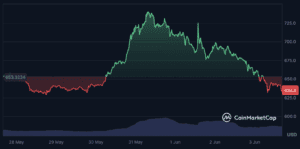
BNB is trading at approximately $653, down over 8% from the $712 peak set just 48 hours ago. The entire $700 breakout has been erased. The level that was supposed to flip from resistance to support broke on the first real test. And the token that was being celebrated as proof that catalysts can overcome a bear market just proved the opposite: in a market this weak, no catalyst holds for long.
The mystery June 1 reveal turned out to be exactly what the market guessed: Binance launching US stock and ETF trading with 7,000 instruments, tokenised bStocks on BNB Chain, and securities lending starting June 4. On paper, it was everything the market wanted. In practice, it was the textbook definition of “buy the rumour, sell the news.”
What Actually Happened
The sequence played out with almost mechanical precision.
BNB started climbing on May 28 when VanEck’s VBNB ETF went live on Nasdaq, giving institutional investors regulated access to the token for the first time. CZ amplified the momentum with his “announcement of an announcement” post. Traders who had been short BNB were squeezed as the price pushed through $700. By Friday night, BNB was at $712 and the mood was euphoric.
Then June 1 arrived. Binance revealed the stock trading product. The details were impressive: 7,000 US equities, tokenised bStocks on BNB Chain, and securities lending launching June 4. It was arguably the most ambitious product launch in Binance’s history.
The price dropped.
Not because the announcement was bad. The announcement was genuinely significant. The price dropped because the market had already priced in everything the announcement could deliver. Traders who bought on the rumour took their profits when the news confirmed their thesis. The buying pressure that drove the breakout came from anticipation. Once the anticipation gave way to reality, there was nobody left to buy.
Bitcoin’s continued decline made everything worse. BTC dropped from $69,000 to $66,922 between Sunday and Tuesday, dragging the entire altcoin market down with it. BNB’s correlation with Bitcoin reasserted itself at exactly the wrong moment. The token that appeared to decouple from BTC during the rally recoupled on the way down.
Why $700 Failed as Support
The $700 level was supposed to be the inflection point. Technical analysts had been watching it for months. Every rally attempt in 2026 stalled there. When BNB finally broke through on heavy volume, the expectation was that the former resistance would become a floor that buyers would defend on pullbacks.
That didn’t happen because the breakout was driven by event-specific catalysts rather than a broad shift in demand. VanEck’s ETF launch and CZ’s teaser created a burst of short-term buying that pushed through $700 but didn’t establish the sustained demand needed to turn a resistance level into genuine support.
For a level to flip from resistance to support, buyers need to show up consistently on pullbacks. They need to view the level as “cheap” and accumulate there over multiple sessions. When BNB pulled back to $700 on Monday, the buyers who drove the breakout were already in profit and looking to exit, not looking to add. The level broke within hours.
The broader market context sealed the outcome. In a healthy market with rising Bitcoin and improving sentiment, BNB’s pullback to $700 might have found buyers willing to defend it. In a market where Bitcoin is making new lows daily and the Fear and Greed Index reads 23, altcoin support levels break because there simply aren’t enough buyers to hold them.
The “Buy the Rumor, Sell the News” Pattern
BNB’s round trip from $640 to $712 and back to $653 is one of the clearest examples of this pattern that crypto has produced in 2026.
The pattern works like this. A catalyst approaches. Traders who anticipate a positive outcome buy the asset ahead of the event. The price rises as anticipation builds. When the event occurs and confirms what everyone expected, the traders who bought early sell into the announcement. Selling overwhelms any new buying the news attracts, and the price falls back toward where it started.
BNB followed the script perfectly. The VanEck ETF and CZ’s teaser were the sources of the rumors. The June 1 stock trading reveal was the news. The 10% rally was the buying on anticipation. The 8% decline was the selling on confirmation.
The lesson isn’t that Binance’s stock-trading launch doesn’t matter. It does. Having 7,000 US equities available to 200 million Binance users through a crypto exchange is a genuine milestone. Tokenized bStocks on BNB Chain could eventually generate significant network activity. Securities lending adds a revenue stream that didn’t exist before.
The lesson is about timing and market context. In a bull market, the June 1 announcement would have sustained the rally because new buyers would have stepped in after the news. In a bear market with Bitcoin below $67,000 and institutional capital fleeing crypto for AI stocks, there weren’t enough new buyers to absorb the profit-taking from those who bought the rumor.
Good news in a bad market gets sold. That’s the pattern. BNB just demonstrated it with $712 in neon lights.
Where BNB Stands Now
The failed breakout shifts BNB’s technical outlook from bullish back to neutral at best.
The $640 higher low from May remains the key support. As long as BNB holds above that level, the broader structure hasn’t broken. A pullback to $640 that holds and bounces would set up another potential attempt at $700, this time potentially from a stronger base if the broader market stabilizes.
A breakdown below $640 would be more serious. It would invalidate the higher-low pattern and open a path toward the lower boundary of BNB’s 2026 range near $570 to $580. That level represents the floor that has held through the worst of this year’s selloff.
On the upside, $700 becomes resistance again. BNB now needs to break through the same level twice to establish a credible uptrend. The VanEck ETF and securities lending catalysts haven’t disappeared. They just need time to generate the sustained demand that a single announcement can’t deliver.
The VanEck VBNB ETF will continue attracting inflows over the coming weeks and months. Each dollar that enters the fund results in actual BNB being purchased and held in custody. That slow, steady institutional buying is more valuable for long-term price support than a one-day speculative surge, even if it doesn’t produce the kind of headlines that move prices overnight.
Grayscale’s competing GBNB ETF filing adds a second institutional access point that hasn’t been priced in yet. When it launches, BNB will have two regulated ETF products generating structural demand. That infrastructure matters more than any single announcement, but it operates on a timeline measured in months, not days.
The Broader Lesson for Altcoin Traders
BNB’s round trip captures a truth that every altcoin trader in 2026 needs to internalize: individual catalysts can’t overcome a hostile macro environment for more than a few days.
Binance launched the most ambitious product expansion in its history. VanEck brought the first BNB ETF to Nasdaq. CZ generated more social media engagement than most token launches. And none of it held because Bitcoin was falling, ETF money was leaving crypto, and institutional investors were choosing AI stocks over digital assets.
In a bull market, catalysts compound. Good news builds on good news. Each positive development attracts more buyers, pushing prices higher and generating more positive sentiment, which in turn attracts more buyers. The flywheel spins.
In a bear market, catalysts get absorbed. Good news produces a temporary spike that gets sold within days. The broader downtrend reasserts itself. The catalyst gets forgotten as the next Bitcoin selloff dominates the headlines. The flywheel runs backward.
BNB’s fundamentals haven’t changed. The VanEck ETF is real. The stock trading product is live. The network processes 14 million daily transactions. Standard Chartered still targets $2,775 by 2028. Everything that was true at $712 is still true at $653.
The price fell because the market isn’t ready, not because the fundamentals broke. When the macro environment eventually turns, the catalysts that arrived this week will still be there. The question is whether traders have the patience to wait.
FAQ
Why did BNB drop from $712 to $653?
BNB experienced a classic “buy the rumor, sell the news” event. The VanEck ETF launch and CZ’s mystery teaser drove anticipation-driven buying, pushing BNB above $700. When the June 1 reveal confirmed stock trading, early buyers took profits. Bitcoin’s simultaneous decline from $69,000 to $66,922 added selling pressure, overwhelming any new buying from the announcement.
Is the $700 breakout dead?
For now, yes. The $700 level, which was supposed to flip from resistance to support, broke on the first pullback. BNB needs to stabilize above $640 and build a stronger base before attempting $700 again. A sustained break below $640 would signal a deeper correction toward the $570-$580 floor.
Does the failed breakout change BNB’s long-term outlook?
Not fundamentally. The VanEck ETF, Grayscale’s pending GBNB fund, the stock trading launch, and BNB Chain’s network activity all remain intact. Standard Chartered’s $2,775 target for 2028 hasn’t changed. The failed breakout reflects bear-market conditions overwhelming individual catalysts, rather than a deterioration in BNB’s underlying value proposition.
Disclaimer: This article is for informational purposes only and does not constitute financial advice. Cryptocurrency investments carry significant risk. Always conduct your own research before making any investment decisions.