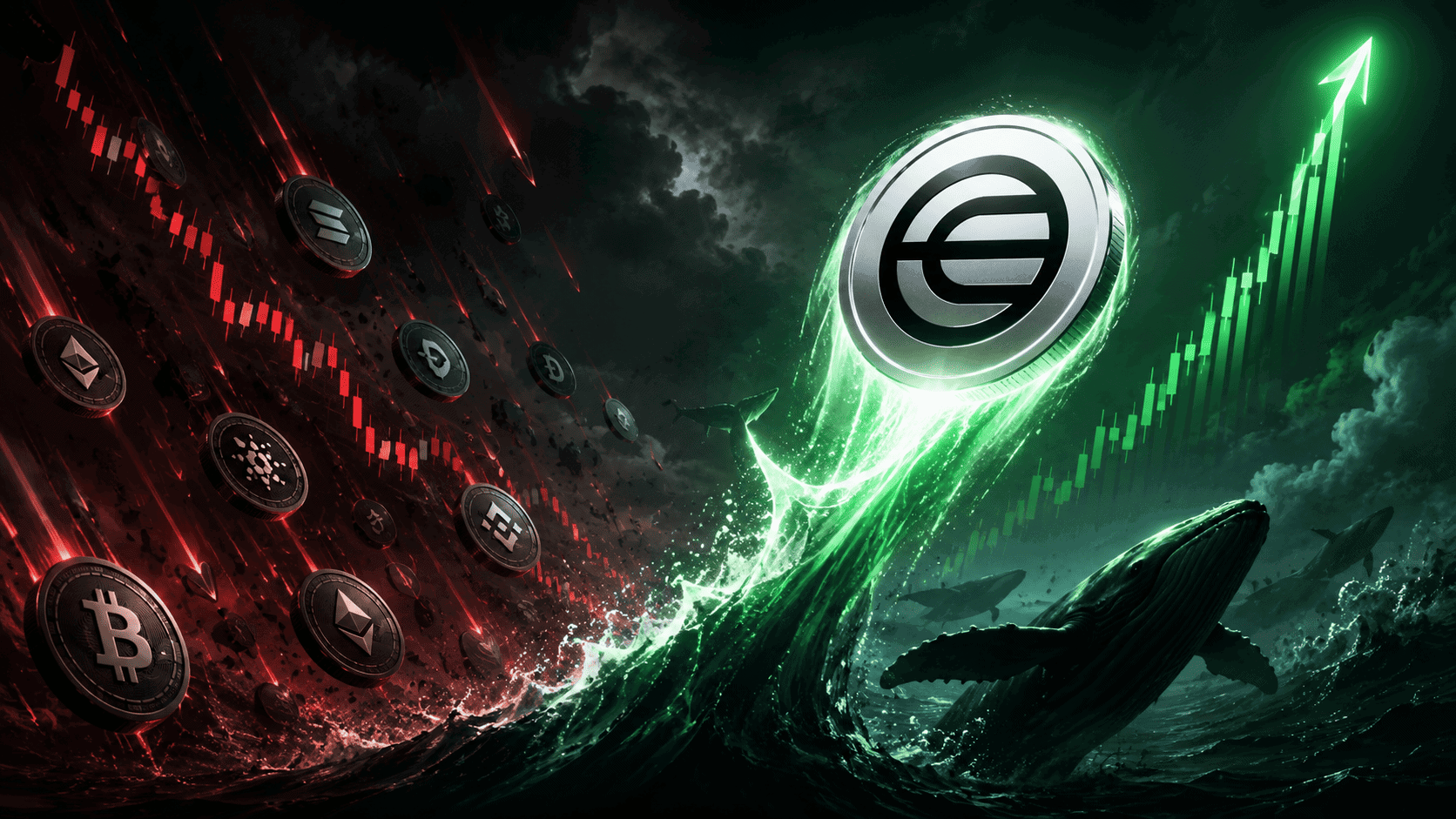
Bitcoin lost 15% this week. Ethereum broke below $1,900. Over $3 billion in leveraged positions were liquidated. The Fear and Greed Index hit 12. And Worldcoin went up 60%.
WLD climbed from $0.33 to $0.53 in seven days, gaining over 30% in the last 24 hours alone. While nearly every major cryptocurrency posted deep losses, Sam Altman’s AI-linked token posted the kind of rally that most projects can’t achieve in a bull market, let alone during the worst week of the year.


The move wasn’t random retail speculation. On-chain data shows whale transactions above $100,000 hitting their highest level of 2026. Exchange outflows turned negative, meaning large holders are withdrawing WLD from exchanges to hold rather than sell. Active addresses climbed above 1,300. New wallet creation accelerated.
Three specific catalysts converged at the same time: a major reduction in daily token emissions coming July 24, growing institutional interest in WLD as a proxy for OpenAI’s upcoming IPO, and a massive short squeeze that forced bearish traders to buy back tokens they’d been betting against.
The July 24 Supply Shock
The most concrete catalyst is the tokenomics change arriving in seven weeks.
On July 24, Worldcoin’s daily token unlock will drop from approximately 5.1 million WLD to 2.9 million, a 43% reduction. Community tokens see a 50% decrease from 3.2 million to 1.6 million daily. Team and investor tokens see a 32% reduction from 1.9 million to 1.3 million daily.
Token unlocks have been one of the biggest headwinds for WLD since launch. Every day, millions of new tokens enter circulation and create selling pressure as early investors and team members take profits. That constant supply expansion has kept the price depressed even during periods of genuine demand.
The July 24 cut doesn’t eliminate unlocks entirely. It reduces them significantly. Fewer new tokens entering the market each day means less automatic selling pressure, which creates a higher floor under the price if demand stays constant or grows.
Traders are front-running this event. The logic is straightforward: if daily selling pressure drops 43% in seven weeks, buying before the cut positions you ahead of the supply reduction. The 60% rally reflects that positioning playing out in real time.
The OpenAI IPO Proxy Trade
The second catalyst is more speculative but potentially more powerful.
OpenAI is targeting a September 2026 public listing, aiming to raise $60 billion at a valuation approaching $1 trillion. Anthropic filed its own IPO prospectus after a $65 billion funding round. The AI sector is heading for the biggest IPO wave in tech history.
Worldcoin was co-founded by Sam Altman, CEO of OpenAI. WLD is the most direct crypto exposure to Altman and by extension to the AI industry’s most valuable private company. For investors who want AI IPO exposure through crypto, WLD is the most obvious trade.
Arthur Hayes’ fund Maelstrom published a research note calling WLD “an AI proxy trade” and setting a $5 price target, roughly 10x from current levels. Analyst Lukas Ruppert cited three factors: WLD’s deep valuation discount relative to AI equity valuations, the July token unlock reduction, and potential buying pressure from Eightco Holdings, a Nasdaq-listed company that holds approximately 283 million WLD tokens alongside $144 million in cash.
The Maelstrom note gave institutional traders a framework for buying WLD that goes beyond “meme coin goes up.” It positioned the token as a calculated bet on AI sector capital rotation, with a specific catalyst timeline and identifiable demand sources.
Whether WLD actually deserves to be valued as an OpenAI proxy is debatable. Worldcoin and OpenAI are separate companies with different businesses. Owning WLD doesn’t give you equity in OpenAI. But markets don’t always price based on legal structure. They price based on narrative. And the narrative connecting Altman, OpenAI, and WLD is powerful enough to move billions.
The Short Squeeze That Amplified Everything
Before the rally, WLD was one of the most heavily shorted tokens in the mid-cap altcoin space. Traders who had watched the token decline from $11.74 (its March 2024 all-time high) to $0.23 (its May 2026 low) were confident it would keep falling.
When the price broke above $0.40 on the back of the unlock news and Maelstrom report, those short positions came under immediate pressure. As WLD rose, short sellers faced mounting losses. Their positions were liquidated automatically, forcing them to buy WLD to close. That forced buying pushed the price higher, triggering more liquidations, creating more buying.
The 30% single-day gain reflects this mechanical amplification. Organic buying from whales and retail provided the initial push above $0.40. The short squeeze turned a healthy rally into a parabolic move to $0.53.
Short squeezes produce fast, dramatic moves. They also tend to exhaust quickly. Once the shorts are cleared, the forced buying stops and the price either consolidates or pulls back. The RSI is now near 69, approaching overbought territory. A cooldown before any push toward the $0.65 resistance is likely.
Who’s Actually Buying
The on-chain data separates real demand from speculative noise.
Santiment data shows daily whale transactions above $100,000 at their highest level of 2026. Large addresses added nearly 30 million WLD tokens to their holdings outside of exchanges. Exchange net flows are negative, confirming that more WLD is being withdrawn from exchanges than deposited, a classic accumulation signal.
Eightco Holdings, the Nasdaq-listed company that Maelstrom flagged, holds approximately $374 million in total assets including 283 million WLD tokens, 11,068 ETH, indirect OpenAI exposure, Beast Industries equity, and about $144 million in cash. The company has positioned itself as a public vehicle for AI, digital identity, and digital asset exposure.
Selini Capital acquired $5.64 million in WLD from Binance in April. Multiple other institutional addresses have increased positions since the token bounced from its all-time low near $0.23 in mid-May.
The buying isn’t coming from a single source. It’s distributed across whales, institutional funds, and retail traders who are all converging on the same thesis: the unlock cut tightens supply, the OpenAI IPO creates a narrative catalyst, and the current price is cheap relative to where WLD could trade if both catalysts deliver.
The Risks That Could Unwind This Rally
A 60% weekly gain in a bear market demands scepticism alongside excitement.
WLD is still 95% below its all-time high of $11.74. The token has been in a structural decline for over two years. One good week doesn’t reverse that trend. The descending channel breakout is encouraging, but previous breakout attempts in WLD’s history have failed and returned to new lows.
The unlock reduction on July 24 reduces daily emissions but doesn’t eliminate them. Even at 2.9 million tokens per day, that’s still over $1.5 million in new supply hitting the market daily at current prices. If demand doesn’t match or exceed that rate, the price drifts lower regardless of the reduction.
The OpenAI IPO proxy trade is a narrative, not a legal claim. If OpenAI’s September listing disappoints, or if the AI sector rotation fades, the premium traders are assigning to WLD as an AI proxy evaporates quickly.
And the RSI near 69 with a 60% weekly gain means a pullback is statistically likely before any continuation higher. Buying after a 60% move and expecting another 60% is the kind of trade that works until it doesn’t. Waiting for a retest of $0.44 to $0.38 would offer a better risk-reward entry for anyone who missed the initial breakout.
Where WLD Goes From Here
The immediate resistance sits at $0.55 to $0.56. A clean break above that level targets $0.64 to $0.65, the next major cluster where previous sellers are waiting. Above $0.65, the path opens toward $0.80 to $1.00.
Support sits at $0.44, the breakout level that triggered the short squeeze. Below that, $0.38 represents the last higher low. A drop below $0.38 would suggest the rally was entirely squeeze-driven and the downtrend is resuming.
The July 24 unlock cut provides a natural timeline for the trade. If WLD holds above $0.44 and builds a base between now and the emission reduction, the supply shock could drive the next leg higher. If it fails to hold and returns to the $0.30s, the unlock cut alone won’t be enough to save it.
For a token that gained 60% while Bitcoin lost 15%, the momentum is undeniable. Whether that momentum reflects a genuine re-rating or a bear market squeeze that’s about to reverse is the $5 question that Maelstrom is betting everything on.
Disclaimer: This article is for informational purposes only and does not constitute financial advice. Cryptocurrency investments carry significant risk. Always conduct your own research before making any investment decisions.