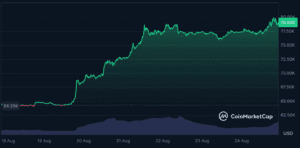
Bitcoin traded around $77,900 on Monday, holding a 22% weekly gain but stalling below the $80,000 level analysts have identified as the decisive test, four days before Federal Reserve Chair Kevin Warsh delivers his first Jackson Hole keynote.
The cryptocurrency rose from a weekly low of $63,387 to nearly $80,000 by Friday before settling into a $77,000 to $78,000 range. It is up 23% month-to-date and on track for its best August since 2017, when it gained 65%. The median August return is negative 7%.

The rally followed the Treasury’s announcement that it would double long-end bond buybacks, which pulled yields lower, alongside the SEC’s proposed Regulation Crypto framework and a short squeeze exceeding $3 billion.
Warsh speaks Friday, August 28 at 10:00 a.m. ET, 19 days before the Fed’s September 16 rate decision. CME FedWatch data puts the probability of rates remaining at 3.50% to 3.75% after that meeting at 63.1%.
The $80,000 wall
Analysts across several firms have converged on the same level, which is unusual enough to be worth noting.
CoinShares head of research James Butterfill called $80,000 an “important boundary,” arguing a decisive move above it would require confirmation that Fed policy is shifting away from further tightening. He characterised the rally as “primarily a macro story rather than a crypto specific one,” noting bitcoin remains acutely sensitive to liquidity expectations and real yields.
Rekt Capital warned that both the 50-week exponential moving average and the broader $80,000 area function as resistance, and that price has so far topped out below it. “Each Bear Market Relief Rally thus far would retrace sharply in the week following a strong breakout rally,” he wrote, pointing to a series of macro lower highs that would reinforce the bear market despite recent strength.
Others are more constructive. One analyst quoted by Decrypt described the move as “a trend re-selection phase in the late stage of the bear market,” identifying $82,000 as the next major obstacle and suggesting a clean break could open a path toward $95,000.
The near-term levels are tighter. Bitcoin trades inside a descending channel with liquidity clusters concentrated between $78,500 and $80,000. A break above $78,500 opens $79,500. On the downside, $75,000 is the first support, followed by the $70,000 to $72,000 breakout region.
CryptoQuant flagged a different threshold. Analysis of UTXO cost bases puts the breakeven for recent buyers at $73,000, above both short-term and long-term holder cost bases, making $68,000 to $73,000 the region that determines whether the profitability reset holds.
The wildcard is the speaker
Warsh is difficult to position around because he has deliberately made himself so.
Since taking office in May, he has curtailed forward guidance at every opportunity, shortened the post-meeting statement to roughly a third of its previous length, and given evasive answers at both press conferences he has held. He has framed that approach around independence from market pricing.
Asked about Friday’s speech after the July FOMC meeting, he said his keynote was “a blank piece of paper right now.” He also indicated he intends to widen the lens rather than signal a move: “There is a tendency, especially with the proliferation of meetings and press conferences, to get caught up in the myopic. If I could, in the high mountain air in Jackson, Wyoming, I’d like to also frame the big questions.”
That creates a two-way risk with no policy record to anchor on. It also means the committee may carry more signal than the podium. Roughly half the FOMC penciled in 2026 rate hikes at Warsh’s first meeting in June, and three regional presidents dissented in favour of a hike in July.
Two factors give the speech unusual crypto relevance. The symposium theme, “Financial Innovation: Implications for Payments and Policy,” places digital payments at the centre of Jackson Hole for the first time. And Warsh disclosed holdings across more than a dozen blockchain protocols in his April ethics filing before divesting them on confirmation, then appointed a prominent bitcoin investor to co-lead the Fed’s AI and productivity task force. Any language on digital asset regulatory direction could move crypto on policy content rather than rate mechanics alone.
Warsh has separately convened 15 external experts to review the Fed’s monetary policy framework, with recommendations due by year-end. The last overhaul, completed under Powell in 2020, introduced average inflation targeting. With inflation above 2% for more than five years, speculation that Warsh could modify or scrap that approach is likely to amplify any hint he offers.
History suggests a small move
BeInCrypto measured bitcoin’s performance on every Fed chair Jackson Hole keynote day since 2018 and found only one speech actually hurt it.
That was Powell’s 2022 address on August 26, when he offered markets no relief on inflation. Bitcoin fell from $21,518 to $20,230 in a single session, a 6% drop, while the S&P 500 lost 3.4%. By August 28 bitcoin sat 9% below its pre-speech level.
That is the scenario traders are positioning against. The base case, on eight years of data, is a small move.
The week around it
Warsh’s speech closes a data-heavy stretch rather than opening one.
Consumer confidence and new home sales arrive Tuesday. Wednesday is the pivotal session: July PCE inflation, with core forecast to accelerate to 0.2% month-over-month from 0.1% while holding at 3.3% annually, alongside the second estimate of Q2 GDP, forecast at 1.5% against 2.1% in the prior quarter. Nvidia reports the same day.
That combination, hot inflation with slowing growth, is precisely the pairing that complicates Warsh’s position. Friday brings Michigan consumer sentiment, with one-year inflation expectations expected to tick up to 4.3%, and the preliminary annual payrolls revision.
One on-chain signal argues for caution. Analyst Axel Adler Jr. flagged that short-term holder supply in profit jumped to 74.9% from 26.1% as bitcoin climbed from $63,000 to $77,000. Most recent buyers now sit on gains, which historically raises the probability of profit-taking. Bitcoin also reclaimed both its Bull Market Support Band and 200-day moving average, a setup that failed in 2018 but marked bottoms in 2019 and 2023.
The clean framing is that Jackson Hole is a catalyst to watch rather than a guaranteed trigger. No rate cut has been announced and no policy pivot confirmed. After a 22% week, bitcoin may be more sensitive to disappointing data than it would have been a fortnight ago.
FAQ
When does Warsh speak and why does it matter?
Kevin Warsh delivers his first Jackson Hole keynote as Fed chair on Friday, August 28 at 10:00 a.m. ET, with the symposium running August 27 to 29. It falls 19 days before the September 16 rate decision. The 2026 theme, “Financial Innovation: Implications for Payments and Policy,” places digital payments at the centre of the event for the first time, meaning Warsh could address digital asset regulatory direction rather than only rate policy.
What is the key price level?
Analysts including CoinShares’ James Butterfill identify $80,000 as the decisive boundary, with Rekt Capital noting both the 50-week EMA and the surrounding area function as resistance. Liquidity clusters sit between $78,500 and $80,000. On the downside, $75,000 is first support, followed by the $70,000 to $72,000 breakout region. CryptoQuant puts recent buyers’ breakeven at $73,000, making $68,000 to $73,000 the zone that determines whether the profitability reset holds.
What does history say about Jackson Hole and bitcoin?
BeInCrypto measured bitcoin’s move on every Fed chair keynote day since 2018 and found only one speech materially hurt it: Powell’s 2022 address, when bitcoin fell 6% in a session from $21,518 to $20,230 and sat 9% lower by August 28. On eight years of data, the base case is a small move, though Warsh’s lack of a policy record makes this a two-way risk.
Disclaimer: This article is for informational purposes only and does not constitute financial advice. Cryptocurrency investments carry significant risk. Always conduct your own research before making any investment decisions.