
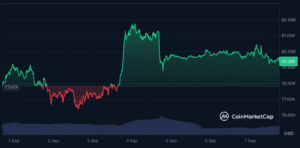
Bitcoin trades around $79,400. Reaching $100,000 before the end of December requires roughly 26% in under four months.
That is not an outlandish move by bitcoin’s standards. It has done considerably more in shorter periods. But the path has to run through a Federal Reserve that is being priced for a rate increase, and the year has already produced a 38% drawdown from October’s record.


The question is worth asking properly rather than answering with a target. Here is what the evidence actually supports.
Where bitcoin stands
Bitcoin closed above its 50-week moving average last week for the first time since November 2025, which is a genuine technical shift rather than a daily fluctuation.
That level had capped every rally attempt through the year. Clearing it on a weekly basis is the kind of signal that separates a bounce from a trend change, though it needs to hold rather than simply print once.
The token spent the weekend in a tight range after failing to break above $81,400, and slipped 1.3% on Monday. It sits roughly 38% below the all-time high of $128,198 recorded on 6 October 2025.
River now estimates that bitcoin represents about 1% of global money.
The prediction markets are split by timeframe
Two numbers from betting markets describe the position more precisely than any analyst target.
Polymarket prices a 72% chance that bitcoin finishes September above $82,500. That is a modest target, roughly 4% above current levels, and traders are reasonably confident about it.
Kalshi traders put the odds of bitcoin hitting $50,000 before $100,000 at under 16%. Read the other way, that implies roughly 84% confidence that six figures arrives before a return to $50,000.
Those two figures are not contradictory, and the distinction matters. The Kalshi contract has no deadline. It asks which level bitcoin touches first, not when. A market can be 84% confident bitcoin eventually reaches $100,000 while being far less confident it happens by December.
The honest reading is that prediction markets currently see bitcoin’s floor as more secure than its ceiling is close.
Institutional demand has returned
The flows tell a genuinely improved story compared with the first half of the year.
US spot bitcoin ETFs took $986.9 million in the week ending 5 September, completing their strongest three-week stretch of 2026 at $3.8 billion. Total net assets crossed $101 billion. Thursday alone brought $730.9 million, the largest single-day inflow since 14 January.
August delivered $3.5 billion, the best month since September 2025.
The caveat is the annual figure. Year-to-date net flows remain roughly $1 billion negative, which tells you how severe the earlier exodus was. Three weeks of heavy buying narrowed a deficit rather than building a surplus.
Sustained inflows at this pace would be the single most plausible mechanism for a move toward $100,000. Whether they continue is the question.
The Fed is the obstacle
Everything runs through monetary policy, and the near-term calendar is unhelpful.
Stronger-than-expected August employment data pushed rate-hike expectations sharply higher. Traders assigned roughly 58% odds to a September increase following the payrolls report, with some readings above 66%.
Three catalysts land before the decision. Producer prices arrive Thursday, consumer prices Friday, and the Treasury auctions reopened ten-year notes on Wednesday. The Federal Reserve meets on 15 and 16 September.
Higher rates raise the opportunity cost of holding an asset that pays nothing. That mechanism has driven bitcoin’s entire 2026, and a hike would make a 26% rally considerably harder to produce.
The war in Iran complicates it further by keeping energy prices elevated, which keeps inflation elevated, which keeps the Fed cautious.
What would have to happen
For bitcoin to reach $100,000 by December, several things need to align rather than just one.
The Fed would need to hold rather than raise, and ideally signal that tightening is finished. ETF inflows would need to sustain something close to the recent pace across the remaining months rather than arriving in three-week bursts. Bitcoin would need to hold above its 50-week moving average rather than losing it again. And no significant shock would need to intervene, which in a year that has produced the Coldcard exploit, a $320 million Liquid Network drain and an ongoing conflict is not a trivial condition.
Against that, the argument for the downside is straightforward. Momentum has stalled below $81,400. Rate-hike odds are rising. The CLARITY Act, which markets have repeatedly rallied on, now carries passage odds of 13 to 18% on Polymarket, and Senator Cynthia Lummis has warned that failure this term pushes market-structure legislation to 2030.
An honest answer
Bitcoin reaching $100,000 in 2026 is possible and not the base case.
The technical picture has improved, institutional demand has returned, and prediction markets are broadly confident the asset revisits six figures before it revisits $50,000. Those are real positives and they are recent.
But 26% in under four months, against a central bank that markets expect to tighten, with the year still running a net ETF outflow, requires more to go right than has been going right. The most likely outcome is a range somewhere between the current level and the low $90,000s, with $100,000 arriving in 2027 rather than December.
The useful things to watch are narrow. Whether the 50-week moving average holds on weekly closes. Whether ETF flows stay positive through the Fed meeting. And what Friday’s CPI print does to the September hike odds.
Anyone quoting a specific year-end number with confidence is guessing. The data supports a direction, not a destination.
FAQ
How far is bitcoin from $100,000?
Roughly 26%. Bitcoin trades around $79,400, about 38% below its all-time high of $128,198 from 6 October 2025.
What do prediction markets say?
Polymarket prices a 72% chance bitcoin ends September above $82,500. Kalshi traders put the odds of bitcoin hitting $50,000 before $100,000 at under 16%, implying confidence in the level eventually rather than by a specific date.
What is the main obstacle?
Interest rates. Traders assign roughly 58% odds to a September Fed increase after strong August employment data, with producer prices on Thursday and consumer prices on Friday preceding the 15-16 September meeting.
Disclaimer: This article is for informational purposes only and does not constitute financial advice. Cryptocurrency investments carry significant risk. Always conduct your own research before making any investment decisions.