
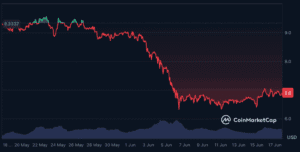
Avalanche is trading at approximately $6.93. The price represents a 23.81% decline over the past week and places AVAX firmly in extreme bearish sentiment territory across every major market analysis platform. The token has become one of the most-trending bearish narratives in crypto, with traders, analysts, and on-chain observers all positioning around the assumption that Avalanche’s structural decline is continuing.
The bearish positioning isn’t unjustified. The technical chart shows AVAX trading below every major moving average, with the 20 EMA at $7.37, the 50 EMA at $8.23, and the 200 EMA at $11.13. The stacked bearish configuration confirms a sustained downtrend that has lasted longer than most major crypto assets. Daily RSI at 34.23 confirms persistent bearish momentum without yet hitting deeply oversold territory that would suggest imminent reversal.


But while the price action and technical positioning tell one story, the on-chain data and adoption metrics tell another entirely. Avalanche’s real-world asset (RWA) transfer volume surged 3,810% over the past 30 days to $428.9 million. The total distributed asset value on the network grew over 27% to $914.6 million. BlackRock’s USD Institutional Digital Liquidity Fund accounts for over half of that total value, building on a network that the asset management industry has been quietly integrating into core operations.
And then there’s the FIFA World Cup integration. The Right-to-Buy ticketing layer on Avalanche generated over 60,000 transactions, spiking on-chain volume 24x and active addresses 10x ahead of the tournament opening on June 11, 2026. The biggest sporting event in the world is running its ticketing infrastructure on Avalanche, and the price is approaching levels not seen in years.
The disconnect between Avalanche’s fundamental adoption story and its price action is approaching the kind of extreme that historically marks mispriced assets. Whether this represents a generational entry point for a token with genuine structural use cases or another value trap where the bearish positioning is justified depends on factors that the chart alone can’t reveal.
The Technical Picture That Justifies the Bears
The bearish case for AVAX has strong technical foundations that deserve honest examination.
The daily chart shows AVAX trading below all three major moving averages in a stacked bearish configuration. When price trades beneath the 20, 50, and 200 EMAs simultaneously, with each higher MA serving as resistance, the technical structure indicates sustained downward momentum that takes time to reverse. The configuration has persisted for months, suggesting the bearish trend has institutional staying power rather than being a temporary correction.
The 200 EMA at $11.13 represents the longer-term price magnet that AVAX would need to recover to signal a genuine trend reversal. From the current $6.93 level, that’s approximately 60% upside required just to reclaim the long-term moving average. The gap between current price and the 200 EMA reflects how far AVAX has fallen and how much work the recovery would require.
Volume analysis supports the bearish positioning. Trading volumes during the recent decline have been relatively low, suggesting that the move down has been driven by lack of buying interest rather than aggressive selling pressure. Low-volume declines can be persistent because they don’t create the kind of capitulation events that mark cycle bottoms. Without significant buying volume to absorb the supply, AVAX could continue grinding lower without producing the V-shaped recovery that more dramatic capitulation might enable.
The Fear and Greed Index at 23 places AVAX in fearful territory but not extreme fear. The lack of extreme fear means traders haven’t fully capitulated yet. Historically, the strongest contrarian buying signals come at extreme fear levels of 10 or below. AVAX’s current sentiment isn’t there yet, suggesting more downside might be required before the truly contrarian setup emerges.
Bitcoin dominance near 56.5% creates a risk-off environment that works against altcoin recoveries broadly. When Bitcoin captures more of the total crypto market cap, capital is concentrating in BTC rather than spreading across altcoins. AVAX as a higher-beta altcoin faces structural headwinds in this environment that persist regardless of token-specific factors.
The token unlock schedule continues releasing approximately 0.23% of total AVAX supply on regular intervals. These unlocks represent ongoing dilution that requires sustained buying pressure to absorb. In bearish market conditions, unlocks often correlate with downward price pressure as recipients realise liquidity.
The Fundamental Story That Bears Are Ignoring
While the technicals support bearish positioning, the fundamental adoption story for Avalanche has been quietly building one of the most substantive real-world use cases in crypto.
The FIFA World Cup integration is the most visible example. FIFA chose Avalanche to power its Right-to-Buy ticketing system for the 2026 World Cup, the biggest sporting event in the world. The integration generated 60,000+ transactions during the tournament’s opening week, spiked on-chain volume 24 times, and increased active addresses 10x compared to baseline levels. The activity represents real users completing real transactions for tickets to actual events.
The FIFA partnership matters beyond the immediate volume impact. Major global sporting organisations evaluating blockchain partnerships now have a concrete example of Avalanche delivering institutional-scale infrastructure for high-profile use cases. The MLB, NBA, NFL, NHL, NCAA, and various international sporting bodies have all been exploring blockchain integration for ticketing, fan engagement, and merchandise. Avalanche’s FIFA delivery becomes a reference case for those evaluations.
The RWA growth is even more substantial. Tokenised real-world assets on Avalanche reached $428.9 million in transfer volume over the past 30 days, growing 3,810% over the period. Total distributed asset value crossed $914.6 million. These aren’t speculative DeFi assets but rather tokenised representations of traditional financial instruments including Treasury funds, corporate bonds, and structured products.
BlackRock’s USD Institutional Digital Liquidity Fund (BUIDL) accounts for over half of the distributed value on Avalanche. The world’s largest asset manager has chosen Avalanche as primary infrastructure for its institutional tokenisation strategy. This isn’t a small pilot. It’s a meaningful percentage of BlackRock’s $11 trillion AUM being processed on Avalanche infrastructure.
VanEck has filed for an Avalanche spot ETF, joining the growing list of institutional ETF products targeting the network. While the ETF approval timeline remains uncertain, the filing itself demonstrates institutional confidence in AVAX as an investment vehicle.
JP Morgan and Citi have both built integrations with Avalanche for various tokenisation and settlement use cases. The bank-level engagement provides credibility that few other Layer 1 networks can match.
These adoption metrics tell a story that’s almost diametrically opposed to the price action. Avalanche is being chosen by the largest institutions in the world for the most important real-world use cases in crypto. The price keeps falling. The disconnect is the kind of pattern that occasionally precedes major reversals.
What’s Causing the Disconnect
The gap between Avalanche’s fundamental story and its price action reflects several specific dynamics that traders should understand.
Token economics matter significantly. The continuing token unlocks introduce regular supply that requires sustained demand to absorb. Even strong fundamental adoption can produce poor price action if new supply consistently outpaces demand growth. The token unlock dynamics are mechanical and persistent, affecting AVAX regardless of how impressive the adoption story becomes.
Value accrual to the AVAX token specifically is the deeper challenge. Many of the institutional integrations with Avalanche don’t require holders to buy AVAX. BlackRock’s BUIDL fund operates on Avalanche infrastructure but doesn’t drive direct AVAX demand from BlackRock or from users who invest in the fund. The FIFA ticketing integration similarly operates on Avalanche but doesn’t necessarily generate AVAX buying pressure proportional to the volume processed.
The Layer 1 wars have shifted in ways that have affected AVAX positioning. Solana has captured significant institutional attention and price performance throughout 2025-2026. Base has become the preferred Layer 2 for many institutional integrations. XRP Ledger has secured major bank partnerships. Each of these competing networks has been gaining mindshare that AVAX might otherwise have captured.
The Avalanche brand suffers from the perception that the network peaked during the 2021-2022 cycle and has been struggling to define its position since. The fundamental case for Avalanche has actually been improving substantially, but market perception lags fundamentals significantly. Many investors who tracked AVAX during its previous peak have moved their attention elsewhere, missing the institutional adoption story.
The Swiss and US regulatory investigations into Avalanche-based FIFA tokens add uncertainty that affects sentiment. While the investigations don’t directly threaten the underlying network, they create a regulatory overhang that some investors find concerning. Resolution of these investigations could remove the overhang, but the timing remains uncertain.
The Contrarian Setup
For investors willing to look past the bearish sentiment and technical positioning, AVAX presents a setup that combines specific elements historically associated with significant reversals.
The fundamental adoption is real and growing. BlackRock’s BUIDL fund running on Avalanche, FIFA World Cup ticketing processing 60,000+ transactions, $914.6 million in distributed asset value, and bank-level integrations with JP Morgan and Citi all represent durable adoption that isn’t going away regardless of price action. The fundamental case for Avalanche has rarely been stronger.
Technical positioning is oversold but not extreme. Daily RSI at 34.23 indicates persistent bearish momentum but isn’t yet at extreme oversold levels. If broader market sentiment improves and crypto enters a recovery phase, AVAX has room to bounce sharply from current levels. The asymmetric risk-reward favours patient buyers who can wait for broader market improvement.
Sentiment is at yearly lows. When the entire crypto market gives up on a token, the conditions for major upside reversal start to form. The “most-trending bearish narrative” positioning is exactly the kind of crowded short trade that gets unwound violently when sentiment shifts.
The catalyst pipeline is substantial. The FOMC outcome today, the CLARITY Act vote this week, the June 19 Iran peace deal signing, and the broader crypto recovery thesis all could provide tailwinds that lift AVAX along with other oversold altcoins. VanEck’s pending Avalanche ETF, additional institutional integrations, and resolution of regulatory investigations all represent potential token-specific catalysts.
The price levels matter. If AVAX holds the $6.32-$6.55 support zone, the technical setup for a relief rally toward $8.00 emerges. A break below $6.25 invalidates the contrarian thesis and opens lower targets. The asymmetric risk-reward favours waiting for confirmation of support before sizing positions aggressively.
The comparison to XRP at $1.10 (which we wrote about as “the most mispriced token in crypto”) provides a framework for thinking about AVAX. Both tokens showed extreme disconnects between institutional infrastructure and price action. XRP has recovered to $1.28. AVAX hasn’t yet, but the structural setup is similar.
How to Play This
For investors evaluating AVAX exposure at current levels, several specific approaches make sense based on time horizon and risk tolerance.
For long-term investors with multi-year horizons, the current levels represent attractive accumulation territory if you believe in the institutional RWA thesis. AVAX as the infrastructure for BlackRock’s BUIDL fund and FIFA’s ticketing system has structural use cases that don’t disappear regardless of price action. Dollar-cost averaging into positions over the coming weeks captures the asymmetric upside if sentiment reverses while limiting downside if the bearish trend extends.
For traders with shorter horizons, the technical setup argues for waiting. The stacked bearish moving averages haven’t broken. The Fear and Greed Index hasn’t reached extreme territory. Until either AVAX shows clear technical reversal signals (reclaiming the 20 EMA at $7.37, then the 50 EMA at $8.23) or broader market sentiment shifts dramatically, positioning long carries more risk than waiting for confirmation.
For investors looking at AVAX as a portfolio addition, the current levels offer meaningful diversification from Bitcoin and Ethereum-focused crypto exposure. AVAX’s correlation with major crypto assets has been high during the recent decline, but the fundamental drivers are sufficiently different that AVAX could decouple if institutional RWA adoption accelerates while broader crypto remains range-bound.
For investors who already hold AVAX through the recent decline, the question is whether to add to losing positions or maintain current exposure. Adding at current levels makes sense if the fundamental thesis remains intact. Maintaining without adding represents holding through volatility while waiting for broader confirmation. Either approach is more defensible than selling at current levels, which locks in losses without capturing potential upside.
The longer-term Avalanche thesis depends on whether the institutional RWA growth translates into sustained AVAX demand. If BlackRock continues expanding its tokenisation operations on Avalanche, if FIFA and other major partners continue using the network, if the regulatory investigations resolve favourably, and if VanEck’s ETF gets approved, the conditions for substantial recovery exist. If these catalysts disappoint, AVAX could remain range-bound or continue lower despite strong fundamentals.
The bearish positioning may be justified by the immediate technical picture. The contrarian opportunity is what the fundamental picture suggests. The market will eventually resolve which interpretation is correct.
FAQ
Why is Avalanche sentiment so bearish?
AVAX trades at $6.93, below every major moving average (20 EMA $7.37, 50 EMA $8.23, 200 EMA $11.13), in a stacked bearish configuration. The token has declined 23.81% over the past week and reached yearly sentiment lows. Bitcoin dominance near 56.5% creates a risk-off environment for altcoins. Continuing token unlocks add supply pressure. The combination has made AVAX one of the most-trending bearish narratives in crypto.
What’s the fundamental case for AVAX?
Avalanche has become institutional infrastructure for major real-world use cases. BlackRock’s USD Institutional Digital Liquidity Fund (BUIDL) accounts for over half of the $914.6 million in distributed asset value on Avalanche. Real-world asset transfer volume surged 3,810% to $428.9 million in the past 30 days. FIFA chose Avalanche to power World Cup ticketing, generating 60,000+ transactions. JP Morgan and Citi have integrations. VanEck filed for an Avalanche spot ETF.
Is AVAX at $6.93 a buying opportunity?
The fundamental adoption story contrasts sharply with bearish price action, creating conditions historically associated with significant reversals. However, technical positioning hasn’t reached extreme oversold levels, sentiment hasn’t reached extreme fear, and value accrual to AVAX from institutional integrations remains imperfect. For long-term investors with multi-year horizons, current levels offer attractive accumulation territory. For traders with shorter horizons, waiting for technical confirmation reduces risk.
Disclaimer: This article is for informational purposes only and does not constitute financial advice. Cryptocurrency investments carry significant risk. Always conduct your own research before making any investment decisions.