Dollar stablecoins dominated crypto. Europe is quietly testing the euro version.
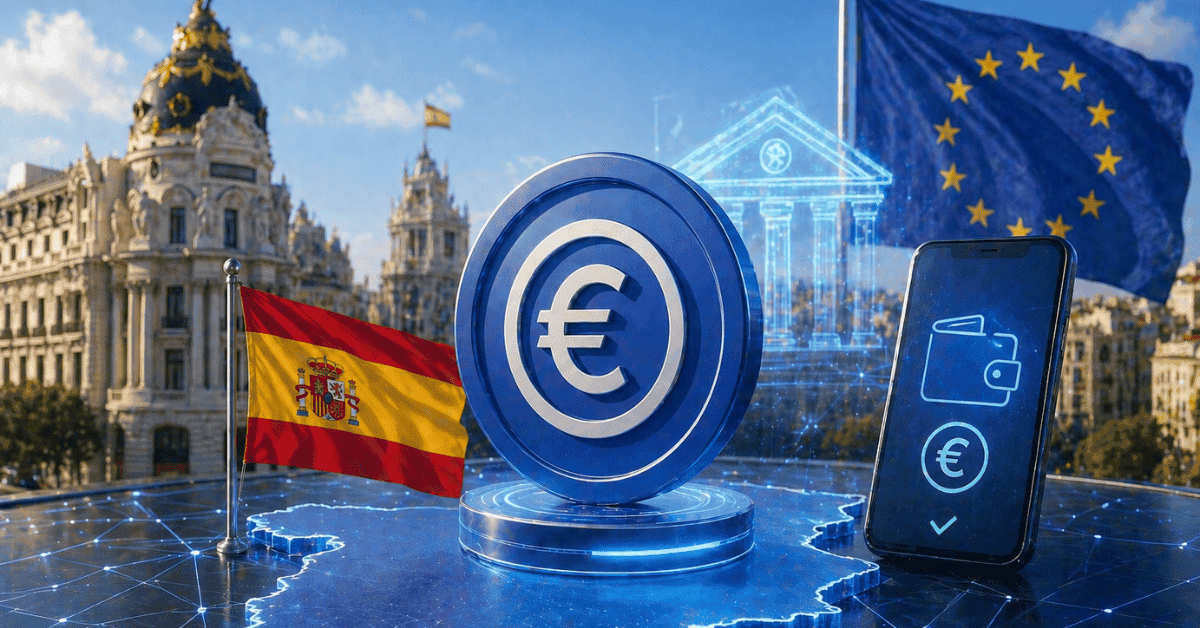
Spain has emerged as the strongest retail market in Europe for Circle’s euro-backed stablecoin EURC, according to Brighty data cited by Cointelegraph. The data showed Spain accounted for around 36% of EURC transactions and 25% of EURC volume on Brighty in 2025 and the first quarter of 2026, putting it ahead of other European markets.


That may sound like a niche datapoint, but it matters because stablecoin adoption is usually discussed through a dollar lens. USDT and USDC dominate global crypto liquidity, exchange trading pairs and dollar-based settlement. Euro stablecoins remain much smaller, but Spain’s retail usage suggests a different adoption story may be developing inside Europe.
Spain Is Showing What Euro Stablecoin Usage Could Look Like
The interesting part of the Brighty data is not just that Spain led Europe. It is how people appear to be using EURC.
Cointelegraph’s report, as mirrored by Coinness, said the average EURC payment in Spain was around 49 euros, or about $57. That points toward small-value retail payments rather than only large institutional transfers or exchange settlement.
That is important because euro stablecoins need a different use case from dollar stablecoins. Dollar tokens already dominate crypto trading, offshore liquidity and DeFi collateral. A euro token is less likely to beat USDT or USDC on global exchange depth overnight. Its stronger opening may be ordinary euro-denominated payments, payroll, savings-like balances and cross-border transfers inside Europe.
In that context, Spain becomes a useful test case. If a euro stablecoin can find retail traction in one large European market, other countries may follow, especially where users want digital euro exposure without constantly converting into dollars.
EURC Has a MiCA Advantage
EURC’s regulatory status is a major part of the story.
Circle describes EURC as a euro-backed stablecoin that is redeemable one-to-one for euros and issued under a full-reserve model. Circle also says EURC is MiCA-compliant and available across networks including Avalanche, Base, Ethereum, Solana and Stellar.
That matters because Europe’s Markets in Crypto-Assets regulation has changed the stablecoin landscape. MiCA created clearer rules for stablecoin issuers, reserve backing and authorisation requirements. That clarity can make compliant euro stablecoins more attractive to platforms that want to serve European users without regulatory uncertainty.
MiCA does not automatically guarantee adoption. Regulation can make a product safer and more acceptable to institutions, but it can also make issuance and distribution more complex. Still, EURC has a cleaner European story than many offshore stablecoins because it is built around the euro and designed for the EU rulebook.
Dollar Stablecoins Still Dominate the Market
The euro stablecoin story should not be overstated.
Dollar stablecoins remain overwhelmingly dominant. Even European regulators have acknowledged the imbalance. Spain’s CNMV has argued for a stronger euro stablecoin presence, warning that dollar-backed stablecoins still make up nearly all of the market and that Europe needs credible euro-denominated alternatives.
That dominance exists for practical reasons. Crypto markets are priced mostly in dollars, the deepest trading pairs are dollar-based and global investors are used to treating dollar stablecoins as crypto’s main cash layer. For many users, USDT and USDC are not just stablecoins. They are the default settlement currency of the industry.
Euro stablecoins therefore face a liquidity challenge. A user may prefer euros for spending, accounting or salary, but still need dollars for trading. Until euro pairs become deeper across exchanges and DeFi platforms, EURC and similar tokens may remain strongest in payments rather than speculative market activity.
Banks Are Also Watching the Euro Stablecoin Opening
Spain’s role is also interesting because European banks are moving into the stablecoin conversation.
A consortium of European banks, including CaixaBank, ING and UniCredit, announced plans in 2025 to launch a euro-backed stablecoin in the second half of 2026 under MiCA rules. The project is designed to support low-cost cross-border payments and digital asset settlement, while strengthening Europe’s role in digital payments.
That shows the euro stablecoin market is not only a crypto-native experiment. Banks, fintechs and regulators are all watching whether tokenised euros can become useful payment infrastructure.
For Circle, Brighty and other crypto-first companies, the opportunity is to move faster than banks. For banks, the opportunity is to bring trust, licensing and existing customer relationships into tokenised money. Spain’s early EURC usage gives both sides a live market to study.
Why Retail Payments Matter
Retail payment data can be more revealing than exchange volume.
Exchange volume tells us where traders are active. Retail payment activity tells us whether people are actually willing to use a stablecoin like money. If Spanish users are making small EURC payments through Brighty, that suggests euro stablecoins may have a practical role beyond trading.
That does not mean EURC is about to replace card payments or bank transfers. Europe already has strong payment infrastructure, and consumers do not adopt new payment methods just because they are crypto-based. The product has to be faster, cheaper, easier or more useful across borders.
But euro stablecoins could become attractive in specific situations: freelancers paid across borders, crypto users who want euro exposure, merchants serving international customers, and consumers who want blockchain-based transfers without taking dollar currency risk.
The Bigger Stablecoin Shift
Spain’s EURC activity is a small signal inside a much bigger market, but it points to where stablecoins may go next.
The first stablecoin era was about dollars. USDT and USDC became the crypto market’s settlement layer because traders needed a digital dollar. The next era may be more regional. Europe may develop euro stablecoins, Asia may experiment with local currency tokens and banks may issue regulated versions of tokenised deposits or stablecoin-like products.
That would make stablecoins less of a one-currency story and more of a payments infrastructure story.
Spain is not proving that euro stablecoins have already won. It is proving that there is real-world demand worth watching. Under MiCA, Europe now has clearer rules, local currency needs and growing institutional interest.
For now, dollar stablecoins still dominate crypto. But Spain’s EURC usage shows that Europe may be quietly building a different version of the stablecoin market, one small euro payment at a time.
Disclaimer: This article is for informational purposes only and does not constitute financial, investment, or legal advice. Always conduct your own research before making any investment decisions.