
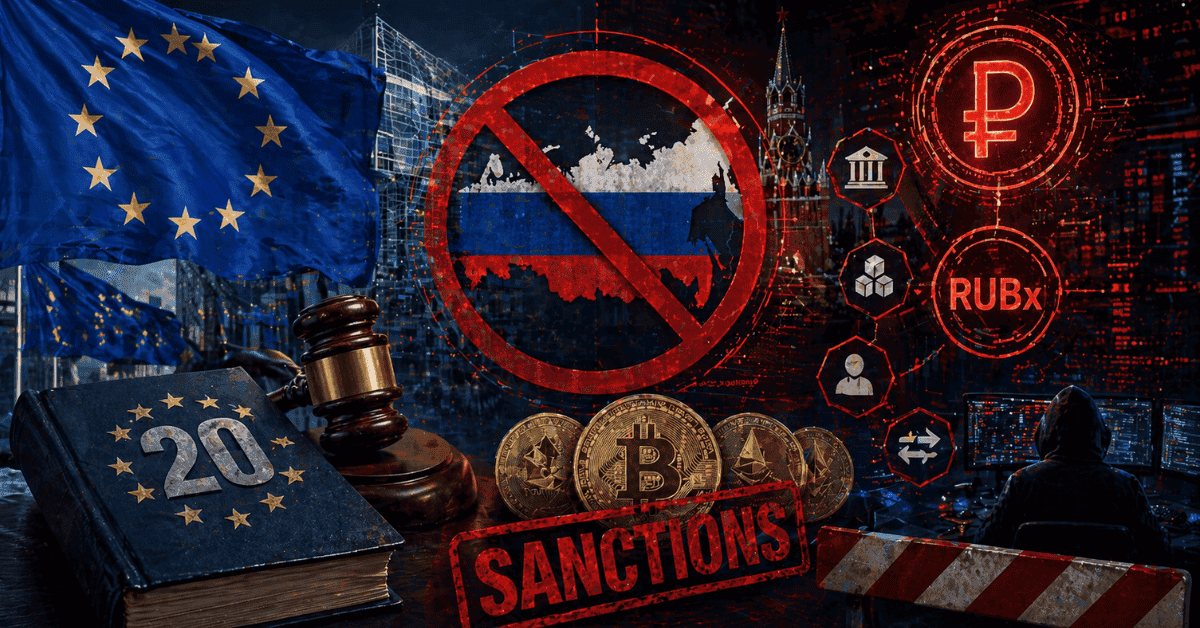
The European Union has adopted its 20th sanctions package against Russia, and this time crypto is not a side issue. It is one of the main enforcement targets.
The new package introduces a sectoral ban on transactions with Russian crypto-asset service providers, while also adding Russia-linked digital assets to the EU’s sanctions framework. That includes RUBx, a ruble-backed crypto asset, and Russia’s digital ruble, the central bank digital currency being developed by the Bank of Russia.


For EU firms, exchanges, wallet providers, fintechs and compliance teams, the message is direct. Russia-linked crypto rails are now being treated as part of the broader sanctions-evasion infrastructure that Brussels wants to shut down.
What the New Crypto Restrictions Cover
Russian Crypto Providers Are Now Off Limits
The 20th sanctions package includes a broad ban on EU persons and entities carrying out transactions with Russian crypto-asset service providers. This means EU residents, companies and regulated financial actors are barred from dealing with Russian crypto platforms that fall within the scope of the measures.
That is a major escalation from earlier sanctions focused on specific wallets, exchanges or individual entities. Instead of only naming bad actors one by one, the EU is moving toward a sector-wide restriction on Russia’s crypto service layer.
The goal is to reduce Moscow’s ability to use crypto platforms for cross-border settlement, capital movement and sanctions circumvention. It also raises compliance expectations for exchanges outside the EU that may still touch Russian or Belarusian platforms.
RUBx and the Digital Ruble Are Explicitly Targeted
The package also bans transactions involving RUBx and prohibits EU support for the development of the digital ruble.
That second point is especially notable because the digital ruble is not yet a major retail payment system. By targeting it now, the EU is acting preemptively. Brussels appears to be saying that Russia’s central bank digital currency could become a sanctions-evasion tool before it reaches full scale.
RUBx is more immediately tied to the ruble-linked crypto ecosystem. By placing RUBx alongside other prohibited crypto assets, the EU is making clear that stablecoins and tokenized fiat instruments can be treated as sanctions infrastructure when they are linked to Russia’s financial system.
Why A7A5 Still Matters
Ruble Stablecoins Have Become a Sanctions Concern
The EU’s latest move comes after earlier action against A7A5, another ruble-backed stablecoin ecosystem that has been tied to Russian sanctions evasion concerns.
Chainalysis says A7A5 and related infrastructure helped process $93.3 billion in volume in less than a year. That scale explains why Western regulators have become increasingly focused on ruble-linked stablecoins. These assets can make it easier to move value between Russian users, offshore exchanges, stablecoins such as USDT and eventually fiat currency.
A7A5’s growth showed that crypto can become a practical settlement layer for sanctioned actors, especially when banks are cut off from normal correspondent relationships. RUBx and the digital ruble are now being treated through that same risk lens.
Third-Country VASPs Face More Pressure
The new sanctions also increase risk for virtual asset service providers outside the EU. Chainalysis warned that exchanges in third countries, especially in Central Asia, the Caucasus and the UAE, may face closer scrutiny if they handle ruble-linked stablecoins or serve as bridges for Russian flows.
That is one of the most important parts of the story. EU sanctions do not only affect European firms. They can also reshape global compliance behavior because exchanges that want access to European banking, liquidity or counterparties may avoid risky ruble-linked activity altogether.
For regional exchanges, the question becomes simple: is supporting Russia-linked crypto liquidity worth the regulatory exposure?
The Digital Ruble Ban Is a Preemptive Strike
CBDCs Are Now in the Sanctions Conversation
The digital ruble is Russia’s planned central bank digital currency. Like other CBDCs, it is designed to be a state-issued digital version of national money. In normal circumstances, that would make it a payment modernization project.
In the sanctions context, however, the EU sees a different risk. A state-controlled digital currency could help Russia build payment channels that are harder for Western banks to monitor or block.
That is why the EU’s ban on support for digital-ruble development matters. It signals that central bank digital currencies are no longer just a monetary-policy or payment-technology topic. They are now part of sanctions strategy.
The Ban Could Shape Future CBDC Policy
The measure may also influence how other jurisdictions view hostile-state CBDCs. If a sanctioned country builds a state-controlled digital payment system, regulators may treat technical support, integration work, wallet infrastructure and liquidity services as sanctions-sensitive activity.
That could have wider consequences. Crypto firms and fintech providers may need to assess not only which tokens they list, but also whether their software, APIs or infrastructure could support a sanctioned CBDC ecosystem.
Why This Matters for Crypto Compliance
The EU’s 20th sanctions package shows how quickly crypto compliance is becoming more complex. It is no longer enough for exchanges to screen only obvious sanctioned addresses.
Firms now need to monitor service providers, ruble-linked stablecoins, DeFi platforms, cross-chain flows, liquidity pools and counterparties in high-risk jurisdictions. The risk is especially high where Russian users can move from rubles into stablecoins and then into global crypto markets.
This is why blockchain analytics firms are calling the package a new phase of crypto enforcement. Regulators are no longer treating illicit crypto flows as isolated wallet problems. They are looking at entire ecosystems that support sanctioned finance.
What Comes Next
The next key issue is implementation guidance. EU firms will need clarity on how to identify prohibited Russian crypto providers, how to treat indirect exposure through DeFi, and what due diligence is expected when counterparties operate in third countries.
Enforcement actions will be the second signal. If Brussels moves against exchanges handling ruble-linked stablecoins in Central Asia, the Caucasus or the UAE, it would show that the EU intends to police not only European activity but also offshore routes into Russian crypto liquidity.
The third signal is how Russia responds. If RUBx, A7A5 or digital-ruble infrastructure shifts to new exchanges, new chains or new intermediaries, compliance teams will need to follow the flows quickly.
For now, the EU has made its direction clear. Crypto rails are part of the sanctions battlefield, and ruble-linked digital assets are now firmly inside Europe’s enforcement perimeter.
Disclaimer: This article is for informational purposes only and does not constitute financial, investment, or legal advice. Always conduct your own research before making any investment decisions.