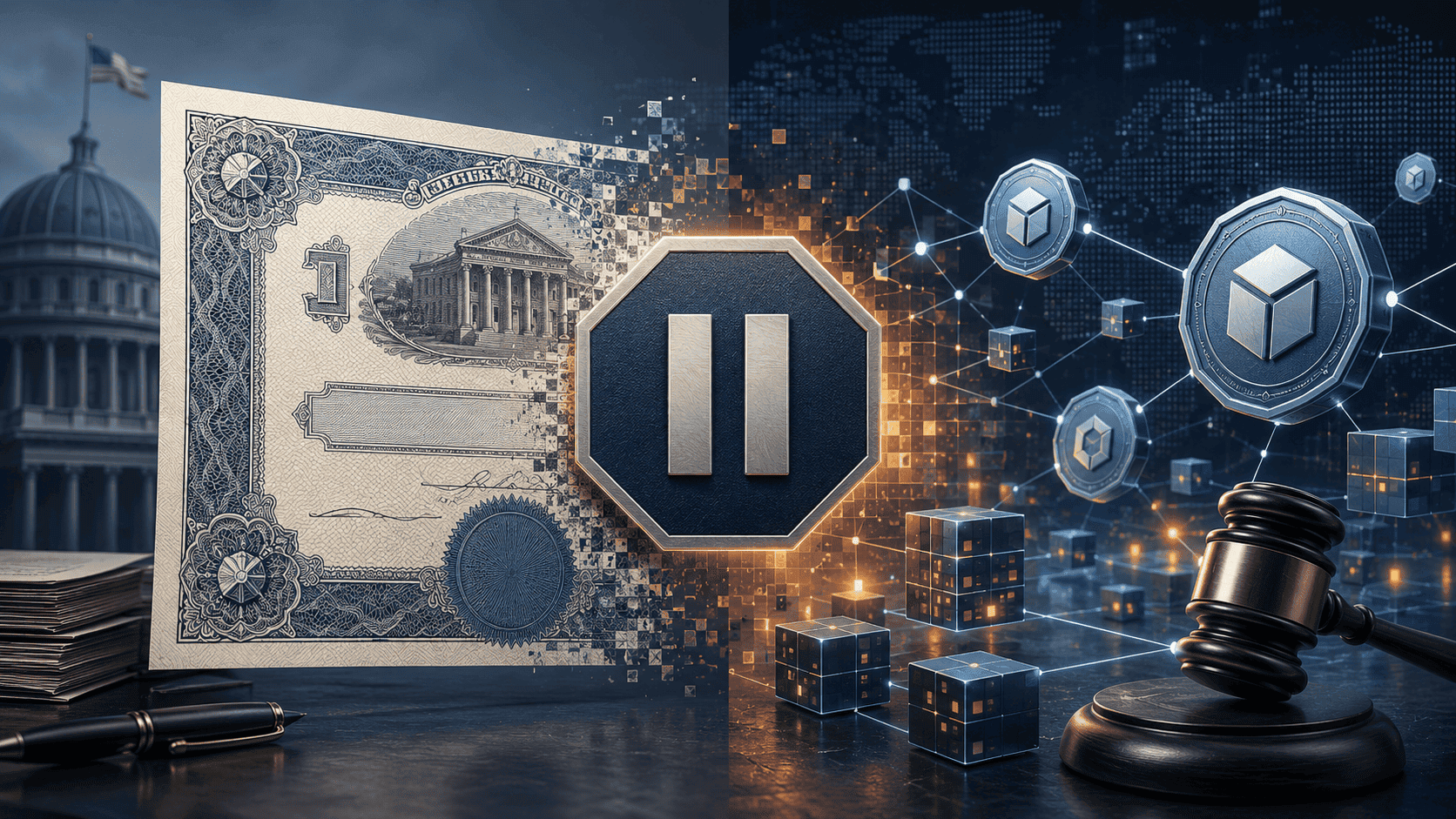
The Securities and Exchange Commission was days away from publishing one of the most significant regulatory proposals in crypto history. A framework that would have allowed US firms to trade tokenized versions of stocks on the blockchain, creating a regulated bridge between traditional equities and on-chain markets.
Then it stopped. The SEC indefinitely shelved the proposal after internal reviews and meetings with stock exchange officials raised concerns that the framework could create serious problems for public companies.


The central issue is straightforward. Under the draft proposal, third parties could tokenize a public company’s shares and trade them on blockchain platforms without that company’s knowledge or approval. Imagine waking up one morning to discover that someone has created a digital version of your company’s stock and is trading it on an exchange you’ve never heard of. You can’t track who holds it. You can’t distribute dividends to the token holders. You can’t count their votes at shareholder meetings.
That’s the scenario that alarmed former regulators, stock exchange operators, and corporate governance experts enough to convince the SEC to pull back.
What the Proposal Would Have Done
SEC Chair Paul Atkins had signalled for weeks that the agency was preparing to debut what he called an “innovation exemption” for on-chain equities. The framework would have functioned as a regulatory sandbox, allowing crypto firms to trade tokenised versions of US stocks under specific conditions.
Under the draft rules, platforms offering tokenised equities would need to guarantee that token holders receive the same rights as traditional shareholders: dividend payments, voting access, and legal protections. The idea was to bring the benefits of blockchain, 24/7 trading, instant settlement, and fractional ownership, to the stock market without compromising investor rights.
The SEC’s Investor Advisory Committee formally recommended a tokenisation framework on March 12, creating institutional pressure for the agency to act. SEC staff had been preparing to publish the proposal as soon as this week. Everything was on track.
Then the meetings with stock exchange officials happened. And the problems became impossible to ignore.
The Third-Party Token Problem
The sticking point that derailed the proposal centers on what regulators call “third-party tokens,” digital versions of company shares created and traded without the issuing company’s consent.
This isn’t a hypothetical concern. Platforms like Hyperliquid and Ondo Global Markets already offer synthetic or tokenized versions of traditional equities. SpaceX pre-IPO contracts trade on multiple platforms. The practice exists today in a regulatory grey area.
The problems this creates for public companies are numerous and practical. If tokenized shares exist on a blockchain that the company doesn’t control, the company has no way to verify who actually holds them. That makes distributing dividends extremely complicated since you can’t pay dividends to people you can’t identify. Shareholder voting becomes equally chaotic since tokens trading on pseudonymous blockchain platforms can’t easily be reconciled with the company’s official share registry.
There’s also a proliferation risk. Multiple platforms could independently tokenize the same company’s shares, creating competing versions of the same stock trading on different blockchains with potentially different prices. The governance and compliance headaches multiply with each additional platform.
Tom Farley, CEO of crypto exchange Bullish, said the SEC appeared to be recognizing that only public companies themselves should be permitted to issue blockchain-based versions of their shares. That “issuer model” would solve most governance problems, but it would also dramatically narrow the scope of the exemption and slow the pace of tokenized stock adoption.
Michael Burry Thinks the Whole Thing Should Be Stopped
The opposition isn’t limited to procedural concerns. Some prominent voices are questioning whether tokenized stocks should exist at all.
Michael Burry, the investor made famous by The Big Short for predicting the 2008 financial crisis, warned last week that the SEC’s tokenization push could trigger what he described as a “Snow Crash” scenario, a reference to the dystopian Neal Stephenson novel in which the virtual and real economies merge in chaotic ways.
Burry’s concern is that tokenizing stocks without adequate safeguards could fragment market structure, create new forms of manipulation, and ultimately harm the investors the SEC is supposed to protect. Whether his fears are justified or exaggerated, the fact that one of the most famous contrarian investors in history is publicly opposing the framework gives political cover to regulators who want to slow things down.
Not everyone agrees. Commissioner Hester Peirce, who has consistently pushed for more crypto-friendly regulation, defended the proposal’s narrow scope. She wrote on X that any exemption she expected would be “limited in scope and would facilitate trading only of digital representations” of equity securities that already trade in public secondary markets, not synthetics or entirely new financial products.
The distinction between “digital representations” of existing stocks and “synthetic” versions of those stocks is crucial. Peirce’s framing suggests the SEC may eventually approve a narrower version of the exemption that only covers company-approved tokenization, not the open-ended third-party model that triggered the delay.
What This Means for the Tokenisation Market
The delay doesn’t kill tokenized equities. But it slows them down significantly in the US.
Companies that had been preparing to launch tokenized asset projects under the anticipated framework are now in limbo. Ondo Global Markets already offers over 100 tokenized US equities, but regulatory clarity would have dramatically expanded the addressable market. Prometheum, which describes itself as a blockchain-native broker-dealer, said the delay undermines its plans to bring tokenized securities to mainstream distribution through traditional Wall Street channels.
The broader tokenization market continues to grow regardless. Tokenized US Treasuries have crossed $14 billion. BlackRock is building tokenized fund products on Ethereum. JPMorgan settled tokenized Treasury redemptions on the XRP Ledger. The total RWA market exceeds $30 billion. None of that activity depends on the SEC’s stock tokenization exemption.
But stocks are the prize that matters most. The US equity market is worth over $50 trillion. Even capturing a fraction of that market through blockchain-based trading would dwarf every other tokenization use case combined. The SEC’s delay keeps that prize out of reach for now.
The Risk of Falling Behind
The SEC’s own Investor Advisory Committee’s recommendation remains on the record, creating institutional tension between the committee’s endorsement and the staff-level hold that blocks action.
Meanwhile, international competitors aren’t waiting. The EU’s MiCA regulation provides a structured path for tokenized financial products. The UK’s FCA regulatory sandbox is actively processing proposals for tokenized securities. Singapore, Switzerland, and Abu Dhabi all have frameworks in place.
If the US delays too long, the innovation moves offshore. Developers, companies, and investors who want to build and trade tokenized stocks will go wherever the rules allow. By the time the SEC resolves its concerns about third-party tokens and shareholder voting, the rest of the world may already have established the standards and captured market share.
Carlos Domingo, a tokenization industry executive, took a more measured view. He wrote on X that delaying was better than getting the framework wrong and “unleashing all sorts of problems.” That’s a reasonable position. But the gap between “getting it right” and “never getting it done” is one that regulators don’t always navigate successfully.
The SEC has not scheduled any public rulemaking or open meeting on tokenized securities. The delay is officially indefinite. For an industry that was counting on regulatory progress to unlock the next phase of growth, an indefinite timeline is the worst possible outcome.
Disclaimer: This article is for informational purposes only and does not constitute financial advice. Cryptocurrency investments carry significant risk. Always conduct your own research before making any investment decisions.