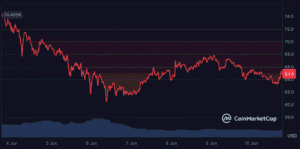
Solana is trading near $64.17 on June 10, down about 13% over the past week, with a market cap of $37.2 billion holding the number 7 spot. The price chart is ugly. The 24-hour low touched $63.92, just above the $62 level that analysts are watching as the last major support before a deeper slide.
The price says fear. The institutional pipeline says the opposite.


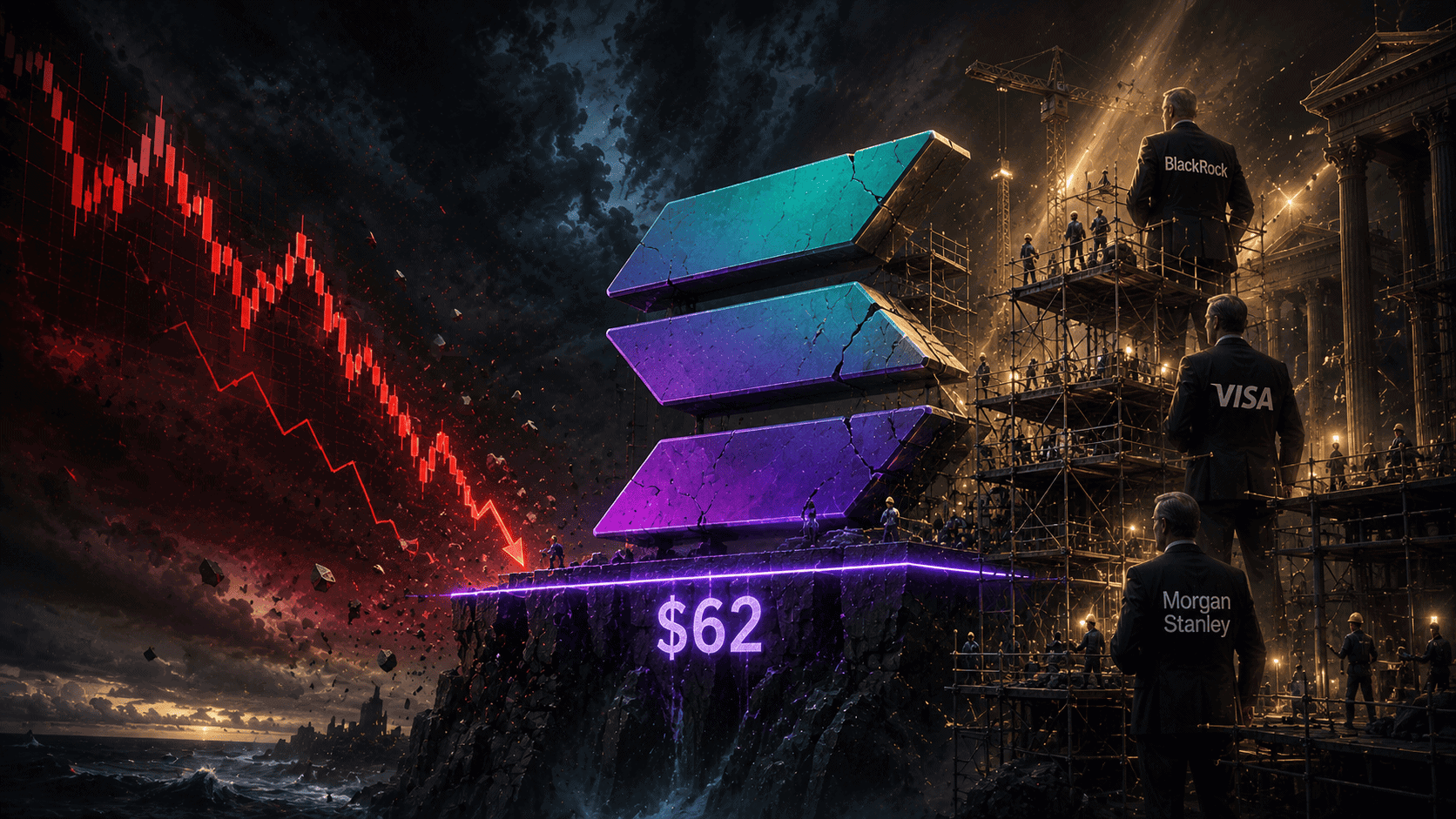
While SOL bleeds toward cycle lows, the roster of institutions building on Solana keeps growing. Reports this week highlighted BlackRock and Visa moving into the Solana ecosystem, the latest steps in a trend that includes spot Solana ETFs surpassing $1 billion in assets, Morgan Stanley filing for its own Solana trust, and Galaxy Digital tokenising its SEC-registered stock directly on the chain.
The disconnect is stark. The asset is down by half from its highs, and the institutional infrastructure around it has never been bigger. Solana is living the same contradiction as Ethereum: a network with growing adoption and a token with a collapsing price. The question for SOL holders is whether the institutions or the chart are right about where this goes next.
The $62 Line Is the One That Matters
Solana’s technical picture has deteriorated to a critical level.
SOL failed to hold above $67 and corrected sharply, breaking below $66 and $65 to enter a short-term bearish zone. The price moved below the 50% Fibonacci retracement of the upward wave from the $60.12 swing low to the $67.90 high, and broke a bullish trend line with support at $66 on the hourly chart. Each of those breaks confirmed that sellers control the short-term direction.
The immediate support is $62. That’s the level analysts are watching after this week’s slide, with the 24-hour low near $63.92 sitting just above it. If $62 holds, SOL has a chance to stabilise and attempt a recovery. If it breaks, the next support sits lower with limited historical buying activity to slow a decline.
Reclaiming $65 and holding above the key moving averages would be the first sign of stabilisation. Beyond that, $70 is the bigger test. SOL needs to push back above $70 to signal that the immediate downtrend has broken and a recovery is underway. Until then, every bounce is a relief rally within a continuing decline.
The RSI has been among the most oversold of any major token in 2026, touching levels that historically precede at least a short-term bounce. But in the current macro environment, with Bitcoin testing $60,000 and the CPI report dropping today, oversold signals have been failing to produce sustained recoveries. SOL’s direction is tied almost entirely to whether the broader market stabilises.
The Institutional Roster Keeps Growing
Here’s what makes Solana’s price decline so jarring against its fundamentals.
Spot Solana ETFs have surpassed $1 billion in assets under management. That milestone, reached during one of the worst stretches for crypto in 2026, demonstrates that institutional demand for regulated SOL exposure is real and growing even as the price falls. Morgan Stanley filed for its own Solana trust, adding another major Wall Street name to the list of issuers building SOL products.
BlackRock and Visa both moved into the Solana ecosystem this week. BlackRock, the world’s largest asset manager, has been expanding its tokenisation efforts across multiple blockchains, and its involvement with Solana signals that the network is being taken seriously as institutional infrastructure. Visa, the global payments giant, has been building stablecoin settlement capabilities and sees Solana’s speed and low costs as advantages for payment applications.
Galaxy Digital tokenised its SEC-registered stock directly on Solana, a notable demonstration of the chain’s capability to host real regulated securities. When a publicly traded financial firm chooses to put its own stock on Solana, it validates the network’s compliance and technical readiness for institutional use.
Cash App chose Solana as one of four networks for its zero-fee USDC rollout to 60 million users. Circle minted $3.25 billion in USDC on Solana in a single week in late May, the largest weekly stablecoin injection on any blockchain this year. The stablecoin infrastructure on Solana has been expanding rapidly even as SOL’s price collapses.
The Treasury Companies Aren’t Flinching
The corporate holders of Solana are demonstrating the same conviction that Bitcoin and Ethereum treasury companies have shown through the crash.
Forward Industries, the Nasdaq-listed Solana treasury company, holds approximately 6.9 million SOL. The company just reported a 319% revenue jump alongside a $283 million loss driven by SOL’s price decline. Despite that loss, Forward Industries is still holding its SOL position and running its own validator on the network.
That behaviour mirrors what’s happening across the corporate crypto treasury landscape. Strategy bought more Bitcoin even while underwater. Ethereum treasuries are nursing billions in paper losses without selling. And now Solana corporates are absorbing massive losses while maintaining and even expanding their positions.
The conviction from these institutional holders provides a psychological floor even if it doesn’t provide a price floor. When companies are willing to report nine-figure losses without selling their SOL, it signals that the long-term holders with the most at stake believe the current price is a temporary dislocation rather than a permanent repricing.
Whether that conviction is justified or whether it’s the same denial that trapped Bitcoin treasury companies above their cost basis is the open question. Forward Industries’ $283 million loss is real. The 6.9 million SOL it holds could lose more value if the broader market continues lower. Running a validator and holding through the pain is a bet that Solana recovers, not a guarantee.
The Alpenglow Catalyst Still Looms
Solana’s most important forward-looking catalyst hasn’t changed despite the price collapse.
The Alpenglow upgrade, which would slash transaction finality from 12.8 seconds to approximately 150 milliseconds, could arrive as early as Q3 2026 according to co-founder Anatoly Yakovenko. The upgrade would make Solana faster than virtually every other blockchain and most traditional payment systems, reinforcing the network’s appeal for high-frequency DeFi, real-time payments, and the kind of institutional applications that BlackRock and Visa are exploring.
Combined with the Firedancer validator client from Jump Crypto, which is progressing toward launch, Alpenglow represents the technical foundation for Solana to handle institutional-scale activity. If the upgrades deliver as described, Solana would have a performance advantage that no competing Layer 1 can match.
The timing matters. “As early as Q3” isn’t confirmed. If the upgrade slips to Q4 or 2027, the catalyst that bulls are counting on moves further away while the price pressure continues. But if it launches on schedule and the broader market recovers, Alpenglow could be the trigger that re-rates SOL back toward triple digits.
Where SOL Goes From Here
Solana’s near-term direction depends on two things: whether $62 holds and what today’s CPI report shows.
If $62 holds and CPI comes in soft, sparking a broad relief rally, SOL could bounce toward $70 and attempt to reclaim its key moving averages. The deeply oversold RSI would amplify any recovery, potentially producing a sharp move higher from current levels.
If $62 breaks and CPI comes in hot, dragging Bitcoin below $60,000, SOL faces a deeper decline toward $55 to $57, levels last tested in mid-2024. The thin liquidity below current support means the move could be fast and violent.
The longer-term case for Solana is built on the institutional infrastructure that keeps expanding regardless of price. Spot ETFs over $1 billion. BlackRock and Visa moving in. Morgan Stanley filing a trust. Galaxy tokenising its stock on-chain. Forward Industries holding 6.9 million SOL through a $283 million loss. The Alpenglow upgrade approaching.
That infrastructure represents a bet by some of the most sophisticated institutions in finance that Solana matters for the long term. The price at $64 represents a market in extreme fear that’s selling everything. Which signal proves correct, the institutions building or the traders selling, will determine whether $64 looks like a generational entry point or the start of a longer decline.
For now, SOL is defending $62 with the institutions on one side and the macro environment on the other. Today’s CPI report tips the balance.
FAQ
Why has Solana fallen to $64?
SOL dropped about 13% over the past week, dragged down by Bitcoin’s slide toward $60,000 and the broader market’s extreme fear ahead of today’s CPI report. The price broke below key technical levels including $66 and $65, entering a short-term bearish zone. The immediate support is $62, the last major level before a deeper potential decline.
What institutions are building on Solana?
This week, reports highlighted BlackRock and Visa moving into the Solana ecosystem. Additionally, spot Solana ETFs surpassed $1 billion in assets, Morgan Stanley filed for a Solana trust, Galaxy Digital tokenised its SEC-registered stock on Solana, and Cash App chose Solana for its USDC rollout. Forward Industries, a Nasdaq-listed treasury company, holds 6.9 million SOL.
What are the key price levels for SOL?
Immediate support is $62, with the 24-hour low near $63.92 just above it. If $62 breaks, the next support sits at $55 to $57. On the upside, reclaiming $65 and holding above key moving averages is the first sign of stabilisation, with $70 the bigger test. The Alpenglow upgrade (potentially Q3 2026) is the main forward-looking catalyst.
Disclaimer: This article is for informational purposes only and does not constitute financial advice. Cryptocurrency investments carry significant risk. Always conduct your own research before making any investment decisions.