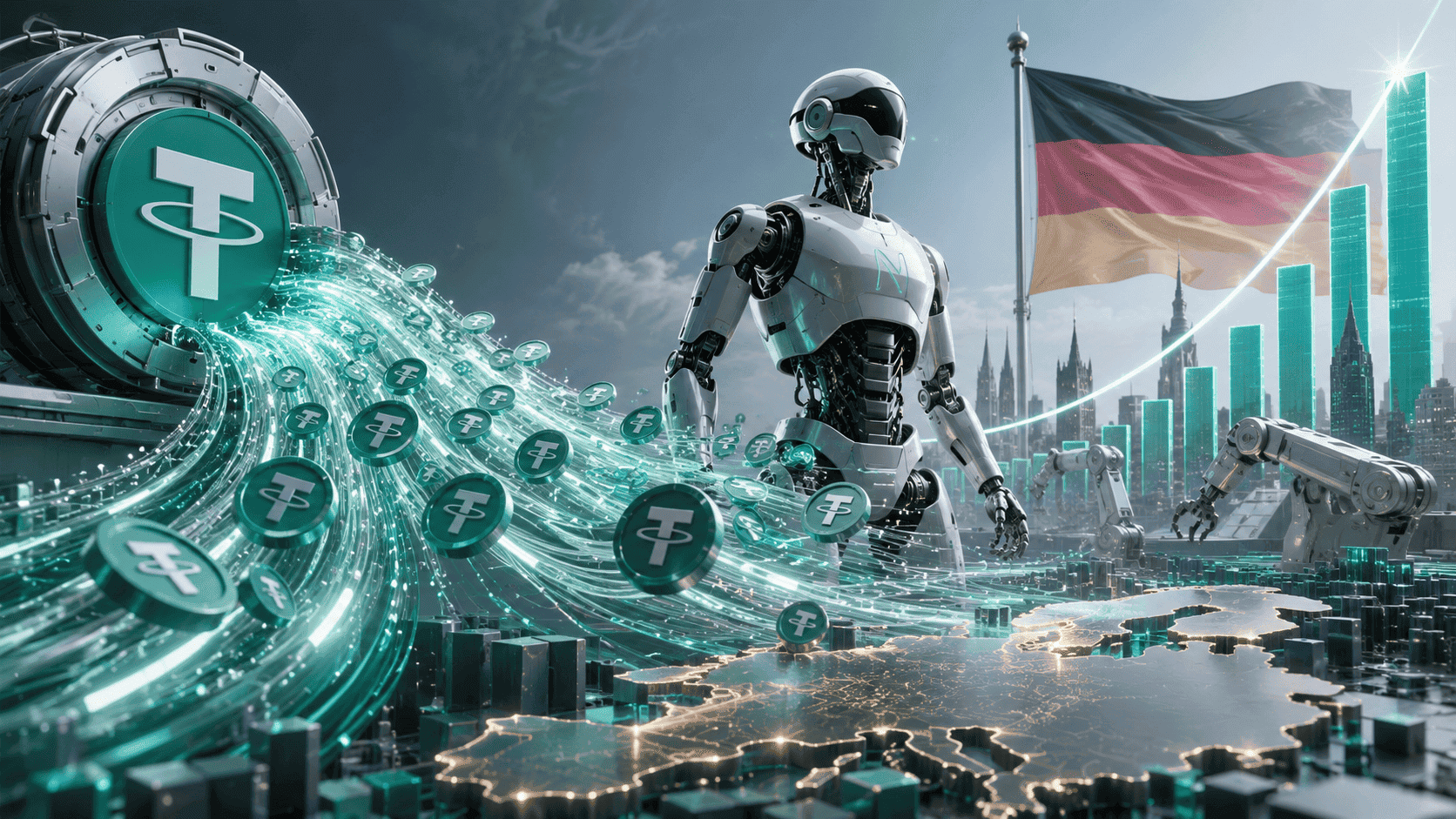
Tether announced on June 10 that it is leading a Series C funding round of up to $1.4 billion in NEURA Robotics, a German cognitive humanoid robotics company. The German business newspaper Handelsblatt is calling it the largest startup financing round in German history.
Read that again. The company best known for issuing USDT, the largest stablecoin in the world, is leading the biggest private funding round Germany has ever seen, and it’s not for a fintech, a blockchain protocol, or even a payments company. It’s for a robotics startup building humanoid robots that can think.


That sentence captures everything strange and significant about what Tether has become in 2026. The company that started as a stablecoin issuer has evolved into a sovereign tech investor with the firepower to lead nine-figure rounds across entirely unrelated industries. NEURA Robotics joins a growing portfolio of Tether investments that already includes Bitcoin mining infrastructure, AI development, telecommunications, and renewable energy.
The $1.4 billion deal isn’t just a milestone for Germany or for NEURA. It’s a milestone for crypto. When the issuer of a single stablecoin can write the largest cheque in German startup history, the financial power that has accumulated within crypto has become impossible to ignore.
What NEURA Robotics Actually Does
NEURA Robotics is one of the most ambitious robotics companies in Europe. The Munich-based startup builds what it calls cognitive humanoid robots, machines that can interact with humans, navigate physical environments, and learn from experience using onboard AI systems.
The company’s flagship products combine humanoid form factors with advanced AI capabilities. Unlike industrial robots that perform specific repetitive tasks in controlled environments, NEURA’s machines are designed to work alongside humans in factories, warehouses, healthcare facilities, and eventually homes. The cognitive element means the robots can understand natural language instructions, adapt to changing conditions, and improve their performance through machine learning.
The market NEURA is targeting is enormous. Goldman Sachs has projected the humanoid robotics market to reach $38 billion by 2035. Tesla, Boston Dynamics, Figure AI, and Apptronik are all pursuing similar visions. NEURA represents Europe’s most credible entry in a category that’s been dominated so far by American and Chinese competitors.
The company has been growing rapidly. Existing customers include major German industrial firms looking to automate complex tasks that traditional robotics can’t handle. The Series C funding will accelerate manufacturing capacity, expand R&D into more advanced cognitive capabilities, and support international expansion beyond Germany’s borders.
Why Tether Is Leading a Robotics Round
The strategic logic behind Tether’s investment in NEURA reveals how the stablecoin issuer thinks about its position in the global economy.
Tether’s USDT generates massive revenue through the interest earned on the Treasury bonds backing the stablecoin. With approximately $180 billion in USDT supply and Treasury yields around 4 to 5%, Tether’s revenue from interest alone runs into the billions annually. That cash flow has accumulated into a war chest that gives the company the ability to make investments at a scale most venture capital firms can’t match.
What’s distinctive is how Tether is choosing to deploy that capital. Rather than reinvesting purely in financial assets or crypto-adjacent businesses, the company has been building positions across what could be called “the next infrastructure layer.” Bitcoin mining (which provides energy diversification and potential vertical integration). AI development. Telecommunications. Renewable energy. And now humanoid robotics.
The common thread is bets on industries that will define the next two decades of economic development. AI, robotics, energy, and connectivity infrastructure are the foundational categories that will determine which economies grow and which fall behind. Tether is positioning itself not just as a stablecoin issuer but as a financial sovereign with investments across the entire stack of foundational technology.
For NEURA Robotics, having Tether as a lead investor provides more than capital. It provides a connection to a financial network that operates outside traditional banking systems, potentially valuable for a company building physical robots that will eventually need to transact globally for parts, services, and labour. The combination of humanoid robots and crypto-native payments is exactly the kind of integrated vision that Tether’s broader portfolio suggests it’s building toward.
The German Startup Record
The $1.4 billion round is significant on its own as a financial milestone for Germany.
The previous record for German startup funding was held by various companies that had raised between $500 million and $800 million in single rounds. NEURA’s $1.4 billion exceeds the previous record by 75% or more, depending on which historical benchmark you use. It’s the largest single-round venture investment in any German company.
The fact that the record is being set by a crypto-affiliated investor in a robotics company tells you something about how funding flows have shifted globally. Traditional German venture capital has been historically conservative compared to Silicon Valley counterparts. Major rounds for European startups have often come from American or Asian investors rather than European ones.
Tether stepping in as the lead investor for the largest German round in history disrupts that pattern. The company is registered in the British Virgin Islands and operates globally without strong ties to any particular European venture ecosystem. It’s deploying capital into German technology because the opportunity is compelling, not because of regional or strategic ties.
The Handelsblatt coverage frames the deal as a turning point for European technology funding. If Tether’s investment signals to other large crypto-affiliated capital pools that European deep tech is investable at scale, more rounds of this size could follow. Germany, France, the Netherlands, and Switzerland all have growing AI and robotics ecosystems that have historically struggled to access the kind of capital that comparable American startups receive routinely.
What This Means for Tether and the Stablecoin Sector
Tether’s growing portfolio raises important questions about what stablecoin issuers are becoming.
The traditional view of a stablecoin issuer is simple. The company holds reserves in safe assets like Treasury bills. It mints tokens backed 1:1 by those reserves. It earns interest on the reserves while users hold the tokens. Revenue accumulates over time. The end.
Tether’s actual operations have evolved far beyond that model. The company has been deploying its accumulated wealth across diverse industries, building a portfolio that increasingly resembles a sovereign wealth fund or a tech-focused holding company rather than a simple stablecoin issuer.
That evolution carries implications for how regulators, competitors, and users think about stablecoin issuers. If Tether is functioning as a major industrial investor, should it face the same disclosure and governance requirements as similarly sized financial institutions? Should the connection between USDT reserves and Tether’s investment portfolio be examined more closely? Should other stablecoin issuers like Circle pursue similar diversification strategies?
Circle has taken a different path, raising venture capital and pursuing a public listing while staying focused on its core stablecoin business. The contrast between Circle’s institutional, public-markets approach and Tether’s offshore, sovereign-investor approach reflects two very different visions of what stablecoin issuers should become as they accumulate scale.
For NEURA Robotics, the choice of Tether as lead investor signals confidence in Tether’s long-term staying power. Large rounds with patient capital are most valuable when the lead investor has a multi-decade horizon. Tether’s offshore structure, accumulated cash reserves, and lack of public market pressure give it the kind of patience that traditional VCs often can’t provide.
The Broader Pattern of Crypto Capital Reshaping Industries
The Tether-NEURA deal fits into a larger pattern of crypto-affiliated capital influencing industries far beyond crypto itself.
In recent months, major crypto wealth has flowed into AI infrastructure, renewable energy, semiconductor manufacturing, defence technology, and biotechnology. Vitalik Buterin and other Ethereum-era founders have personally funded longevity research and public goods. Solana ecosystem participants have backed AI startups. The Trump family has built a multi-billion dollar empire from crypto ventures.
Tether’s $1.4 billion robotics investment is the largest single example of this pattern in 2026, but it’s not isolated. Crypto capital is reshaping investment flows in ways that traditional financial systems haven’t fully reckoned with. When a stablecoin issuer can lead the largest startup round in German history, the boundary between crypto wealth and broader technology investment has effectively dissolved.
For NEURA Robotics specifically, the funding provides the resources to compete with American and Chinese humanoid robotics leaders. For Tether, it adds another piece to a portfolio that increasingly suggests the company is positioning itself for the long-term transformation of the global economy. For Germany, it’s a reminder that the country can still attract record-setting investment even as concerns about European economic competitiveness grow.
And for the broader crypto industry, it’s another data point in the increasingly clear picture that the wealth accumulated within crypto is no longer just sitting on blockchains or in tokens. It’s being deployed across the real economy in ways that will shape industries for decades.
Disclaimer: This article is for informational purposes only and does not constitute financial advice. Cryptocurrency investments carry significant risk. Always conduct your own research before making any investment decisions.