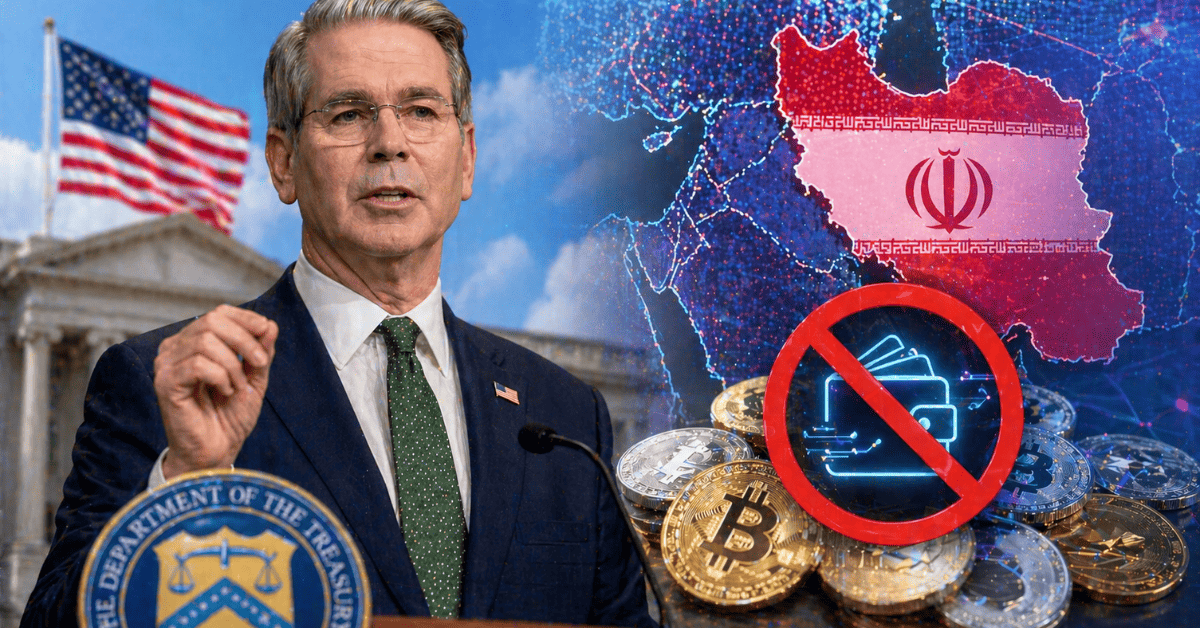
U.S. Treasury Secretary Scott Bessent says the Treasury Department is targeting Iran’s access to crypto as part of a broader financial pressure campaign against Tehran.
In a post on X, Bessent said Treasury’s “Economic Fury” campaign has gone after Iran’s international shadow banking infrastructure, crypto access, shadow fleet, weapons procurement networks, funding for regional proxy groups and Chinese “teapot” refineries that support Iran’s oil trade.


The Treasury Department, through Economic Fury, has targeted Iran’s international shadow banking infrastructure, access to crypto, shadow fleet, weapons procurement networks, funding for terrorist proxies in the region, and independent Chinese “teapot” refineries that support…
— Treasury Secretary Scott Bessent (@SecScottBessent) April 29, 2026
The statement comes days after the U.S. sanctioned Iran-linked crypto wallets and froze $344 million in digital assets. Together, the actions show that Washington now sees crypto not as a side channel, but as a major part of Iran’s sanctions-evasion toolkit.
Why Treasury Is Focusing on Crypto
Stablecoins Have Become Useful for Sanctions Evasion
Iran has been under U.S. sanctions for years, which has limited its access to the global banking system. That has pushed parts of the regime and related networks toward alternative financial rails, including shell companies, oil-trade intermediaries and digital assets.
Crypto is useful in this context because it can move value across borders quickly. Stablecoins are especially important because they let users hold and transfer dollar-like value without needing a conventional bank account.
That does not mean every Iranian crypto user is part of a sanctions network. Many ordinary Iranians use crypto as a hedge against inflation, currency weakness and capital controls. But Treasury’s focus is on wallets and networks it alleges are linked to sanctioned entities, including Iran’s central bank, the Islamic Revolutionary Guard Corps and Hezbollah-linked financing.
The $344 Million Freeze Was a Major Signal
The U.S. recently sanctioned multiple Iran-linked crypto wallets, resulting in the freeze of about $344 million in digital assets. Blockchain intelligence firms said the action involved wallets associated with Iran’s central bank and that Tether coordinated with U.S. authorities to freeze USDT held in the targeted addresses.
That is significant for two reasons. First, it shows that stablecoin issuers can become central players in sanctions enforcement when assets sit in tokens with issuer-controlled freeze functions. Second, it shows that large state-linked crypto reserves are not necessarily beyond the reach of U.S. financial pressure.
For sanctioned actors, crypto can be faster than banks. But when the assets are held in centralized stablecoins, they may also be easier to freeze once investigators identify the wallets.
Operation Economic Fury Expands the Pressure
Crypto Is Only One Piece of the Campaign
Bessent’s post framed crypto access as one part of a wider sanctions strategy. Treasury is also targeting Iran’s shadow banking networks, oil shipping infrastructure, procurement channels and financing for proxy groups.
That wider context matters. Iran’s financial networks do not rely on one method. They use oil sales, front companies, informal brokers, shipping intermediaries, regional banks, commodity trades and now digital assets.
The point of the campaign is to make each route harder to use. Freezing wallets may not stop all Iranian crypto activity, but it can disrupt reserves, raise compliance risk for exchanges and force counterparties to think twice before processing suspicious flows.
Third-Party Exchanges Face More Scrutiny
The next pressure point is likely to be crypto service providers outside the U.S. Exchanges, brokers and over-the-counter desks in regions with heavy trade links to Iran may face increasing demands to screen wallets, monitor stablecoin flows and block sanctioned entities.
This is where enforcement becomes difficult. Illicit actors can move funds through new wallets, cross-chain tools, informal brokers or smaller exchanges with weaker compliance. That creates a cat-and-mouse game between investigators and sanctioned networks.
Still, the $344 million freeze shows that U.S. agencies are getting better at tracing large balances and coordinating with private-sector stablecoin issuers.
What This Means for Crypto Markets
The sanctions push highlights a split in the crypto industry.
On one side, blockchain transparency gives law enforcement a powerful tool. Public ledgers allow investigators to follow funds in ways that are impossible with cash or opaque shell-company networks.
On the other side, crypto remains attractive to sanctioned actors because it can be accessed globally, moved quickly and routed through services that may not always follow strict compliance standards.
For stablecoin issuers, the pressure is especially high. If USDT, USDC or other major stablecoins become central to geopolitical finance, issuers will face more demands from governments to freeze assets tied to sanctioned wallets. That could strengthen the case for regulated stablecoins, but it may also intensify debates about censorship and financial neutrality.
What Comes Next
The first thing to watch is whether OFAC designates more Iran-linked wallets or crypto service providers. Additional wallet sanctions would suggest that the $344 million freeze was only the beginning of a larger campaign.
The second signal is whether exchanges in the Middle East, Central Asia and East Asia tighten screening around Iranian flows. If regional platforms face secondary sanctions risk, they may become more cautious about ruble, rial or USDT flows tied to sanctioned networks.
The third issue is how Iran adapts. The regime and related networks may move toward more decentralized tools, privacy systems or smaller intermediaries if centralized stablecoins become easier to freeze.
For now, Bessent’s message is clear. The U.S. is not only targeting Iran’s banks, ships and oil buyers. It is also targeting the crypto rails that Tehran may use to move money outside the traditional financial system.
Disclaimer: This article is for informational purposes only and does not constitute financial, investment, or legal advice. Always conduct your own research before making any investment decisions.