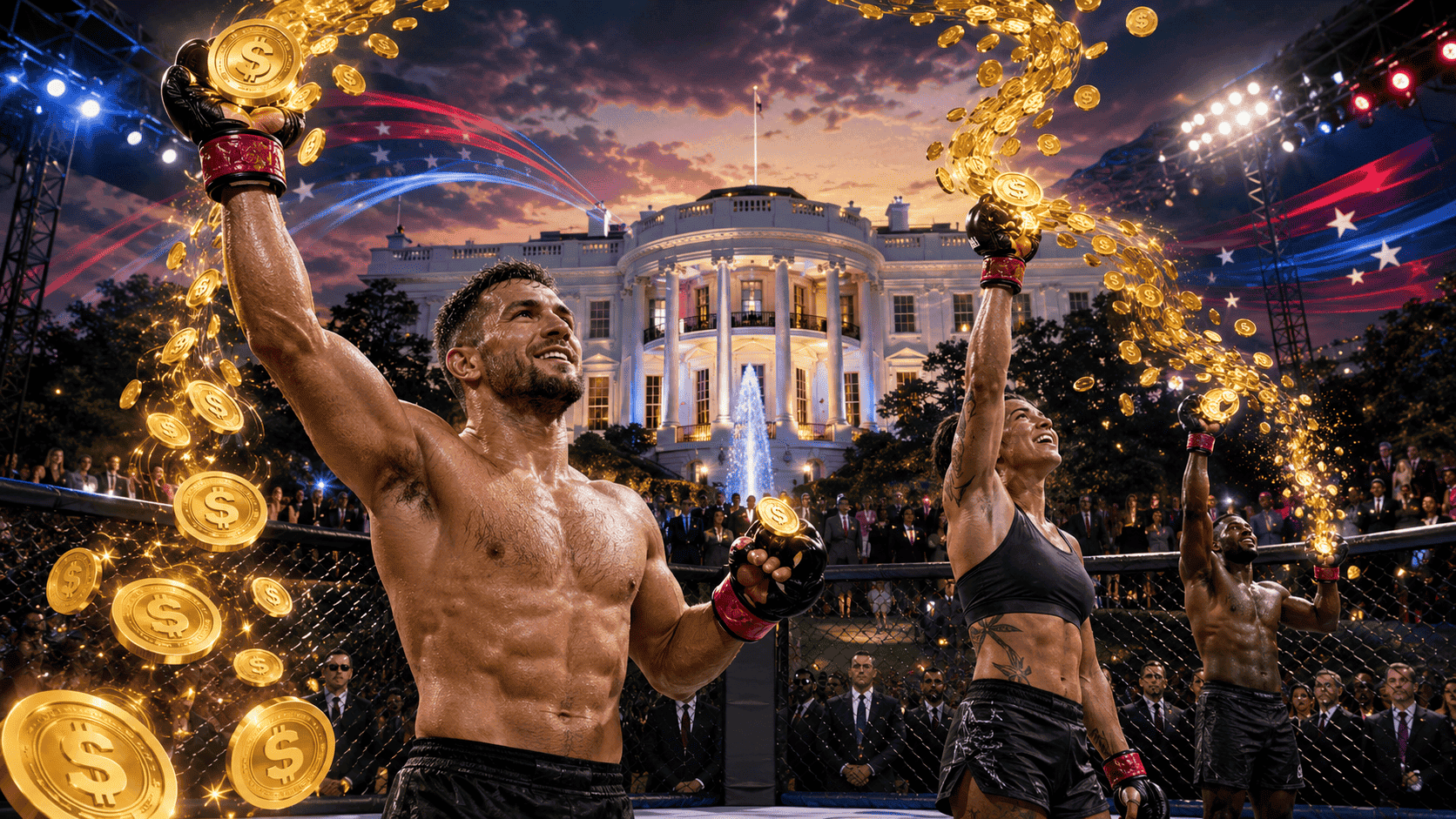
On Sunday June 14, the White House South Lawn was converted into a temporary UFC arena. UFC Freedom 250, organised to mark President Donald Trump’s 80th birthday and the United States’ 250th anniversary, hosted a seven-fight card featuring some of the biggest names in mixed martial arts. UFC President Dana White announced from the Lincoln Memorial earlier in the week that the total bonus pool would reach $1.65 million, the largest in UFC history.
The fighter bonuses themselves grabbed the headlines for a different reason. World Liberty Financial, the Trump family-backed crypto venture, served as the presenting partner of the “Performance of the Night” award and contributed $250,000 paid entirely in its USD1 stablecoin. Two fighters won the bonus. Both received their payments in dollar-pegged tokens issued by a company in which the President of the United States is publicly listed as “Chief Crypto Advocate.”


The setup is unprecedented. A sitting US president whose family runs a stablecoin company. A UFC event held on White House grounds. Fighter bonuses paid in that family’s own stablecoin. All while World Liberty Financial pursues a federal banking license from the Office of the Comptroller of the Currency. The combination produces the most overt political-commercial deployment of a stablecoin in US history.
The $250,000 figure is small relative to World Liberty’s $4.6 billion USD1 supply or the event’s $60+ million production budget. The symbolism is anything but small.
What Actually Happened at the Event
UFC Freedom 250 took place on June 14 on the South Lawn of the White House. The event was timed to coincide with President Trump’s 80th birthday and the country’s 250th anniversary celebrations. UFC President Dana White confirmed the arrangement at a press conference at the Lincoln Memorial earlier in the week.
The card was headlined by a lightweight title unification bout between Ilia Topuria and Justin Gaethje, with former two-division champion Alex Pereira facing Ciryl Gane at heavyweight. The total bonus pool of $1.65 million was distributed across four fighters in two categories. Two “Fight of the Night” winners each received $400,000, funded by a $1 million pool in Crypto.com’s CRO token sponsored by Crypto.com. Two “Performance of the Night” winners each received $425,000.
The $250,000 in USD1 from World Liberty Financial represented a portion of the Performance of the Night payouts. The remaining funds came from UFC’s standard bonus infrastructure. Both Performance of the Night winners received their full bonuses in mixed currencies, with the USD1-denominated portion functioning as actual stablecoin distribution rather than cash converted from crypto.
Crypto.com and Ram Trucks served as the event’s official presenting sponsors. World Liberty’s involvement was limited to the Performance of the Night bonus category. The combined sponsorship structure produced a UFC event where crypto was woven into both the marketing and the financial mechanics in ways that previous UFC events have only flirted with.
Polymarket traders placed approximately $4.1 million in bets across 18 prediction markets tied to the event outcomes. The largest single market was the Topuria-Gaethje main event, which attracted $2 million in volume with Topuria entering as an 80% favourite. The prediction market activity added another crypto element to the event that ran in parallel with the stablecoin bonuses.
Why USD1 Specifically
The choice to pay fighter bonuses in USD1 rather than USDC, USDT, or any other established stablecoin matters strategically.
USD1 was launched by World Liberty Financial in 2025 as the company’s flagship stablecoin product. It’s a US dollar-pegged token backed by US Treasuries and cash equivalents, with custody handled by BitGo. The stablecoin trades on Ethereum, Solana, BNB Chain, Aptos, and Mantle. Circulating supply has grown rapidly, expanding from $3.3 billion on January 1, 2026 to approximately $4.6 billion by mid-June.
The growth trajectory makes USD1 one of the fastest-expanding stablecoins of the past year, though it remains significantly smaller than USDC ($75+ billion) or USDT ($180+ billion). The UFC sponsorship represents the most visible mainstream deployment of USD1 since its launch.
For World Liberty Financial, the marketing value of paying fighter bonuses on the White House lawn is genuinely difficult to estimate but clearly substantial. UFC events draw millions of viewers globally. The White House setting adds an extra layer of media attention that ordinary corporate sponsorships can’t match. Fighter bonuses paid in USD1 will appear in athlete financial disclosures, tax filings, and post-fight interviews for years.
Todd Phillips, a crypto expert at Klaros Group, framed the economics directly in comments to The Guardian. “Paying the fighters in the USD1 stablecoin would have the same economic function as writing them a check.” The functional payment doesn’t differ much from a traditional cash payment. The visibility and branding implications, however, are dramatically different.
USD1 trades alongside USDC and USDT in the broader stablecoin market, but it operates with a different strategic positioning. Tether dominates offshore and emerging markets. Circle has carved out the US institutional and compliance-focused niche. USD1 appears to be carving a third path: politically connected, aggressively marketed through mainstream entertainment, and positioned as a bridge between crypto-native users and traditional finance with explicit political affiliation.
The Banking License That Changes Everything
While the UFC event generated headlines, World Liberty Financial’s more consequential activity is happening at the OCC. The company is pursuing a federal banking license that would dramatically expand its operational scope and regulatory standing.
The trust bank charter application has already produced friction in Washington. During a June 5 House Financial Services Committee hearing, lawmakers questioned OCC Comptroller Jonathan Gould about the review process and whether the company’s ties to President Trump should influence regulators’ decision-making. Gould told lawmakers the application would be evaluated under existing banking laws and ethics requirements, but Democratic lawmakers including Representative Gregory Meeks raised concerns about the ownership structure and political connections.
If approved, the banking license would give World Liberty Financial direct access to Federal Reserve services, expanded ability to issue stablecoins under federal oversight, and the kind of regulatory credibility that has historically been reserved for established banks and financial institutions. The competitive implications for Circle, Tether, and other stablecoin issuers without bank charters would be significant.
The conflict-of-interest concerns extend beyond the immediate banking application. World Liberty Financial reportedly received a $500 million investment from UAE-based sources during 2025. The political appearance of a foreign nation investing hundreds of millions in a US president’s family crypto venture has drawn criticism from across the political spectrum, though the specific business implications remain disputed.
For the OCC’s review process, the political dynamics create genuine difficulty. Approving the application invites accusations of political favouritism toward a presidential family business. Denying it invites accusations of political bias against a legitimate crypto firm. The decision, whenever it comes, will produce significant political consequences regardless of the outcome.
The Conflict of Interest Question
The UFC event amplifies questions that have been building around the Trump family’s crypto ventures throughout 2026. A Reuters investigation published earlier this month estimated the Trump family has earned approximately $2.3 billion from crypto ventures by the end of April 2026. Investors in those ventures lost roughly $2.25 billion over the same period, creating one of the most striking parallel financial outcomes in recent history.
The conflict-of-interest concerns specifically with USD1 centre on several factors. President Trump’s administration is simultaneously writing cryptocurrency regulations including the CLARITY Act and the GENIUS Act on stablecoins. The legislation directly affects how stablecoins like USD1 can be issued, marketed, and used. The administration is also reviewing World Liberty Financial’s banking license application through the OCC. Decisions about these regulatory and licensing matters affect the value of the family’s stablecoin business directly.
Critics argue this creates structural incentive for the administration to craft rules and approve applications that benefit the family’s ventures rather than the public. Supporters counter that Trump’s crypto advocacy predates his second term and that his administration’s broad crypto-friendly positioning benefits the entire industry, not just family ventures.
Earlier compliance issues with USD1 have added to the scrutiny. In recent months, World Liberty Financial borrowed over $75 million in stablecoins on Dolomite, with utilisation rates reaching 93% in some pools and temporarily restricting retail withdrawals. The episode raised questions about World Liberty’s risk management practices and the operational stability of USD1 as a payment instrument.
Litigation with crypto entrepreneur Justin Sun continues. Sun originally purchased significant WLFI governance tokens and later sued the company, alleging it improperly froze his holdings. World Liberty Financial countersued for defamation. The dispute has produced months of public allegations from both sides about company practices and treatment of token holders.
What This Means for Stablecoin Adoption
Beyond the political dimensions, the UFC event signals genuine progress in stablecoin adoption for everyday transactions.
Stablecoins have historically been used primarily for crypto trading, cross-border remittances, and DeFi applications. Using them to pay athletes for performance bonuses at a mainstream sporting event represents a different use case. The recipients receive value in stablecoin form rather than cash, raising practical questions about how those payments are managed, converted, or held.
For UFC fighters specifically, receiving substantial bonuses in stablecoins requires immediate decisions about tax treatment, conversion to fiat, holding strategy, and security practices. Some fighters may choose to hold the USD1 as a long-term position. Others may convert immediately to dollars. The choices made by professional athletes at the receiving end of these payments will inform how stablecoin adoption proceeds in adjacent categories like entertainment, sports, and freelance economies.
The broader implications include normalisation effects. When millions of UFC viewers watch fighters being paid in stablecoins on the White House lawn, the perception of stablecoins as legitimate financial instruments shifts incrementally. Each high-profile use case adds to the cumulative legitimacy that stablecoins need to compete with traditional payment infrastructure.
Whether USD1 specifically benefits from this normalisation depends on whether the political and conflict-of-interest concerns ultimately overwhelm the marketing benefits. The federal banking license decision, when it comes, will be the most important data point. The product can either become formally regulated infrastructure under direct federal oversight or remain a politically-affiliated crypto venture operating within the broader stablecoin framework.
UFC Freedom 250 produced the year’s most visible stablecoin marketing moment. The next phase of the story unfolds in the regulatory and legal proceedings that the marketing was, at least partly, designed to influence.
FAQ
What happened at UFC Freedom 250?
UFC Freedom 250 was held on June 14, 2026, on the South Lawn of the White House to mark President Trump’s 80th birthday and the United States’ 250th anniversary. World Liberty Financial, the Trump family-backed crypto venture, served as presenting partner of the Performance of the Night bonus pool and contributed $250,000 paid in its USD1 stablecoin. Two fighters received the Performance of the Night bonuses denominated in USD1.
What is USD1?
USD1 is a US dollar-pegged stablecoin issued by World Liberty Financial, the Trump family-backed DeFi venture. It’s backed by US Treasuries and cash equivalents with custody handled by BitGo. The stablecoin trades on Ethereum, Solana, BNB Chain, Aptos, and Mantle. Circulating supply has grown from approximately $3.3 billion on January 1, 2026 to approximately $4.6 billion by mid-June, making it one of the fastest-growing stablecoins of the past year.
Why is this controversial?
A sitting US president whose family runs a stablecoin company sponsored an event held at his official residence, with fighter bonuses paid in that family’s own stablecoin. The Trump administration is simultaneously writing cryptocurrency regulations and reviewing World Liberty Financial’s federal banking license application. Critics argue this creates structural incentive for the administration to craft favourable rules. Earlier compliance issues with USD1 including a $75 million Dolomite borrowing situation and ongoing litigation with Justin Sun have added to the scrutiny.
Disclaimer: This article is for informational purposes only and does not constitute financial or political advice. Cryptocurrency investments carry significant risk. Always conduct your own research before making any investment decisions.