XRP is trading at $1.35 on Monday evening. It’s been stuck between $1.30 and $1.50 for so long that some traders have stopped watching. That could be a mistake.
Two catalysts are arriving in the same window. The XRPL maintenance upgrade goes live tomorrow at 03:49 UTC, fixing critical bugs across NFTs, vaults, lending, and permissioned domains. And the CLARITY Act, the most comprehensive crypto market-structure bill in US history, is moving through the Senate, with over 100 amendments under debate ahead of a potential floor vote.


Neither catalyst alone would necessarily move the needle. Together, arriving in the same week, with XRP’s technical indicators compressed to their tightest levels of 2026 and institutional ETF money still flowing in while Bitcoin and Ethereum funds bleed, the setup is as loaded as it’s been all year.
The price doesn’t reflect it yet. But the conditions for a sharp move are all present.
The Technical Picture Right Now
XRP’s chart looks like a spring being compressed from both sides.
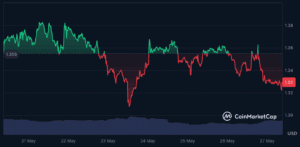
The price has been trapped in a narrowing range since March. The $1.30 support has held through multiple tests, with buyers consistently stepping in every time the price approaches that level. The $1.50 resistance has capped every rally attempt, with heavy selling appearing near the $1.44 to $1.52 zone where roughly 36.8 billion XRP sits at breakeven.
That 36.8 billion figure represents approximately 60% of total circulating supply. When that many tokens are held at the same average cost basis ($1.44), it creates a mechanical ceiling. Holders who bought near that level and have been sitting on losses for months will look to sell at breakeven. Breaking through that wall requires sustained buying pressure strong enough to absorb all of that supply.
The Bollinger Bands on the daily chart have compressed to levels not seen since early February, right before XRP’s last significant move. The RSI sits at 42, neutral territory with room to run in either direction. The MACD histogram is contracting, suggesting bearish momentum is fading but hasn’t flipped bullish yet.
Tight Bollinger Bands, neutral RSI, fading MACD, and a price squeezed between clearly defined support and resistance. This is a textbook pre-breakout setup. The direction depends entirely on which catalyst arrives first and whether it’s strong enough to push through the supply wall.
The CLARITY Act: XRP’s Single Biggest Catalyst
The CLARITY Act has been the single most important variable for XRP throughout 2026. And this week, it reaches its most critical stage.
The Senate Banking Committee advanced the bill on May 14 in a 15-9 bipartisan vote. That cleared the first major hurdle. Now the bill faces over 100 amendments from senators on both sides who want to reshape specific provisions before it reaches a full floor vote.
For XRP, the bill matters more than almost any other token because it would formally classify digital assets, including XRP, as commodities rather than securities. That distinction is everything. It determines which regulator oversees XRP (the CFTC rather than the SEC), how exchanges can list and trade it, and how institutional investors can hold it in regulated products.
Standard Chartered projected that if the CLARITY Act passes the full Senate, it could unlock $4 to $8 billion in additional XRP ETF inflows. That kind of institutional capital entering a market with 60% of supply sitting at a $1.44 cost basis would create exactly the kind of demand imbalance that produces explosive moves.
Galaxy Research raised its odds of passage to 75%. Polymarket puts the probability at 73%. Former Senator Cynthia Lummis warned that a failed vote before the Memorial Day recess could mean waiting until 2030, because a new Congress would have to restart the entire legislative process.
The stakes couldn’t be higher. A successful vote opens the door to massive institutional inflows. A failure would send XRP back to grinding sideways within its $1.30 to $1.50 range, potentially for years.
Tomorrow’s XRPL Upgrade Strengthens the Foundation
While the CLARITY Act grabs headlines, tomorrow’s technical upgrade strengthens the case that institutional investors need to see.
Version 3.1.3 of the XRP Ledger goes live at 03:49 UTC on May 27. The release patches bugs across four areas that directly affect institutional use cases: expired NFT offers cluttering the ledger, vault withdrawals bypassing token limits, lending records not updating properly during defaults, and permission settings being accidentally modified by failed transactions.
These aren’t glamorous features. But for banks and asset managers evaluating whether the XRP Ledger is ready for production-grade financial services, each bug fix removes a potential objection from compliance and risk teams.
The upgrade arrives two weeks after JPMorgan, Mastercard, Ripple, and Ondo Finance completed the first cross-border tokenized Treasury settlement on the XRPL. That transaction demonstrated the network’s capability at the highest institutional level. Tomorrow’s maintenance release ensures the infrastructure supporting those capabilities works correctly under all conditions.
Over 50% of the network’s nodes have already updated. Node operators who haven’t upgraded by the deadline will be disconnected from consensus, ensuring the entire network runs the same software with the same rules.
The ETF Money Keeps Flowing In
While Bitcoin and Ethereum funds bleed billions, XRP continues to attract institutional capital.
XRP-linked ETFs pulled in $12.57 million in the most recent weekly reporting period. That extended a trend in which XRP funds have posted positive flows in weeks when every other major crypto fund category posted losses. Cumulative XRP ETF inflows since their November 2025 launch have reached approximately $1.53 billion.
Those numbers are modest compared to Bitcoin’s $57 billion in cumulative ETF inflows. But the direction matters more than the size right now. In a market where institutional investors are actively reducing their exposure to Bitcoin and Ethereum, XRP is the only major asset with consistently positive fund flows.
Jane Street added to its XRP ETF positions in recent filings. UBS disclosed XRP holdings ahead of its launch of crypto trading. Goldman Sachs exited its XRP position, but multiple other institutional buyers have stepped in to fill the gap.
The sustained ETF inflows provide a baseline of demand that didn’t exist a year ago. Combined with the CLARITY Act catalyst and the improving technical infrastructure, the institutional case for XRP is building even while the price sits at $1.35 doing nothing.
What Ripple Has Been Building in the Background
The price may be flat, but Ripple, the company, has been anything but idle.
The cross-border tokenized Treasury settlement with JPMorgan demonstrated that the XRP Ledger can serve as institutional-grade settlement infrastructure. Ripple’s RLUSD stablecoin expanded to OKX across 280+ spot pairs. The company closed a $200 million debt facility for its Ripple Prime brokerage. And Ripple CEO Brad Garlinghouse said he expects 30% of the company’s $13 trillion annual payment flow to move on-chain within five years.
XRPL daily transactions tripled to 3 million in March 2026, fuelled by real-world asset tokenization that now exceeds $1.5 billion on the network. Multi-purpose tokens launched last year enable institutions to issue tokenized assets with built-in compliance with KYC, AML, and transfer rules.
The disconnect between Ripple’s growing institutional business and XRP’s stagnant price is the central frustration for holders. The fundamentals improve quarter after quarter. The institutional partnerships deepen. The technical infrastructure matures. And the price sits at $1.35, waiting for the one catalyst that can unlock all of that accumulated value.
The CLARITY Act is that catalyst. Everything else has been building the foundation. The legislation is the key that opens the door.
The Scenarios From Here
The next two weeks will likely determine XRP’s direction for the remainder of 2026.
If the CLARITY Act passes the full Senate before the Memorial Day recess, the institutional floodgates open. Standard Chartered’s $4-$8 billion inflow projection kicks in. The $1.44 supply wall gets overwhelmed by sustained buying. Near-term targets shift to $1.80, then $2.30, with the most aggressive analyst models pointing to $8.00 by year-end.
If the vote is delayed but the bill remains on track for summer passage, XRP likely holds its $1.30 to $1.50 range and grinds sideways for a few more months. The XRPL upgrade and continued ETF inflows provide a floor, but without the legislative trigger, there isn’t enough momentum to break through the supply wall.
If the bill fails or gets substantially weakened by amendments, the downside opens up. Support at $1.30 comes under pressure. A breakdown below $1.28 targets $1.20 and potentially $1.10. The timeline for the next legislative attempt stretches to 2030.
The asymmetry in those scenarios is what makes XRP interesting at $1.35. The downside to $1.20 is about 11%. The upside to $2.30 is about 70%. The extreme upside to Standard Chartered’s $8.00 target is nearly 500%. The risk-reward ratio at current levels, with the CLARITY Act vote imminent, favors the long side for anyone with a 6 to 12 month horizon.
That doesn’t mean it can’t go lower first. But the setup, compressed price, converging catalysts, positive ETF flows, and improving infrastructure, is the best XRP has had all year.
FAQ
Why is XRP stuck at $1.35 despite positive developments?
Approximately 36.8 billion XRP, roughly 60% of the circulating supply, is held at an average cost basis of $1.44. That concentration creates a mechanical ceiling where holders looking to sell at breakeven absorb buying pressure near that level. Breaking through requires a catalyst strong enough to overwhelm that supply, which the market is waiting for the CLARITY Act to provide.
What are the key price levels for XRP right now?
Support sits at $1.30 and has been tested multiple times since March. Resistance is at $1.44 to $1.52, where the supply wall is heaviest. A break above $1.50 with volume targets $1.62 and then $1.80. A breakdown below $1.28 targets $1.20 and potentially $1.10. Bollinger Bands are at their tightest levels of 2026, indicating a large move is imminent.
What could cause XRP to break out?
The CLARITY Act’s passage by the full Senate is the most likely trigger. Standard Chartered projects $4 to $8 billion in additional ETF inflows if the bill becomes law. The XRPL May 27 upgrade and continued positive fund flows provide supporting catalysts. Galaxy Research puts the odds of passage at 75%. A failed vote would likely send XRP back to the bottom of its range.
Disclaimer: This article is for informational purposes only and does not constitute financial advice. Cryptocurrency investments carry significant risk. Always conduct your own research before making any investment decisions.