You bought Bitcoin. Now what? Where do you actually keep it?
This is the question nobody answers properly. Most guides assume you already know the difference between custodial and non-custodial, hot and cold, spot and futures. If those words mean nothing to you, you are in the right place.


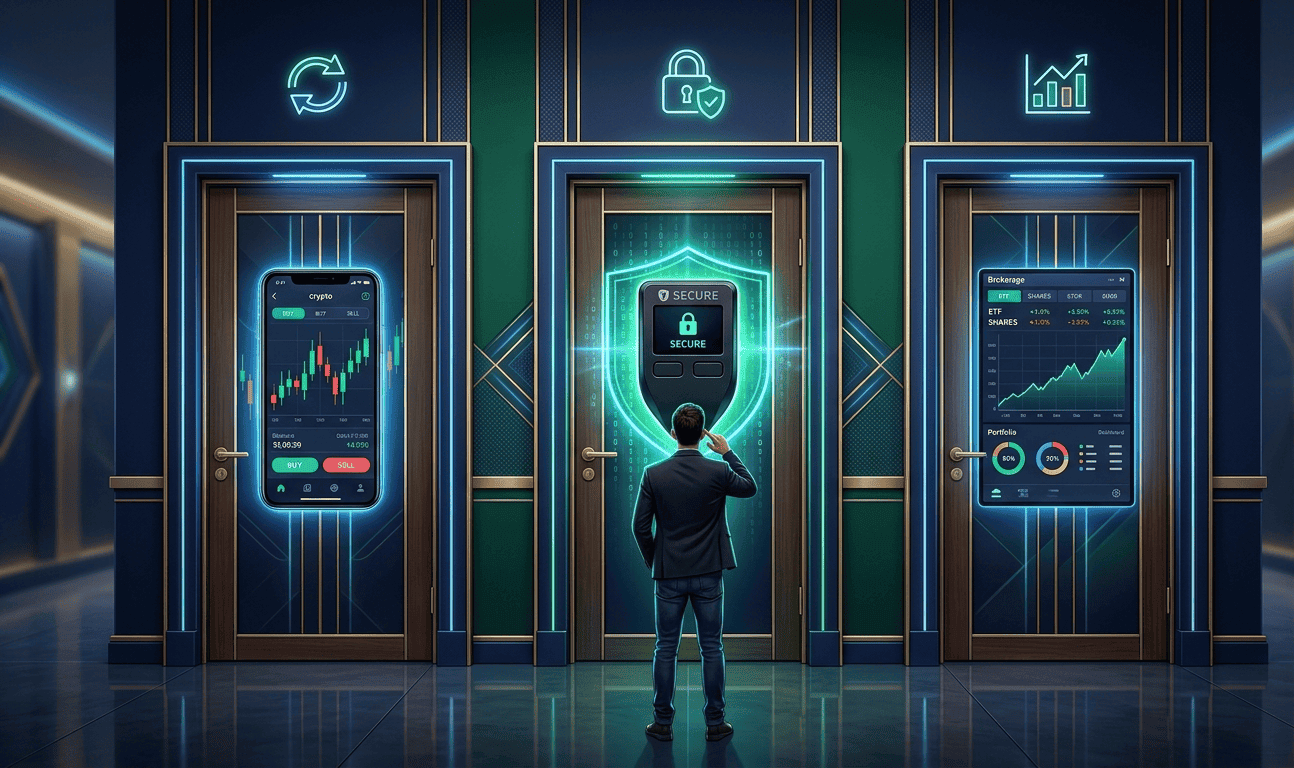
There are three main ways to store Bitcoin in 2026. You can leave it on the exchange where you bought it. You can move it to your own wallet. Or you can hold it through an ETF in your brokerage account. Each option has different trade-offs on security, cost, control, and convenience. None of them is perfect. The best one depends on how you plan to use your Bitcoin and how much you are willing to manage yourself.
Quick Comparison: Exchange vs Wallet vs ETF
| Feature | Exchange (Coinbase, Kraken) | Hardware Wallet (Ledger, Trezor) | Bitcoin ETF (IBIT, FBTC) |
|---|---|---|---|
| You own the Bitcoin? | Sort of (they hold keys) | Yes (you hold keys) | No (fund holds it) |
| Security risk | Exchange could be hacked | You could lose device/seed | Fund manages security |
| Cost to hold | Free | $79-$169 one-time | 0.15%-0.25% per year |
| Setup difficulty | Easy (5 min) | Medium (15 min) | Easy (standard brokerage) |
| Can you spend BTC? | Yes | Yes | No |
| Can you use in DeFi? | Limited | Yes | No |
| Available 24/7? | Yes | Yes | Market hours only |
| Insurance/protection | Varies by exchange | None (you are responsible) | SEC-regulated fund |
| Best for | Active traders, small amounts | Long-term holders, large amounts | Traditional investors, retirement |
Option 1: Leave It on the Exchange
This is what most people do. You buy Bitcoin on Coinbase, Kraken, or Binance, and you just leave it there. It is easy. The app looks nice. You can check your balance anytime. And if you want to sell, it takes seconds.
The problem is that you do not actually control your Bitcoin. The exchange holds the private keys, which are essentially the password that proves ownership. The crypto community has a saying for this: “not your keys, not your coins.” If the exchange gets hacked, goes bankrupt, freezes your account, or gets shut down by regulators, your Bitcoin could disappear.
That is not theoretical. Mt. Gox lost 850,000 BTC in 2014. FTX collapsed in 2022 and took $8 billion in customer funds with it. The Bybit hack in February 2025 cost $1.5 billion. Exchanges are targets because they hold billions of dollars in one place.
That said, exchanges have gotten much better at security. Coinbase stores 98% of customer funds in cold storage and has never been hacked. Kraken publishes proof-of-reserves that anyone can verify. Both are regulated and insured to varying degrees. For small amounts that you plan to trade actively, leaving Bitcoin on a reputable exchange is reasonable.
Use an exchange if: you trade frequently, hold smaller amounts, or are not comfortable managing your own security.
Option 2: Move It to Your Own Wallet
A wallet gives you full control. You hold the private keys. Nobody can freeze your account. Nobody can block your transactions. Your Bitcoin is yours in the most literal sense.
There are two types. A software wallet (like MetaMask or Phantom) runs on your phone or browser. It is free and convenient, but your keys live on an internet-connected device, which makes them vulnerable to malware. We covered the Claude Code malware campaign earlier this month that targeted over 250 browser wallet extensions. Software wallets are better than exchanges for control, but they share the same weakness: they are online.
A hardware wallet (like Ledger or Trezor) is the gold standard. It is a small physical device that stores your keys completely offline. When you want to send Bitcoin, the transaction is signed inside the device and sent out. The keys never touch the internet. Even if your entire computer is infected with malware, the attacker cannot move your funds without physically pressing buttons on the hardware wallet.
The trade-off is responsibility. If you lose your hardware wallet and your seed phrase (the 12 or 24 word backup), your Bitcoin is gone forever. Nobody can recover it. There is no customer service to call. You are your own bank, and that means you are also your own security department.
A Ledger Nano S Plus costs $79. A Trezor Safe 3 costs $79. For anyone holding more than a few hundred dollars in Bitcoin, that is one of the cheapest forms of financial protection you can buy.
Use a hardware wallet if: you are holding for the long term, have significant amounts, or want maximum control and security.
Option 3: Hold It Through an ETF
A Bitcoin ETF is the easiest option for people who come from traditional investing. You buy shares of a fund that holds Bitcoin on your behalf. The fund (run by BlackRock, Fidelity, or similar) handles all the buying, storing, and security. You hold shares in your brokerage account just like any stock.
The big advantage is simplicity. No wallets. No private keys. No seed phrases. No worrying about malware. You buy IBIT on Fidelity, Schwab, or your broker, and you are done. The fund charges a small annual fee (BlackRock’s IBIT charges 0.25%) and handles everything else.
ETFs also sit inside regulated financial infrastructure. They are SEC-regulated. They come with standard tax reporting. And they can be held in retirement accounts like IRAs and 401(k)s, which is something you cannot easily do with Bitcoin held in a wallet.
The downside is that you do not own Bitcoin. You own shares in a fund that owns Bitcoin. You cannot send it to someone. You cannot use it in DeFi. You cannot spend it. And you can only trade during market hours, not 24/7 like real Bitcoin.
There is also counterparty risk. Your Bitcoin sits in BlackRock’s or Fidelity’s custody. If something goes wrong with the fund, you are dependent on the legal system to get your money back. That is unlikely with firms this large, but it is a different kind of risk than holding your own keys.
Use an ETF if: you want the simplest possible exposure, plan to hold in a retirement account, or prefer traditional financial infrastructure.
The Smart Combination
Most experienced Bitcoin holders use a combination of two or three methods.
Keep a small amount on an exchange for trading and quick access. Think of it like the cash in your physical wallet. You would not carry your life savings in your back pocket, and you should not keep it all on Coinbase either.
Keep the bulk of your holdings on a hardware wallet. This is your savings account. Offline, secure, and untouchable by hackers. Move it there and do not touch it unless you need to.
If you have a retirement account and want Bitcoin exposure without managing keys, add an ETF allocation. It sits alongside your stocks and bonds, earns the same tax advantages, and requires zero crypto knowledge.
That three-layer approach covers every scenario: convenience for daily use, maximum security for long-term holding, and regulated exposure for retirement savings.
One Rule That Applies to All Three
Back up your access. On an exchange, enable two-factor authentication and use a unique password. With a hardware wallet, write down your seed phrase on paper (never digitally) and store it somewhere safe. With an ETF, make sure your brokerage account has strong security settings.
The most common way people lose Bitcoin is not hacking. It is losing access to their own accounts. A forgotten password, a lost seed phrase, or a phone that breaks with no backup. The security you set up today is the security that protects you for years.
Bitcoin is worth protecting. The method you choose depends on your life, your comfort level, and how much effort you are willing to put into being your own bank. There is no wrong answer. There is only the answer that fits you.
Frequently Asked Questions
What is the safest way to store Bitcoin in 2026?
A hardware wallet like Ledger or Trezor is the safest option. It stores your private keys completely offline, making it immune to malware, hacking, and exchange failures. For maximum security, combine a hardware wallet for long-term storage with a reputable exchange for active trading.
Should I keep my Bitcoin on Coinbase or move it to a wallet?
For small amounts you plan to trade, Coinbase is fine. For larger amounts you plan to hold long-term, a hardware wallet is safer. Coinbase stores 98% of funds in cold storage and has never been hacked, but you do not control the private keys. With a wallet, you have full control and full responsibility.
Is a Bitcoin ETF safer than holding Bitcoin directly?
Different risks. An ETF removes the risk of losing your keys or getting hacked personally, but adds counterparty risk (you depend on the fund manager). You also cannot use ETF Bitcoin for transactions or DeFi. ETFs are best for traditional investors who want simple exposure without managing crypto directly.
Disclaimer: This article is for informational purposes only and does not constitute financial, investment, or legal advice. Always conduct your own research before making any investment decisions.