Sui is one of the worst-performing major cryptocurrencies of 2026. The token traded at $5.35 in January, briefly capturing top-15 status during the broader market peak. Eighteen months later, SUI sits at approximately $0.75. The 85% decline ranks among the steepest of any meaningful Layer 1 token, alongside Cardano’s drop to multi-year lows and Avalanche’s persistent bearishness throughout the cycle.
By every traditional measure of crypto market positioning, Sui is a token that the market has given up on.


By the most current measure of actual network usage, Sui is processing more transaction volume than at any point in its history. Since June 10, 2026, the network has processed approximately $65 billion in zero-gas stablecoin transactions. That figure represents one of the largest sustained transaction volume events in any Layer 1 blockchain’s history. Eight days. $65 billion. Across a network whose token has lost 85% of its value over the same broader period.
The disconnect between Sui’s price action and its network activity is approaching extreme levels. The technical chart shows a token in deep bearish trend below all major moving averages. The on-chain data shows a network processing volumes that compete with Ethereum during peak DeFi activity. Both stories are true simultaneously. Which one matters more depends on whether Sui can translate operational success into token value accrual, which has been the central challenge for every Layer 1 outside Bitcoin and Ethereum.
The structural setup contains specific elements that warrant detailed analysis. Sui at $0.75 is either a generational entry point for a token whose fundamentals are quietly building or a continuation of a value trap where strong network metrics never translate into sustained price appreciation. The technical levels, the network activity data, and the catalyst pipeline all need examination to understand which interpretation is more likely.
The Technical Picture at $0.75
Sui’s price action has been bearish for an extended period, with the technical structure deteriorating in ways that traders should understand specifically.
The price sits below all five major daily EMAs (10, 20, 50, 100, and 200-day). Each higher moving average serves as resistance, creating a stacked bearish configuration that historically takes substantial buying pressure to reverse. The 200-day EMA, which represents the longer-term institutional benchmark, has been falling since November 2025, indicating persistent macro pressure on SUI.
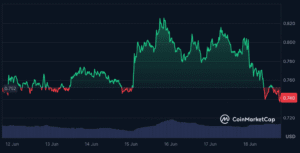
The current price near $0.75 sits between defined support at $0.6671 and resistance at $0.9132. The range has been the operational consolidation zone through the recent weakness. If SUI holds $0.6671, the technical setup allows for relief rally attempts toward $0.9132. If it breaks $0.6671, the next significant support doesn’t appear until the $0.50 zone, which represents the “genesis accumulation level” from early 2024 when Sui first launched broadly.
The $0.50 level carries particular technical significance because it represents where the original Sui ICO participants and earliest adopters acquired the token. If Sui breaks through current support and reaches this zone, it would represent capitulation back to the absolute earliest entry points, washing out all subsequent accumulation. Whether this represents a generational buying opportunity or the start of further decline depends on whether the network’s fundamentals can support price recovery from such depths.
The RSI at approximately 37 indicates oversold conditions but not extreme oversold. The reading suggests selling pressure may be easing but hasn’t fully exhausted. Stronger contrarian buying signals typically appear at RSI levels below 30, which Sui hasn’t yet reached. The combination of oversold-but-not-extreme positioning with sustained selling pressure suggests the bottom may not be definitively in place yet.
The volume profile shows interesting patterns. Trading volumes during the recent decline have been relatively low compared to the absolute network transaction volumes. This disconnect suggests that the price decline reflects a lack of buying interest rather than aggressive selling. Low-volume declines can be persistent because they don’t create the kind of capitulation events that mark cycle bottoms. SUI needs significant buying volume to absorb existing supply before sustained recovery becomes likely.
The Network Activity That Tells a Different Story
Sui’s network metrics paint a fundamentally different picture than the price chart suggests. Understanding the specific activity helps clarify what’s actually happening at the protocol level.
The $65 billion in stablecoin transactions since June 10 came after the network removed fees for stablecoin transfers. The gasless model is a significant strategic move that addresses one of the central challenges for blockchain adoption: transaction costs for everyday payments. By eliminating fees for stablecoin transfers, Sui positions itself directly to compete with traditional payment rails for cross-border and routine transactions.
The volume scale matters specifically. $65 billion in eight days projects to approximately $2.96 trillion annualised if sustained. For comparison, Visa processes roughly $14 trillion annually. Sui’s stablecoin transaction volume during this period reached approximately 21% of Visa’s total annualised volume in just eight days, on a single blockchain network. Whether the rate sustains depends on factors including ongoing user adoption, ecosystem development, and competitive responses from other Layer 1 networks. But the demonstrated capacity is genuinely significant.
The DeFi TVL on Sui sits near $449 million as of the most recent measurements. This level is meaningful for a Layer 1 outside the dominant Ethereum-Solana duopoly. The growth trajectory has been consistent rather than spike-driven, indicating sustained ecosystem development rather than temporary speculative interest.
Remi Technology launched a bank-focused stablecoin infrastructure on Sui, specifically targeting regulated cross-border payments. The product positions Sui as institutional infrastructure for traditional banking flows, similar to how Solana has positioned itself with State Street, BlackRock, and other major financial institutions. The Remi launch isn’t isolated. It’s part of a broader pattern of regulated financial infrastructure being built on Sui that the broader market hasn’t fully recognised.
The network is testing quantum-resistant signatures to meet EU security standards by 2030. This positions Sui as one of the proactive Layer 1 networks addressing the longer-term quantum computing threat, alongside Ripple’s XPL initiative and the Coinbase advisory board’s recent pressure on Bitcoin developers. The technical work happening at Sui’s protocol level represents serious infrastructure preparation for the next decade of blockchain operation.
Recent ecosystem announcements span payments, privacy, AI, and infrastructure across multiple product categories. The breadth of development indicates the Sui Foundation isn’t focused on a single narrow use case but rather building a comprehensive Layer 1 capable of serving diverse application categories. Whether the breadth translates into sustained ecosystem capture or fragments resources too widely remains an open question.
The Bull Case for $0.75 SUI
Several specific factors support the contrarian thesis that current SUI prices represent attractive accumulation territory.
The network fundamentals are genuinely strong. Processing $65 billion in stablecoin volume in eight days demonstrates that the technology works at institutional scale. The gasless transfer model addresses real user needs. The DeFi TVL of $449 million continues growing. The infrastructure investments in quantum resistance, bank-focused stablecoin tools, and AI integration position the network for long-term institutional adoption. None of these fundamentals are reflected in the current price.
Raoul Pal, the macro investor and Real Vision founder, has publicly stated that Sui has the potential to become a top-five cryptocurrency in the 2025 cycle. His framework positions Sui as the institutional Layer 1 of the next Web3 cycle, explicitly distinguishing it from crypto-native narratives. Pal’s macro positioning combined with his public conviction provides credibility that retail-focused analysts can’t match.
The token unlock dynamics may be becoming less problematic. With only 38.5% of maximum supply currently circulating, the remaining 6.15 billion SUI tokens scheduled for future release represent dilution pressure. However, the supply schedule is now well-understood by the market, and much of the dilution has been priced into the current depressed valuation. Future unlocks may produce less price impact than past unlocks because the market has already absorbed the dilution expectation.
The competitive position relative to other Layer 1s has been strengthening. While Ethereum remains dominant in TVL terms and Solana has captured significant institutional integration momentum, Sui has carved out specific niches in stablecoin payments, gaming infrastructure (through SuiPlay), and emerging real-world asset categories. The differentiation provides defensible market position even within a crowded Layer 1 environment.
The catalyst pipeline includes several specific events that could drive price recovery. Continued growth in stablecoin transaction volumes would demonstrate sustained network utility. Major institutional partnership announcements beyond Remi could attract broader investor attention. ETF filings for Sui-related products from major issuers would unlock significant institutional capital. Quantum-resistant signature deployment ahead of competing networks would establish Sui as the security leader in the Layer 1 category.
The Bear Case Worth Taking Seriously
The bearish case for Sui has equally substantive foundations that contrarian investors should examine honestly.
Value accrual to the SUI token is the deeper challenge that the bull case must address. The $65 billion in stablecoin transactions occurred at zero gas fees, meaning the network captured essentially no revenue from this activity. Validators continue earning staking rewards, but the connection between network activity and token demand is genuinely weak under the gasless model. If Sui processes trillions of dollars in stablecoin volume without capturing meaningful revenue, the token value may not benefit proportionally.
The competitive landscape is increasingly hostile. Solana has been gaining institutional momentum throughout 2026 with Moody’s onchain credit ratings, BlackRock’s BUIDL fund, Western Union’s stablecoin, and various other integrations we’ve covered. Base has become the preferred Layer 2 for many institutional integrations. The XRP Ledger has secured major bank partnerships. Each of these competing networks has been gaining mindshare that Sui might otherwise have captured.
The recent network reliability concerns have damaged sentiment. Sui experienced three outages in 48 hours during a software bug incident that caused significant transaction disruptions. While the issues were resolved, the demonstrated network reliability problems raise questions about whether the infrastructure can support the institutional adoption that the bull case requires.
The Aftermath Finance perpetuals exploit on Sui resulted in $1.14 million in losses. While the impact was limited to a single product and other Sui ecosystem applications remained secure, the exploit added to the broader security concerns that affect every Layer 1 outside the most established networks. Each ecosystem exploit creates incremental skepticism about the security of building on the network.
The price action has been bearish for an extended period. Technical analysts have been calling for Sui bottoms multiple times throughout the past 18 months, with each bottom call producing temporary recoveries followed by deeper declines. The pattern of failed recoveries makes it difficult to identify when the actual bottom forms. Investors who position aggressively at every potential bottom have suffered cumulative losses that exceed what would have been achieved by patient accumulation at lower levels.
The longer-term token unlock schedule remains a structural headwind. Even if much of the supply dilution has been priced in, future unlocks introduce ongoing pressure that requires sustained buying demand to absorb. In environments where retail interest remains depressed and institutional flows haven’t fully materialised, the unlocks may continue weighing on price even if fundamental adoption accelerates.
What Investors Should Do
The setup for Sui at $0.75 creates specific positioning considerations based on time horizon and risk tolerance.
For long-term investors with multi-year horizons, the current price levels offer attractive accumulation territory if the institutional adoption thesis materialises. The network fundamentals are real and growing. The technological positioning is genuinely differentiated. The institutional partnerships (Remi, ecosystem developments, quantum-resistance work) provide tangible adoption signals. Dollar-cost averaging into positions over coming weeks captures the asymmetric upside if the thesis succeeds while limiting downside if the bearish trend extends further.
For traders with shorter horizons, the technical setup argues for waiting. The stacked bearish moving averages haven’t broken. The RSI hasn’t reached extreme oversold levels. Until SUI shows clear technical reversal signals (reclaiming the 50-day EMA, then sustained closes above $0.9132) or broader market conditions improve significantly, positioning long carries more risk than waiting for confirmation.
For investors who already hold Sui through the decline, the question is whether to maintain, add to, or reduce positions. The fundamental thesis hasn’t broken if you originally bought based on Sui’s technology and institutional positioning. The price has declined significantly, but the underlying story has been improving rather than deteriorating. Maintaining positions while watching for confirmation of recovery makes sense if you believe in the multi-year thesis. Adding at current levels makes sense if you have additional capital to deploy in conviction positions. Selling locks in significant losses that may be reversed if the recovery materialises.
For investors considering Sui as a new position, the entry price matters but isn’t the only consideration. SUI at $0.75 is meaningfully cheaper than SUI at $5.35. But the better question is whether Sui’s network activity, institutional positioning, and competitive differentiation justify the position at any price. If you believe in the structural case, the current price provides better entry than the cycle peak. If you don’t believe in the structural case, no entry price makes Sui attractive.
The position sizing matters significantly. Sui is a higher-beta asset than Bitcoin or Ethereum, with greater volatility in both directions. Position sizing should reflect this volatility. A small allocation that captures asymmetric upside while limiting portfolio damage from further decline is generally more appropriate than concentrated positioning regardless of price level.
The catalysts to watch over the coming weeks include continued growth in stablecoin transaction volumes, any major institutional partnership announcements, broader crypto market recovery from the hawkish FOMC pressure, and the resolution of any remaining ecosystem reliability concerns. Each positive catalyst provides incremental support for the recovery thesis. Each negative catalyst extends the patience required from current holders.
Sui at $0.75 sits in territory that combines extreme price weakness with strong network fundamentals. The market will eventually resolve which interpretation is correct. Whether it resolves in favour of the network’s adoption metrics or in favour of the persistent price weakness depends on factors that no single catalyst can determine.
The $65 billion in eight days is real. The 85% price decline from the ATH is real. Both will need to be reconciled over the coming months and years. The reconciliation will tell us whether Sui represents the most mispriced Layer 1 in crypto or the most expensive value trap.
FAQ
Why is Sui trading at $0.75 despite strong network activity?
Sui’s network has processed $65 billion in stablecoin transactions since June 10, demonstrating real institutional-scale utility. However, these transactions occurred at zero gas fees under Sui’s new model for stablecoin transfers, meaning the network captured minimal revenue. The disconnect between network activity and token value reflects the broader value accrual challenge facing every Layer 1 outside Bitcoin and Ethereum. The token has also faced ongoing dilution from scheduled unlocks (only 38.5% of maximum supply currently circulating), competitive pressure from Solana and other networks, and recent reliability concerns including three outages in 48 hours.
What are the key price levels for SUI?
Immediate support sits at $0.6671. If this level breaks, the next significant support doesn’t appear until $0.50, the “genesis accumulation level” from early 2024. On the upside, resistance sits at $0.9132, with the next major resistance at $1.05. Reclaiming the 50-day EMA would be the first signal of technical reversal. The price trades below all five major daily EMAs in a stacked bearish configuration that requires substantial buying pressure to reverse.
What could drive SUI recovery?
Several catalysts could support recovery: continued growth in stablecoin transaction volumes demonstrating sustained network utility, major institutional partnership announcements beyond the recent Remi launch, ETF filings for Sui-related products, successful deployment of quantum-resistant signatures ahead of competing networks, broader crypto market recovery from current macro pressure, and resolution of remaining ecosystem reliability concerns. The combination of these catalysts could shift sentiment from the current extreme bearishness toward gradual recognition of the network’s institutional adoption trajectory.
Disclaimer: This article is for informational purposes only and does not constitute financial advice. Cryptocurrency investments carry significant risk. Always conduct your own research before making any investment decisions.