On Monday, Bitcoin gained 2% to reach $66,157. By itself, that’s a meaningful technical recovery that breaks Bitcoin out of its post-SpaceX consolidation range. But the broader market told a more important story.
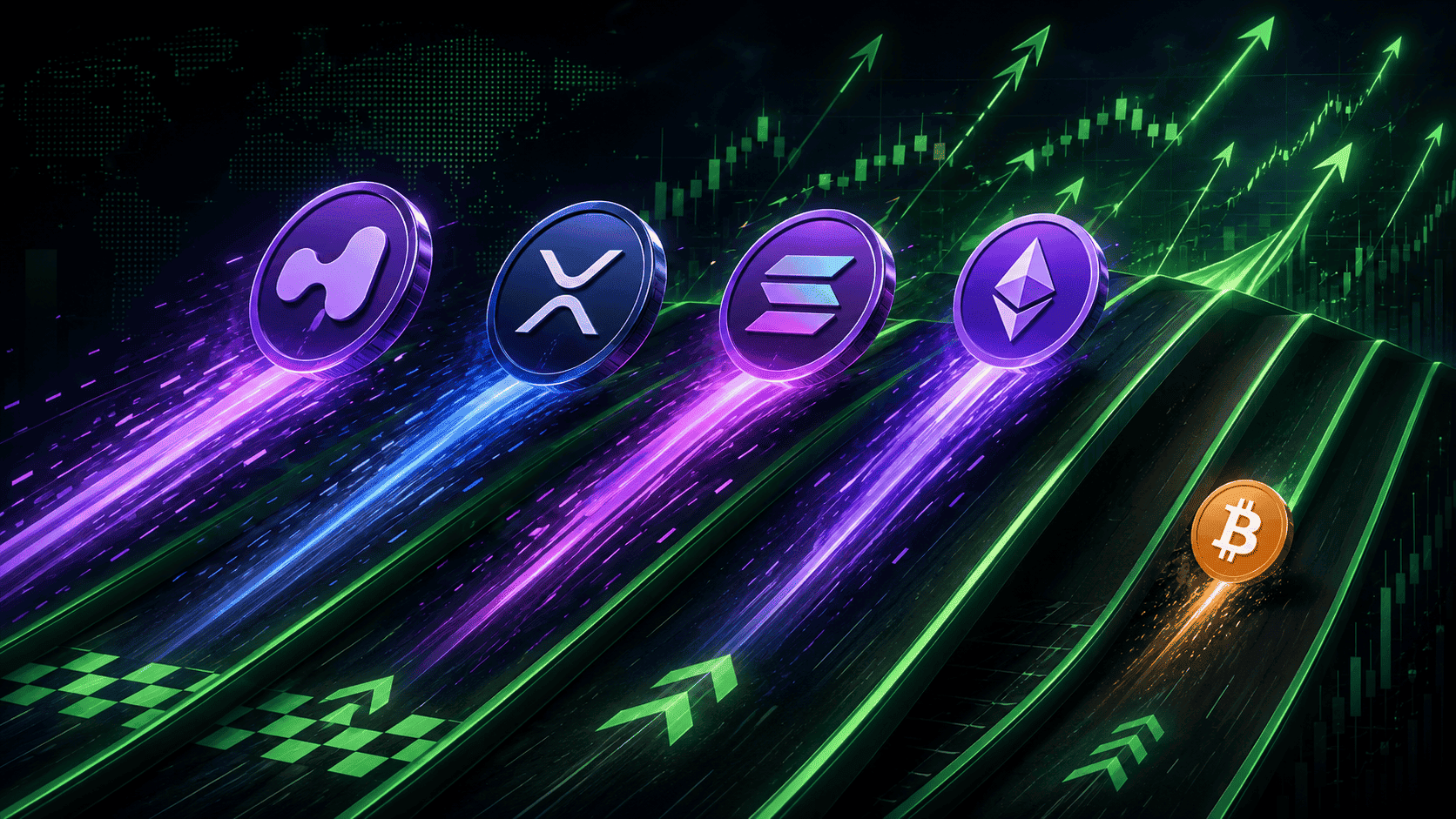
Hyperliquid’s HYPE token gained 7.51%. XRP surged 9.46%. Solana rose 9.30%. Ethereum added 9.29%. Each of these major altcoins delivered gains roughly four to five times larger than Bitcoin’s move on the same trading session. The pattern of altcoins systematically outperforming Bitcoin during an upward move is the textbook signature of returning risk appetite in crypto markets.


The dynamic matters because of what it signals about market structure. During the worst phases of crypto bear markets, Bitcoin typically outperforms altcoins on a relative basis as capital concentrates in the highest-quality asset. When the market shifts from defensive positioning to offensive positioning, the rotation works in reverse. Capital moves out of Bitcoin and into higher-beta altcoins that historically deliver greater returns during bull market phases.
Monday’s session showed exactly this rotation. The breadth of altcoin gains, with no major asset materially underperforming, confirms that the move isn’t driven by any single token-specific catalyst. The rotation is structural, not coincidental.
For investors who have been waiting for confirmation that the bear market is over, the altcoin outperformance provides exactly the kind of signal they’ve been watching for. The next several weeks will determine whether the rotation extends into a sustained altcoin season or whether it represents another false start. The catalysts arriving over the coming days, the FOMC meeting and the CLARITY Act vote, will play significant roles in determining the answer.
What “Altcoin Rotation” Actually Means
Altcoin rotation refers to the cyclical pattern in crypto markets where capital flows shift between Bitcoin and altcoins based on broader sentiment conditions. The pattern has been consistent across multiple crypto cycles since 2017.
During fear-driven environments, capital concentrates in Bitcoin. The asset’s larger market cap, deeper liquidity, and stronger institutional support make it the natural defensive holding within crypto. Altcoins typically underperform during these phases because their smaller size and higher volatility amplify downside moves. Bitcoin dominance, the percentage of total crypto market cap represented by Bitcoin, rises during fear periods as the rotation toward safety plays out.
During greed-driven environments, capital flows the opposite direction. Investors who have made money in Bitcoin look to capture additional upside in higher-beta altcoins. The flow of capital from Bitcoin into altcoins produces the characteristic “altcoin season” where smaller assets outperform Bitcoin for sustained periods. Bitcoin dominance falls during these phases as capital diversifies across the broader market.
Monday’s session showed the classic altcoin rotation pattern in microcosm. HYPE up 7.51% while Bitcoin only up 2%. XRP up 9.46% while Bitcoin only up 2%. Solana up 9.30% while Bitcoin only up 2%. The performance gap between Bitcoin and altcoins is what distinguishes rotation events from broad-based rallies where everything moves together.
The technical mechanics are straightforward. When traders feel confident enough to take risk, they buy altcoins with the proceeds of Bitcoin sales or with new capital they would have parked in Bitcoin during fear conditions. The altcoin demand outpaces Bitcoin demand, producing the differential performance that defines the rotation.
For Monday specifically, several factors contributed to the rotation timing. The Iran peace deal progression eased macro fears. The FOMC tomorrow is widely expected to deliver a neutral hold. ETF flow data turned positive across both Bitcoin and Ethereum products last week. The combination of macro improvements and structural validation produced the conditions for risk-on positioning.
The Standouts That Tell Specific Stories
Each of the major altcoin performers carries individual narratives that contributed to its outperformance beyond the general rotation dynamic.
HYPE gaining 7.51% reflects multiple factors specific to Hyperliquid. The platform has been one of the most consistent revenue generators in crypto, with $620 million annualised revenue and over 50% of all decentralised perpetual futures volume. Three ETF filings are progressing through SEC review. Grayscale is negotiating a $115 million seed deal for a staking ETF. ICE is publicly studying the Hyperliquid model. The fundamental backdrop has supported HYPE’s recovery from the recent FCA warning and Arthur Hayes exit drama. Monday’s 7.51% gain extends the recovery from those negative catalysts.
XRP gaining 9.46% combines two specific drivers. The XRP Ledger 3.2.0 protocol upgrade activated today, June 15, bringing performance improvements including up to 40% reduction in server memory usage. This technical milestone arrives alongside RippleX’s three-stage quantum resistance roadmap announcement. The CLARITY Act floor vote expected this week, which would formally classify XRP as a commodity, provides regulatory catalyst potential. Combined with the macro recovery, XRP’s structural setup produces outsized gains during risk-on sessions.
Solana gaining 9.30% reflects the continued institutional infrastructure expansion. Spot Solana ETFs have surpassed $1 billion in assets. Morgan Stanley filed for a Solana trust. BlackRock and Visa have both moved into the Solana ecosystem. Forward Industries holds 6.9 million SOL through significant unrealised losses, demonstrating institutional conviction. The Alpenglow upgrade targeted for Q3 2026 remains the major forward-looking catalyst. SOL breaking above $70 on Monday confirms that the institutional bull thesis is producing real price impact.
Ethereum gaining 9.29% is particularly significant given the asset’s recent underperformance. The 17-day ETF outflow streak that crushed Ethereum throughout May and early June finally broke on June 5. BitMine’s Tom Lee bought $206 million worth of ETH over three days last week, publicly calling the bottom at $1,627. The recovery from $1,627 to $1,762 (up 8% in two trading sessions) validates the contrarian conviction buying. Ethereum’s $1,800 level becomes the next test for whether the recovery extends into a sustained move.
The breadth of the outperformance, with multiple major altcoins all delivering similar gains, suggests the rotation isn’t a thin liquidity event amplifying one or two specific tokens. The pattern reflects genuine institutional and retail demand returning to the broader altcoin market.
Why This Rotation Could Extend
Several factors support the case that Monday’s rotation represents the beginning of a sustained altcoin recovery rather than a one-day spike.
Bitcoin dominance has been declining gradually since the recent crisis. During the worst of the selloff, dominance climbed above 60% as investors concentrated in Bitcoin. The decline back toward more typical levels suggests capital is willing to spread across the broader market again. If dominance continues falling toward 55% or below, the altcoin season thesis gains significant credibility.
The institutional infrastructure being built around altcoins has reached unprecedented levels. ETF products covering Solana, XRP, and HYPE all exist or are progressing. Major banks including BlackRock, JPMorgan, and Morgan Stanley have integrations with Ethereum, Solana, and XRP Ledger respectively. Mastercard’s Agent Pay for Machines protocol uses Polygon, Solana, and Base as credentialing infrastructure. The systemic importance of altcoins has grown substantially over the past 18 months.
The CLARITY Act vote expected this week represents a specific catalyst that would benefit altcoins more than Bitcoin. The bill formally classifies digital assets as commodities, removing regulatory uncertainty that has constrained institutional altcoin allocations. Standard Chartered projects $4 to $8 billion in additional XRP ETF inflows alone if the bill passes. Similar institutional flows could enter other major altcoins as regulatory certainty improves.
The FOMC outcome tomorrow could provide additional altcoin tailwinds. Altcoins are higher-beta risk assets that historically respond more sharply to macro positive surprises than Bitcoin does. If Warsh delivers anything other than a hawkish shock, the relief rally that follows would likely produce additional altcoin outperformance.
The combination of declining Bitcoin dominance, expanding institutional infrastructure, specific regulatory catalysts, and supportive macro positioning produces the conditions for sustained altcoin outperformance. Whether the rotation extends beyond the current week depends on whether these catalysts deliver as expected.
The Risks to Watch
Several scenarios could invalidate the altcoin rotation thesis.
A hawkish FOMC surprise tomorrow would hit altcoins harder than Bitcoin. The same higher-beta characteristic that produces outsized gains during risk-on sessions amplifies losses during risk-off sessions. If Warsh delivers explicitly hawkish positioning with hike projections, altcoins could give back significant portions of Monday’s gains within hours.
CLARITY Act failure would remove a specific catalyst that altcoins have been pricing in. The regulatory uncertainty premium that constrains institutional altcoin allocation would persist for months or potentially years. Altcoins would underperform Bitcoin during the resulting risk-off rotation.
Bitcoin breaking back below $62,000 would likely trigger broader crypto market weakness regardless of individual altcoin catalysts. The correlation between Bitcoin and altcoins tightens during stress events, with altcoins typically underperforming during sharp Bitcoin declines.
Profit-taking after the strong gains is a near-term risk. Traders who positioned for the rotation may begin selling into strength to lock in gains. The mechanical selling pressure could produce pullbacks even if the underlying recovery thesis remains intact.
For positioning, the asymmetric risk-reward suggests gradual exposure rather than aggressive lump-sum entries. Adding altcoin positions during pullbacks within the broader recovery captures the upside if the rotation extends while limiting downside if catalysts disappoint.
What This Means for Portfolio Strategy
For investors with diversified crypto portfolios, Monday’s altcoin outperformance validates the strategy of maintaining exposure across multiple major assets. The rotation produces strong returns for portfolios that include altcoins rather than concentrating entirely in Bitcoin.
For investors with concentrated Bitcoin positions, the rotation raises strategic questions about whether to add altcoin exposure during the current recovery. Adding positions at current prices captures the upside if the rotation extends but provides less margin of safety than entering during the recent low-fear period. Dollar-cost averaging into selected altcoins reduces the risk of poorly timed entries while still capturing exposure to the rotation thesis.
For investors who reduced crypto exposure entirely during the recent decline, Monday’s session provides additional evidence that the recovery is genuine rather than a false start. Re-entering positions during the current strength captures the recovery but at less attractive prices than entries during the June 4 low. Patient capital that’s willing to accept potential short-term pullbacks may find better entry points during corrections within the broader recovery.
The asset selection within altcoins matters. Not all altcoins are participating equally in the rotation. The strongest performers (HYPE, XRP, SOL, ETH) all have specific institutional catalysts driving demand beyond the general rotation dynamic. Other altcoins with weaker fundamental backdrops may underperform even during the broader rotation. Focusing exposure on altcoins with identifiable institutional catalysts and structural improvements provides better risk-reward than indexed exposure to the broader altcoin market.
The historical pattern of altcoin seasons suggests they typically extend over weeks or months once they begin, with periodic corrections within the broader uptrend. If Monday’s session marks the beginning of a sustained rotation, the gains over the coming months could be substantial. If it represents a false start, the pullback could come quickly and require patience for the next confirmed rotation signal.
Watch the FOMC outcome tomorrow. Watch the CLARITY Act vote this week. Watch Bitcoin dominance for the trend direction. Each of these data points will help determine whether Monday’s rotation extends or fades.
FAQ
What does altcoin rotation mean?
Altcoin rotation describes the cyclical flow of capital between Bitcoin and altcoins based on market sentiment. During fear periods, capital concentrates in Bitcoin as a defensive holding within crypto. During greed periods, capital flows from Bitcoin into higher-beta altcoins that deliver greater returns during bull market phases. The pattern is identified by altcoins systematically outperforming Bitcoin during upward moves, which is what occurred on Monday.
Why did HYPE, XRP, and SOL outperform Bitcoin?
Each altcoin combined general rotation dynamics with specific catalysts. HYPE benefited from Hyperliquid’s expanding institutional pipeline including three ETF filings. XRP gained from the XRP Ledger 3.2.0 upgrade activating Monday and the CLARITY Act vote expected this week. Solana extended its recovery on continued institutional infrastructure expansion through BlackRock, Visa, and Morgan Stanley involvement. The combination of rotation dynamics and individual catalysts produced the outsized gains.
Will the altcoin rotation continue?
Several factors support extension including declining Bitcoin dominance, expanding institutional infrastructure for altcoins, the CLARITY Act vote this week, and the FOMC outcome tomorrow potentially providing additional tailwinds. However, a hawkish FOMC surprise or CLARITY Act failure could invalidate the rotation thesis. The asymmetric risk-reward suggests gradual altcoin exposure rather than aggressive lump-sum entries, with adding positions during pullbacks if the broader recovery extends.
Disclaimer: This article is for informational purposes only and does not constitute financial advice. Cryptocurrency investments carry significant risk. Always conduct your own research before making any investment decisions.