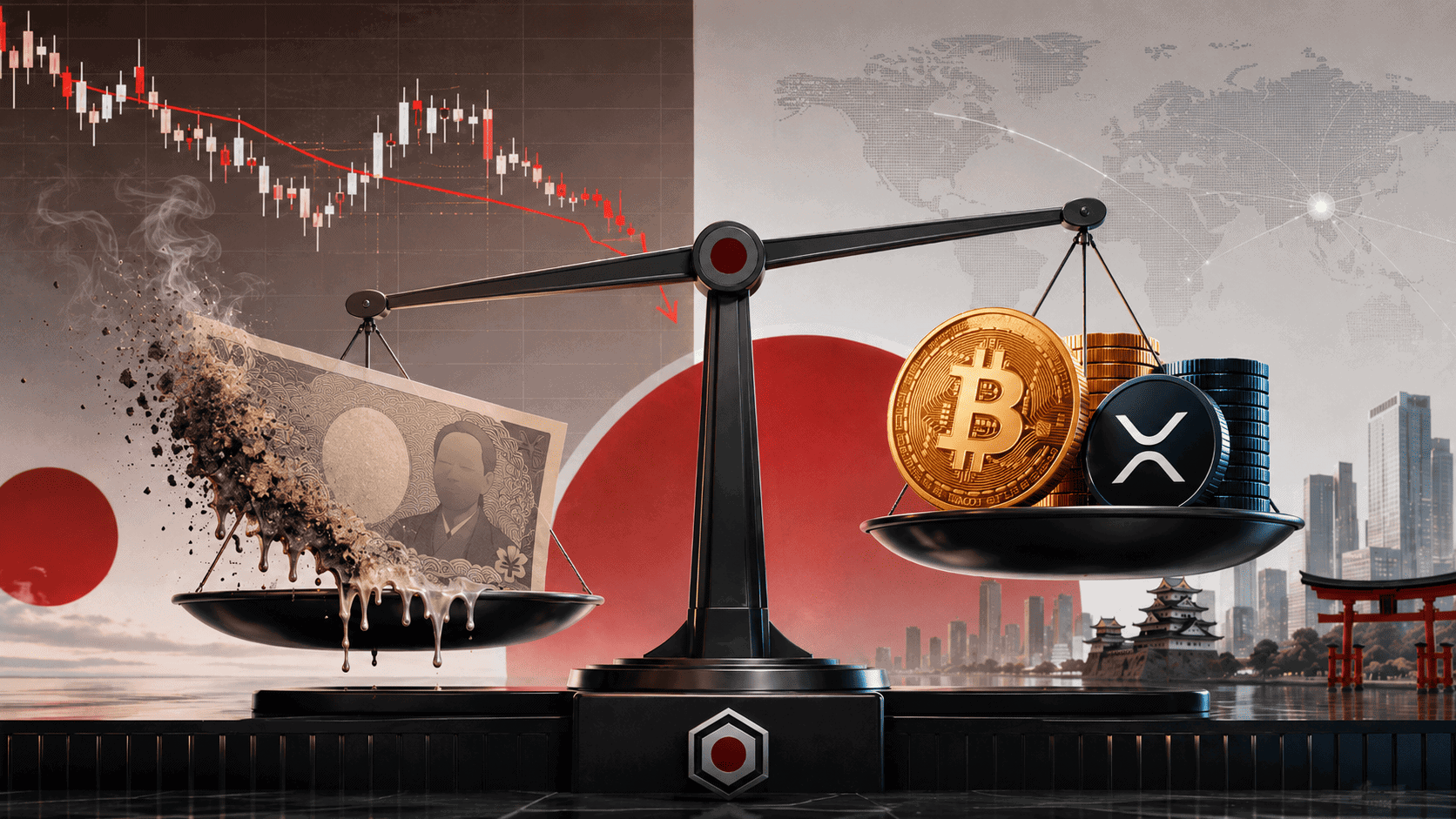
For decades, the safest thing a Japanese company could do with its money was hold yen. Cash was king. It was stable, liquid, and backed by one of the world’s most trusted currencies. Keeping reserves in yen wasn’t a decision anyone had to think hard about. It was simply the default.
That default is breaking down.


The yen is now trading near its weakest level in more than four decades, with the dollar buying around 162 yen. For a Japanese company holding its reserves in cash, that persistent weakness means the real value of those reserves is quietly eroding. And according to SBI VC Trade, the crypto arm of Tokyo-based financial group SBI Holdings, a growing number of firms are responding by doing something that would have seemed radical a few years ago: moving Bitcoin and XRP onto their balance sheets.
The exchange said its registered accounts have surpassed 2 million, roughly double the level a year earlier. Demand for its corporate service, SBIVC for Prime, has grown specifically as the weak yen pushes companies to diversify reserves beyond cash. It’s a quiet but meaningful shift, and it turns one of the oldest arguments for crypto, that it’s a hedge against currency debasement, from theory into corporate practice in the world’s third-largest economy.
Why the Yen Is So Weak
Understanding the crypto adoption requires understanding what’s happening to the yen, and the cause comes down to a single gap.
The driver is the interest-rate difference between the US Federal Reserve and the Bank of Japan. The Fed under Chair Kevin Warsh has maintained a hawkish stance with relatively high interest rates. The Bank of Japan, by contrast, has kept its rates far lower despite recent hikes. When one country offers much higher returns on its currency than another, money flows toward the higher-yielding one. Investors sell yen to buy higher-returning dollar assets, pushing the yen down and the dollar up.
This gap does two things at once. It makes holding yen cash a losing position, because the currency keeps depreciating while earning minimal interest. And it fuels the famous “yen carry trade,” where investors borrow cheaply in yen to buy higher-returning assets elsewhere. Some of that flow is now reaching crypto through regulated Japanese channels rather than offshore ones.
The pressure isn’t easing. Hedge funds have turned the most bearish on the yen since 2007, boosting bets on further losses to nearly 138,000 contracts as of June 30, according to US Commodity Futures Trading Commission data. When the world’s most sophisticated traders are betting heavily on continued yen weakness, Japanese companies holding cash reserves have every reason to look for alternatives that can hold value better.
What Companies Are Actually Doing
The corporate response has taken a few specific forms, and the details reveal how seriously Japanese firms are treating this.
The most direct move is treasury diversification, adding Bitcoin and XRP to corporate reserves as an alternative to cash. The logic mirrors what drove companies like Strategy in the US: if your home currency is losing value, holding a portion of reserves in a scarce, appreciating asset can protect purchasing power. Fidelity Digital Assets recently illustrated the appeal, noting that while US home prices in dollars have risen over $100,000 since 2020, their cost measured in Bitcoin has dropped to about one-tenth, reflecting Bitcoin’s strong appreciation over the period.
A second, more distinctly Japanese trend is the use of crypto in shareholder benefit programs. Japan has a long tradition of “kabunushi yutai,” where companies give shareholders perks and rewards. SBI VC Trade reported that more firms are now distributing Bitcoin or XRP as part of these shareholder incentive schemes. It’s a creative twist that uses crypto not just as a reserve asset but as a tool for corporate engagement, and Metaplanet’s earlier Bitcoin rewards program showed the same instinct at work.
The inclusion of XRP alongside Bitcoin is notable. In most corporate treasury stories globally, Bitcoin dominates and other assets barely feature. In Japan, XRP has genuine traction, partly due to Ripple’s longstanding relationships in the country and SBI’s own close ties to Ripple. XRP has had a strong run recently, gaining around 9.5% in the past week, driven by a sharp increase in spot market volumes that jumped from $42 million in May to over $400 million recently.
The Regulated Channel Advantage
What makes the Japanese story different from crypto adoption elsewhere is the regulatory framework it’s happening within.
Japan has one of the strictest crypto licensing regimes in the world. That strictness has historically kept the market smaller than in the US, but it also means the crypto access Japanese companies now use runs through heavily regulated, compliant channels. When a Japanese company adds Bitcoin to its treasury through SBI VC Trade, it’s doing so through a licensed exchange under a mature regulatory system, not through offshore platforms of uncertain standing.
This matters because it makes crypto adoption viable for conservative corporate treasurers who would never touch an unregulated venue. The carry-trade flows reaching crypto are arriving through domestic regulated rails rather than offshore ones, which lends the trend more durability and legitimacy.
SBI VC Trade has been building infrastructure to support this. Its 2 million registered accounts combine its VCTRADE and BITPOINT services following an April 2026 merger with BitPoint Japan. Beyond spot trading, it has expanded into staking, lending, and stablecoins. It became the first exchange in Japan to list USDC in March 2025, and in June 2026 added Ripple’s dollar-backed RLUSD alongside JPYSC, a yen-pegged stablecoin it described as Japan’s first trust-based yen stablecoin. This growing suite of regulated products gives corporate users more ways to hold and use digital assets within a compliant framework.
What This Means for the Market
The Japanese corporate adoption trend carries implications worth thinking through, both for crypto broadly and for the specific assets involved.
For the debasement thesis, Japan is becoming a real-world test case. The argument that crypto serves as a hedge against currency weakness has often been theoretical or tied to extreme cases like hyperinflation. Japan is a stable, wealthy, developed economy whose currency is simply weakening due to interest-rate dynamics. If companies there increasingly choose Bitcoin over cash to preserve value, it validates the hedge argument in a mainstream context rather than an emergency one.
For Bitcoin and XRP specifically, sustained corporate demand from Japan provides a structural buying source that isn’t tied to the speculative cycles driving much of the market. Corporate treasury allocation tends to be longer-term and less reactive to short-term price swings than retail trading. If the yen stays weak, this demand could persist regardless of what Bitcoin’s price does week to week.
There are real risks to keep in mind. Companies adding volatile crypto to their reserves are trading one form of risk (currency depreciation) for another (price volatility). Bitcoin’s own 50% drawdown from its October 2025 peak is a reminder that crypto reserves can lose value faster than a slowly depreciating yen. A company that moved reserves into Bitcoin near the top would have fared worse than one that simply held cash. The strategy protects against gradual erosion but exposes firms to sharp drawdowns.
The broader significance is what the trend says about how currency dynamics are reshaping corporate behavior globally. Japan’s situation is specific, but the underlying pressure, low-yielding local currency losing value against a stronger dollar, exists in many economies. If the Japanese model proves durable, it could become a template that companies in other weakening-currency environments follow. The yen’s weakness is Japan’s problem today. The corporate response it’s producing may turn out to be a preview of a broader shift in how companies around the world think about what belongs in their treasuries when cash stops feeling safe.
FAQ
Why are Japanese companies buying Bitcoin and XRP?
The Japanese yen is trading near its weakest level in more than four decades, driven by the interest-rate gap between the hawkish US Federal Reserve and the lower-rate Bank of Japan. This makes holding yen cash a losing position as the currency depreciates. According to SBI VC Trade, companies are increasingly moving Bitcoin and XRP onto their balance sheets to diversify reserves beyond cash and protect purchasing power. The exchange’s registered accounts have doubled to 2 million over the past year.
Why XRP alongside Bitcoin?
While Bitcoin dominates corporate treasury adoption globally, XRP has particular traction in Japan due to Ripple’s longstanding relationships there and SBI Holdings’ close ties to Ripple. SBI VC Trade added Ripple’s dollar-backed RLUSD stablecoin in June 2026. XRP has also had a strong run recently, gaining around 9.5% in a week as spot volumes surged from $42 million in May to over $400 million. Japanese firms are using both Bitcoin and XRP in treasury reserves and in shareholder benefit programs.
Is this a safe strategy for companies?
It involves trade-offs. Moving reserves from cash into crypto protects against gradual currency depreciation but exposes companies to crypto’s price volatility. Bitcoin fell roughly 50% from its October 2025 peak, so a firm that allocated near the top would have fared worse than one holding cash. The strategy defends against slow erosion of value but carries risk of sharp drawdowns. The fact that this adoption happens through Japan’s strict regulated exchanges rather than offshore venues makes it more viable for conservative corporate treasurers.
Disclaimer: This article is for informational purposes only and does not constitute financial advice. Cryptocurrency investments carry significant risk. Always conduct your own research before making any investment decisions.