Bitcoin finished July with a gain of roughly 10%, a genuine reversal after the punishing declines of May and June. It briefly pushed above $65,000 and, at one point in the month, touched $66,910. Momentum looked like it was turning.
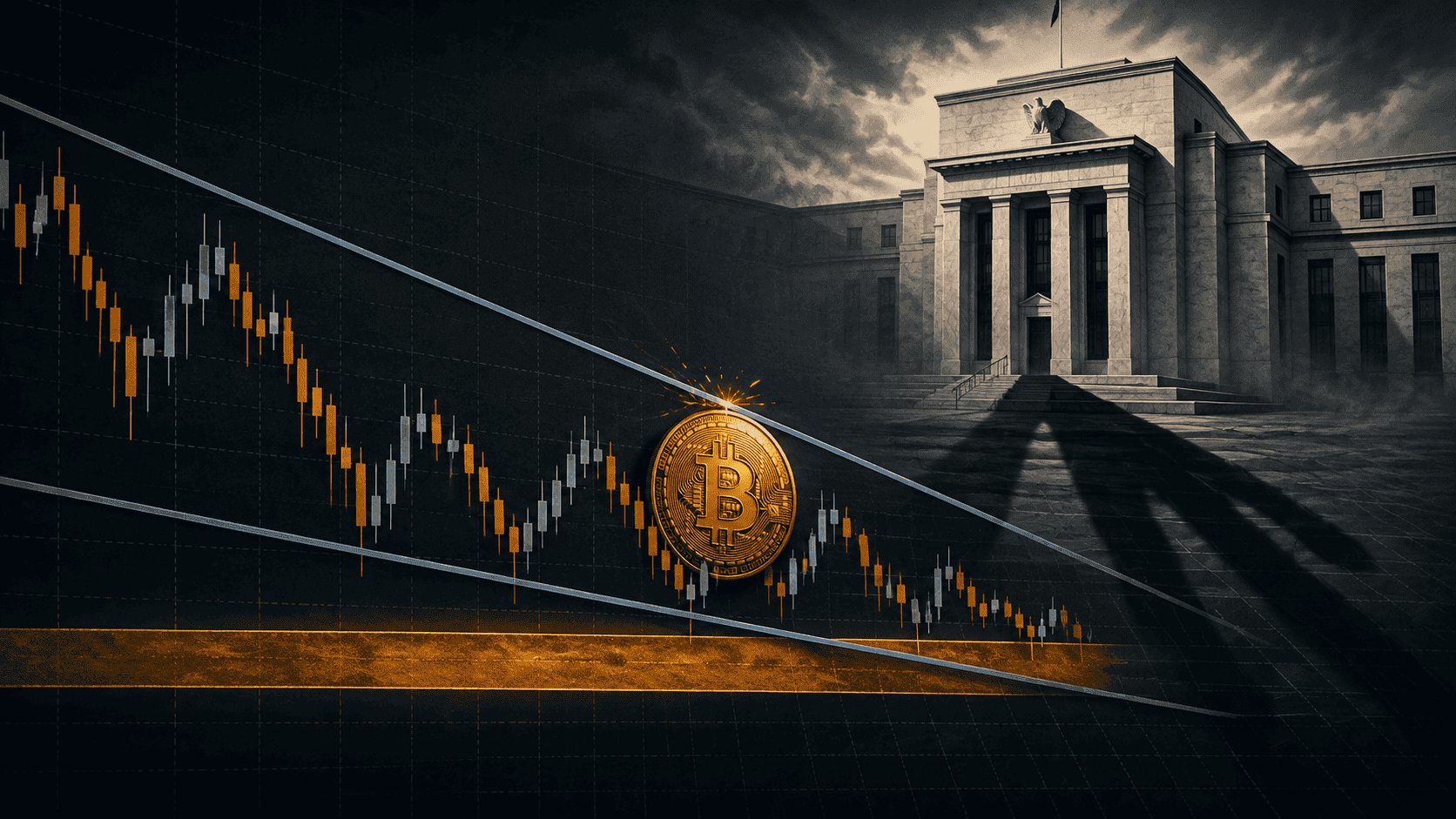
It has spent the first two days of August giving that back. Bitcoin trades near $62,900 after being rejected at the upper boundary of its descending channel, back below its 20-day moving average, with the longer-term averages still sloping down. Ethereum sits near $1,865, having failed to hold above the rising trendline that supported its own July recovery, though its RSI near 51 and its position above key support leave it technically stronger than bitcoin.


Three forces will shape the month: a Federal Reserve that just turned more hawkish than expected, a seasonal pattern that is unusually consistent, and a Jackson Hole symposium that for once has crypto directly on the agenda.
The Fed Turned Harder Than the Headline
Wednesday’s decision was reported as a hold, and it was. But the vote was 9–3, with Beth Hammack, Neel Kashkari and Lorie Logan all dissenting in favour of a quarter-point hike. That broke June’s unanimous hold and made the outcome considerably more hawkish than the rate itself suggested.
Markets repriced immediately. September hike odds moved above 57% on CME FedWatch and had reached roughly 66% by August 1, with the Atlanta Fed’s tracker placing the probability as high as 83% on the day of the decision. There is effectively zero chance of a cut priced in. Long-dated yields moved with it: the 10-year ended July near 4.74% and the 30-year reached 5.27%, its highest since 2007, signalling that bond investors expect rates to stay elevated well past this month.
That matters more for bitcoin than usual. The asset’s correlation with the S&P 500 peaked at 0.96 in April, and ETF flows, which respond directly to shifts in rate-hike probability, are estimated to explain roughly 45% of weekly price moves. Bitcoin’s 2026 has been a rates story from start to finish, and rates just got less friendly.
There is a genuine ambiguity underneath, though. Warsh has defined his reaction function around “underlying inflation” without disclosing how he weighs the indicators. The official dashboard spans 1.5 percentage points: headline PCE at 3.7%, core PCE at 3.3%, Atlanta Fed sticky-price CPI at 2.8%, Cleveland Fed 10-year expected inflation at 2.43%, and the Dallas Fed’s trimmed-mean PCE at 2.2%. One economy is producing readings from nearly double the target to barely above it, and which one Warsh privileges determines September.
The Seasonal Pattern Is Hard to Dismiss
August has a claim to being bitcoin’s worst month, and the data is more consistent than most seasonal arguments.
Across 15 years, August has averaged -0.64% with a median of -7.87%, making it the only month with a negative median return in bitcoin’s entire history. It has closed red nine times in those fifteen years. Notable losses include -32.3% in 2011, -14% in 2022, -8.73% in 2024 and -6.43% in 2025.
The four-year cycle comparison is starker still. Every August in comparable cycle positions has closed deeply negative: -17.55% in 2014, -9.27% in 2018 and -13.88% in 2022, averaging around -13.6%. Analyst LP_NXT projects a bottom in the $58,000 to $62,000 range this month before a rebound.
The honest caveat is that seasonality is a pattern, not a mechanism. Fifteen observations is a small sample, and the average August return across the full history is actually positive at around +1.12%, meaning a handful of strong months pull the mean above a much weaker median. Entering August with positive 30-day momentum, as bitcoin has, has not historically protected it, but nor does the pattern guarantee anything. It is a reason for caution, not a forecast.
The Levels That Matter
The technical structure is reasonably clear for once.
Bitcoin is pressing against a descending trendline running from the October 2025 peak near $126,000, and has been rejected there. All four weekly exponential moving averages slope downward above price, with the 20-week at $69,445 the nearest ceiling, followed by the 200-week at $68,468, the 50-week at $78,365 and the 100-week at $79,077.
The floor bulls need to defend is the $60,000 to $62,000 horizontal support band, which has held through multiple tests since the June low. Losing it would open a path toward that June low near $57,500. On the upside, a decisive break above the descending trendline would be the first genuine signal that the downtrend from October has ended.
Ethereum’s setup is the more constructive of the two. It continues to trade above key support despite recent weakness, and its ascending trendline from the July recovery is the level to watch. XRP remains inside its own descending channel, waiting on a breakout that has not come.
Jackson Hole Is Different This Year
The event worth marking on the calendar is the Jackson Hole Symposium on August 27 to 29, and not only for the usual reasons.
The 2026 edition is themed “Financial Innovation: Implications for Payments and Policy,” which directly covers digital payments, central bank digital currencies and financial technology. In prior years, crypto moved on Jackson Hole only when the speeches shifted rate expectations. This year Warsh’s address could touch digital asset regulation or CBDC frameworks directly, meaning bitcoin could react to policy content rather than just monetary tone.
Warsh has indicated he may offer further guidance on the economic outlook there ahead of the September meeting, and plans to review internal work before the speech. Given he has stripped forward guidance from FOMC statements and there are no fresh projections until September 15–16, Jackson Hole is realistically the only substantial signal traders will get this month.
What to Watch
The month sets up as a genuine test of whether July’s recovery was a turn or a bounce. The bearish case is straightforward: August seasonality plus rising September hike odds pushes bitcoin through the $60,000 to $62,000 band toward $57,500. The bullish case requires the inflation data to cool enough to reprice September lower, which would let bitcoin attack the descending trendline with ETF flows following.
Practically, three things carry the most information. Watch whether the $60,000 to $62,000 support band holds, because it has defined the floor since June. Watch September hike odds on CME FedWatch, since they move ETF flows and ETF flows move price. And watch Warsh at Jackson Hole, where for the first time a Fed chair may speak about digital assets directly rather than only about the rates that govern them.
FAQ
Why are September rate hike odds rising?
The July 29 FOMC held rates at 3.50% to 3.75% but by a 9–3 vote, with Beth Hammack, Neel Kashkari and Lorie Logan dissenting in favour of a quarter-point increase. That broke June’s unanimous hold and signalled genuine internal support for tightening. September hike odds moved above 57% immediately and reached roughly 66% by August 1, with essentially no chance of a cut priced in. The 30-year Treasury yield hit 5.27%, its highest since 2007.
Is August really bitcoin’s worst month?
By median return, yes. Across 15 years August has averaged -0.64% with a median of -7.87%, the only month with a negative median in bitcoin’s history, closing red nine times. In comparable four-year cycle positions the pattern is starker: -17.55% in 2014, -9.27% in 2018 and -13.88% in 2022. However, the full-history average is positive at +1.12%, meaning a few strong Augusts skew the mean. Seasonality is a pattern worth noting, not a mechanism that guarantees an outcome.
What are the key levels?
The critical support is the $60,000 to $62,000 band, which has held through multiple tests since the June low near $57,500. Bitcoin is currently rejected at a descending trendline running from the October 2025 peak near $126,000, with the 20-week EMA at $69,445 and 200-week at $68,468 as overhead resistance. Ethereum is technically stronger, holding above key support with its ascending trendline as the level to defend.
Disclaimer: This article is for informational purposes only and does not constitute financial advice. Cryptocurrency investments carry significant risk. Always conduct your own research before making any investment decisions.