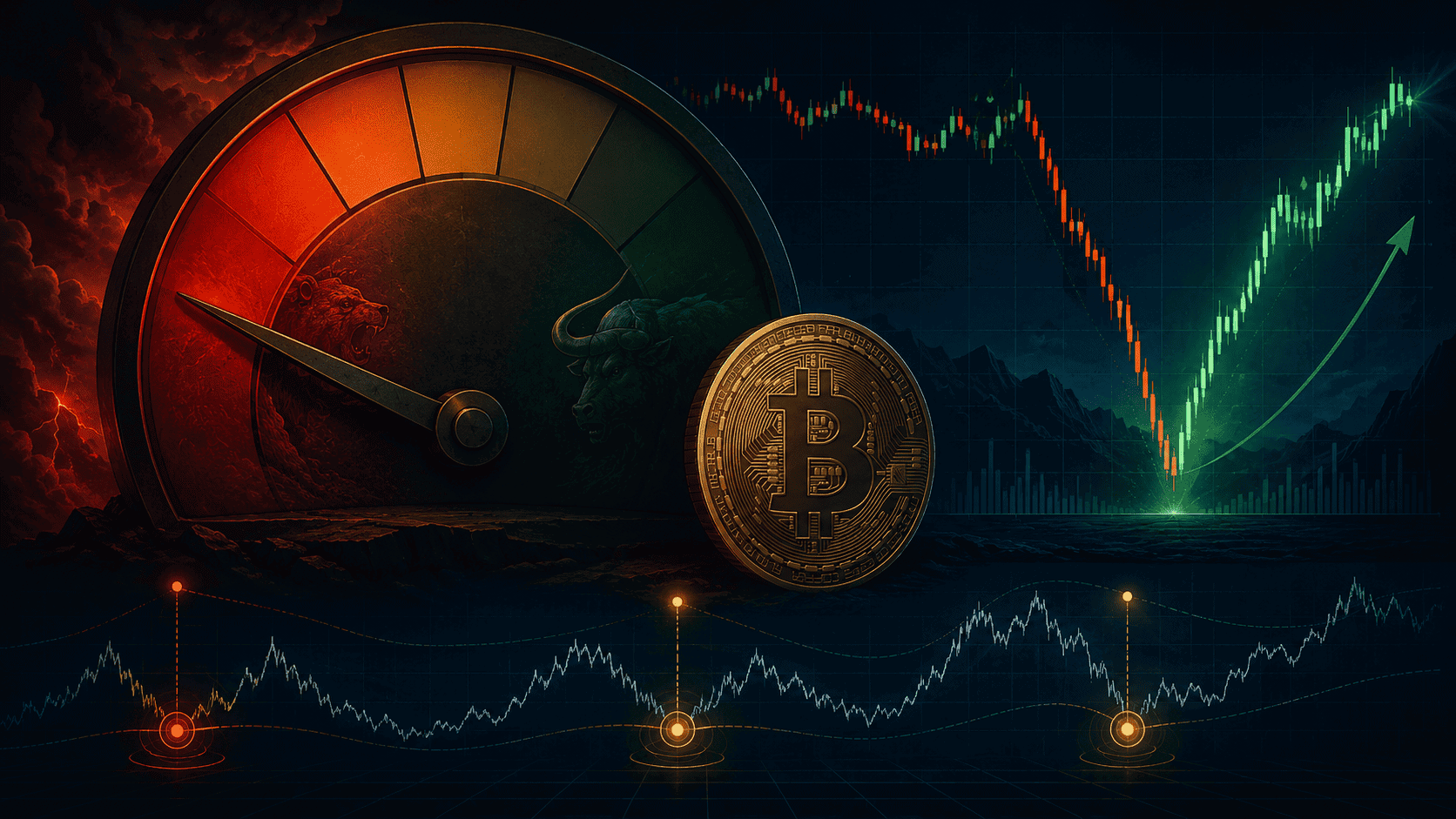
The Crypto Fear & Greed Index has spent most of June below 20. The reading represents “extreme fear” territory, defined by the index methodology as conditions when investors are too pessimistic about market direction. Historically, sustained readings below 20 have marked some of the best multi-year entry points in cryptocurrency. The November 2022 cycle bottom near $16,000. The March 2020 COVID crash at $4,000. The December 2018 capitulation at $3,100. Each of these periods featured extended Fear & Greed readings in the same range that’s persisting now.
But this time something’s different. Bitcoin reached its June 4 low at $59,770. It then recovered 12% to $67,236 by June 17. Then it fell back to $62,445 following the hawkish FOMC. Throughout this entire range, the Fear & Greed Index has remained pinned below 20. Sentiment hasn’t recovered with price action. The disconnect between what investors are feeling and what’s actually happening to Bitcoin’s price has rarely been wider.


For contrarian investors, this disconnect is the most interesting signal of 2026. Sustained extreme fear during recovery phases has historically been a stronger buy signal than extreme fear during decline phases. The pattern indicates that retail investors and momentum traders are convinced the bear market is continuing, even as price action begins forming a bottom. The investors who position correctly during these periods typically capture the largest gains of subsequent cycles.
For investors caught in the bearish positioning, the same disconnect represents a different signal. Maybe sentiment is correct and the recovery from $59,770 is a dead cat bounce that will eventually fail. Maybe the macro environment has genuinely shifted in ways that previous extreme fear readings didn’t have to navigate. Maybe the structural changes to Bitcoin’s investor base mean historical sentiment patterns no longer apply.
Understanding which interpretation is correct requires examining what extreme fear actually means, what the historical pattern looks like in detail, and what specific factors might be different about the current cycle.
What the Fear & Greed Index Actually Measures
The Crypto Fear & Greed Index combines multiple inputs to produce a single 0-100 score representing market sentiment. Understanding the components helps clarify what the current reading actually reflects.
The index incorporates volatility measurements (how much Bitcoin’s price is fluctuating relative to recent ranges), market momentum (recent price trends and trading volume), social media sentiment (analysis of Twitter, Reddit, and other platforms for fear/greed language), surveys (periodic investor sentiment surveys), Bitcoin dominance (the asset’s share of total crypto market cap), and Google search trends (what terms investors are searching for).
Each component contributes a weighted score, and the combined result produces the headline number. Readings below 20 indicate extreme fear: high volatility combined with bearish momentum, fearful social media language, and search patterns dominated by terms like “Bitcoin dead” or “should I sell crypto.”
Readings between 20-40 indicate fear without the “extreme” qualifier. Readings between 40-60 indicate neutral conditions. Readings between 60-80 indicate greed. Readings above 80 indicate extreme greed, when investors are euphoric and momentum trading dominates.
The historical patterns at sentiment extremes have been remarkably consistent. Extreme greed (80+) has typically marked local or cycle tops, followed by significant corrections. Extreme fear (below 20) has typically marked local or cycle bottoms, followed by significant recoveries. The exact timing between extreme readings and subsequent reversals varies, but the directional pattern has held across multiple cycles.
The current reading below 20 has persisted for an unusually extended period. Most extreme fear readings last days or perhaps weeks before sentiment shifts. The current reading has held for most of June. The persistence itself is unusual and provides additional information beyond the simple level of the reading.
The Historical Parallels
Examining the previous periods of sustained extreme fear helps calibrate what the current reading might predict.
November 2022. Bitcoin had fallen from its $69,000 peak in November 2021 through approximately 80% to $16,000 over twelve months. The FTX collapse in early November 2022 produced the final capitulation. The Fear & Greed Index hit single-digit readings (briefly touching 6) during the peak fear period. Sentiment was apocalyptic. Headlines proclaimed crypto’s death. Major institutional investors publicly questioned whether Bitcoin would survive.
What followed was one of the most powerful multi-year rallies in financial history. Bitcoin rallied from $16,000 to $126,000 over the following 35 months, a gain of 688%. The investors who positioned during the November 2022 extreme fear period captured the majority of the cycle’s gains. Investors who waited for confirmation through clearly rising prices generally entered at significantly higher levels.
March 2020. Bitcoin had been trading near $9,000 in February 2020 when COVID-19 pandemic fears began rippling through global markets. The March 12 crash took Bitcoin from $7,900 to $4,000 in a single day as global liquidity evaporated. The Fear & Greed Index hit readings below 10 during the peak fear period.
The recovery was rapid. Bitcoin rallied from $4,000 to $65,000 over the following 13 months, a gain of 1,525%. The March 2020 lows produced the strongest absolute returns of any cycle bottom in Bitcoin’s history. Investors who panic-sold during the fear extreme missed one of the largest single-year gains in crypto history.
December 2018. Bitcoin had fallen from $20,000 in December 2017 through approximately 85% to $3,100 by December 2018. The 12-month decline had been brutal. The Fear & Greed Index hit single-digit readings during the bottom-formation period.
The recovery, while less dramatic in percentage terms than 2020 or 2022, still delivered substantial returns. Bitcoin rallied from $3,100 to $14,000 over the following seven months, a gain of 350%. The pattern of sustained extreme fear preceding significant recovery held again.
In each case, the specific catalysts that drove the recovery differed. November 2022 saw institutional ETF excitement building. March 2020 saw unprecedented monetary stimulus. December 2018 saw gradual return of normal trading volumes after extreme washout. The common thread wasn’t the specific catalyst but rather that extreme fear created conditions where modest positive catalysts produced disproportionate market reactions.
What’s the Same Now
Several factors in the current environment mirror the previous extreme fear periods that preceded major recoveries.
The price action structure is similar. Bitcoin has declined approximately 50% from the November 2025 peak of $126,000 to the recent $59,770 low. The 50% decline isn’t as severe as the 85% drawdowns that produced the 2018 and 2022 bottoms, but it’s comparable to the magnitude of corrections that have produced significant recoveries historically.
The on-chain accumulation pattern matches previous bottom formations. Long-term Bitcoin holders absorbed 125,000 BTC during June, one of the largest monthly accumulation events of the current cycle. The pattern is consistent with the smart money buying that preceded the November 2022, March 2020, and December 2018 bottoms. Sophisticated investors are positioning for recovery while retail sentiment remains extremely bearish.
The institutional positioning has been turning. Standard Chartered’s Geoffrey Kendrick publicly declared “crypto winter is over” and called the cycle low at $59,000. Strategy continued accumulating Bitcoin through the volatility, adding 1,587 BTC for $100 million between June 8-14 and lifting holdings to 846,842 BTC. BitMine’s Tom Lee deployed $206 million into Ethereum over three days. The pattern of institutional research and capital deployment supporting the recovery thesis is similar to what preceded previous cycle recoveries.
The retail capitulation appears underway. Spot Bitcoin ETFs experienced 13 consecutive days of outflows totalling $3.58 billion in late May and early June. Ethereum ETFs broke their longest outflow streak in history. The selling pressure that drove the recent decline came primarily from retail and momentum-following allocators rather than from long-term institutional positioning. The capitulation by these participants typically marks the kind of bottom formation that historical extreme fear readings have predicted.
The sentiment extremes are real. The Fear & Greed Index reading below 20 isn’t artificial or temporary. It reflects genuine pessimism across multiple measurement channels including social media, search trends, and survey data. Investors are positioned for further declines, which historically creates conditions where positive catalysts produce outsized market reactions.
What’s Different
Several factors in the current environment differ from the previous extreme fear periods that preceded major recoveries.
The macro environment is more challenging than 2020 or 2022. The Federal Reserve has shifted to the most hawkish positioning in years. Chair Kevin Warsh’s first FOMC meeting eliminated forward guidance and delivered a dot plot showing 9 of 18 officials projecting at least one rate hike in 2026. The November 2022 bottom formed before the Fed had clearly signalled extended tightening. The March 2020 bottom occurred during massive Fed stimulus. The December 2018 bottom preceded a Fed pause. The current environment differs from each of these macro setups in ways that could affect how the extreme fear resolves.
The geopolitical environment carries different risks. The US-Iran situation, with its just-cancelled Switzerland talks, creates ongoing uncertainty that previous cycles didn’t face. The Strait of Hormuz reopening eases the immediate pressure, but the underlying tensions haven’t been resolved. Renewed escalation could produce inflation pressure and risk-off positioning that previous cycle recoveries didn’t have to navigate.
The institutional base has expanded significantly. The 11 spot Bitcoin ETFs that launched in January 2024 have accumulated over $53 billion in net inflows. Strategy holds 846,842 BTC. SpaceX, Tesla, and various other corporations hold substantial Bitcoin positions. The institutional Bitcoin ecosystem in 2026 is vastly larger than in 2022, 2020, or 2018. This expansion could mean recoveries unfold differently because the marginal buyer dynamics have changed.
The CLARITY Act regulatory uncertainty persists. The Senate floor vote expected during the June 15-18 window didn’t produce definitive results. The regulatory framework that institutional allocators have been waiting for hasn’t fully materialised yet. Until regulatory clarity is established, certain categories of institutional flows that would normally support Bitcoin recoveries remain constrained.
The competitive landscape has expanded. SpaceX’s $2.11 trillion IPO valuation represents capital that could have flowed into Bitcoin but instead went into private equity. AI infrastructure investments are competing for institutional capital allocation. The “everything else is more attractive than Bitcoin” thesis that drove the recent ETF outflows reflects real competition that previous cycles didn’t face in the same form.
Three Scenarios From Here
The combination of sustained extreme fear and uncertain macro conditions creates three plausible scenarios for how the current setup resolves.
Scenario 1: Historical pattern holds. Despite the differences from previous cycles, the fundamental pattern of extreme fear preceding major recovery plays out again. Bitcoin establishes the cycle low at the $59,770 level (or perhaps slightly lower if there’s one more retest). The recovery extends gradually as macro conditions improve and the long-term holder accumulation pattern reasserts itself in price action. Over 12-24 months, Bitcoin recovers to and beyond the previous $126,000 peak. The investors who positioned during the extreme fear period capture returns of 100-300% from current levels.
Scenario 2: Range-bound consolidation. The macro environment proves more challenging than previous cycles. Bitcoin doesn’t crash further but also doesn’t produce the explosive recovery that historical patterns would suggest. The asset trades between $55,000 and $75,000 for an extended period (perhaps 12-18 months) as the market waits for clarity on Fed policy, geopolitical resolution, and regulatory frameworks. Investors who positioned during extreme fear avoid losses but don’t capture the immediate gains historical patterns would predict.
Scenario 3: Structural break. The differences from previous cycles prove more important than the similarities. The institutional infrastructure that has built up over the past few years produces different bottom-formation dynamics. Persistent macro pressure prevents the recovery from materialising. Bitcoin breaks below the $59,000 cycle low and tests the 200-week SMA at $54,000-$56,000. The Fear & Greed Index may push below 10. The eventual recovery occurs, but from significantly lower levels and over a longer timeframe than previous cycles.
The probability weights are difficult to assess precisely. Scenario 1 carries significant probability based on historical patterns and on-chain data. Scenario 2 is consistent with the macro environment and may be the actual base case. Scenario 3 cannot be dismissed given the differences from previous cycles. Each scenario has implications for positioning that differ significantly.
What Investors Should Do With This
The combination of historical patterns and current uncertainties creates specific positioning considerations.
For long-term investors with multi-year horizons, the current extreme fear readings provide attractive conditions for accumulation regardless of which scenario actually plays out. In Scenario 1, current entries produce the historically expected large gains. In Scenario 2, current entries produce modest gains over extended periods. In Scenario 3, current entries provide better cost basis than waiting for confirmation, even if the actual bottom forms lower. The asymmetric risk-reward favors gradual accumulation during periods of sustained extreme fear.
For traders with shorter horizons, the extreme fear signals don’t directly translate into trading positions. Sentiment extremes can persist longer than traders can maintain leveraged positions. The historical pattern of fear preceding recovery operates on multi-month or multi-year timeframes that don’t fit short-term trading approaches. Traders may find more value in technical signals (specific support/resistance levels, momentum indicators) than in sentiment readings alone.
For investors who reduced exposure during the recent decline, the extreme fear readings provide additional support for re-entering positions. The historical pattern suggests that the worst point to be uninvested in Bitcoin has typically been during extreme fear periods. Even if the absolute bottom isn’t established immediately at current levels, gradual re-entry during sustained extreme fear has produced better long-term returns than waiting for clearer confirmation.
For investors who maintained positions through the decline, the sentiment readings validate the conviction approach. The participants with the strongest hands continue accumulating during exactly these conditions. Maintaining positions without panic-selling during extreme fear has been the most reliable wealth-building strategy across multiple Bitcoin cycles.
For investors who haven’t yet entered crypto and are evaluating timing, the current environment provides educational examples of what extreme fear looks like and how it interacts with price action. Whether to actually enter positions now depends on broader portfolio considerations and risk tolerance. The historical pattern suggests that periods like this have been better entry points than periods of broad euphoria, but past performance doesn’t guarantee future results.
The Bottom Line
The Crypto Fear & Greed Index has been below 20 for most of June. Sustained extreme fear has historically marked the best multi-year entry points in Bitcoin’s history, including the November 2022, March 2020, and December 2018 cycle bottoms. The current setup contains similar elements: significant price decline from peak, sustained sentiment extremes, on-chain accumulation by long-term holders, institutional positioning supporting recovery thesis.
The current setup also differs from previous extreme fear periods in important ways. The macro environment is more hawkish than 2020 or 2022. The institutional base has expanded significantly. The geopolitical complications are different. The competitive landscape for capital has changed.
Whether the historical pattern holds depends on factors that can’t be precisely predicted. The probability favors Scenario 1 (historical pattern repeats) or Scenario 2 (range-bound consolidation) rather than Scenario 3 (further significant decline). For long-term investors, the asymmetric risk-reward favors accumulation during this period regardless of which scenario plays out.
The investors who positioned during November 2022, March 2020, and December 2018 captured returns that fundamentally changed their financial futures. The investors who let extreme fear convince them to sell at those bottoms missed those returns and often struggled to re-enter at higher prices later. The pattern doesn’t guarantee repetition. But sustained extreme fear in cryptocurrency markets has historically been a buying signal more often than not.
Sentiment hit extreme fear below 20 the same week Bitcoin recovered from $59,000. The interpretation of what that means for future returns will be tested over the coming months. The historical pattern suggests one answer. The macro environment may produce a different answer. The next several quarters will reveal which interpretation is correct.
Disclaimer: This article is for informational purposes only and does not constitute financial advice. Cryptocurrency investments carry significant risk. Always conduct your own research before making any investment decisions.