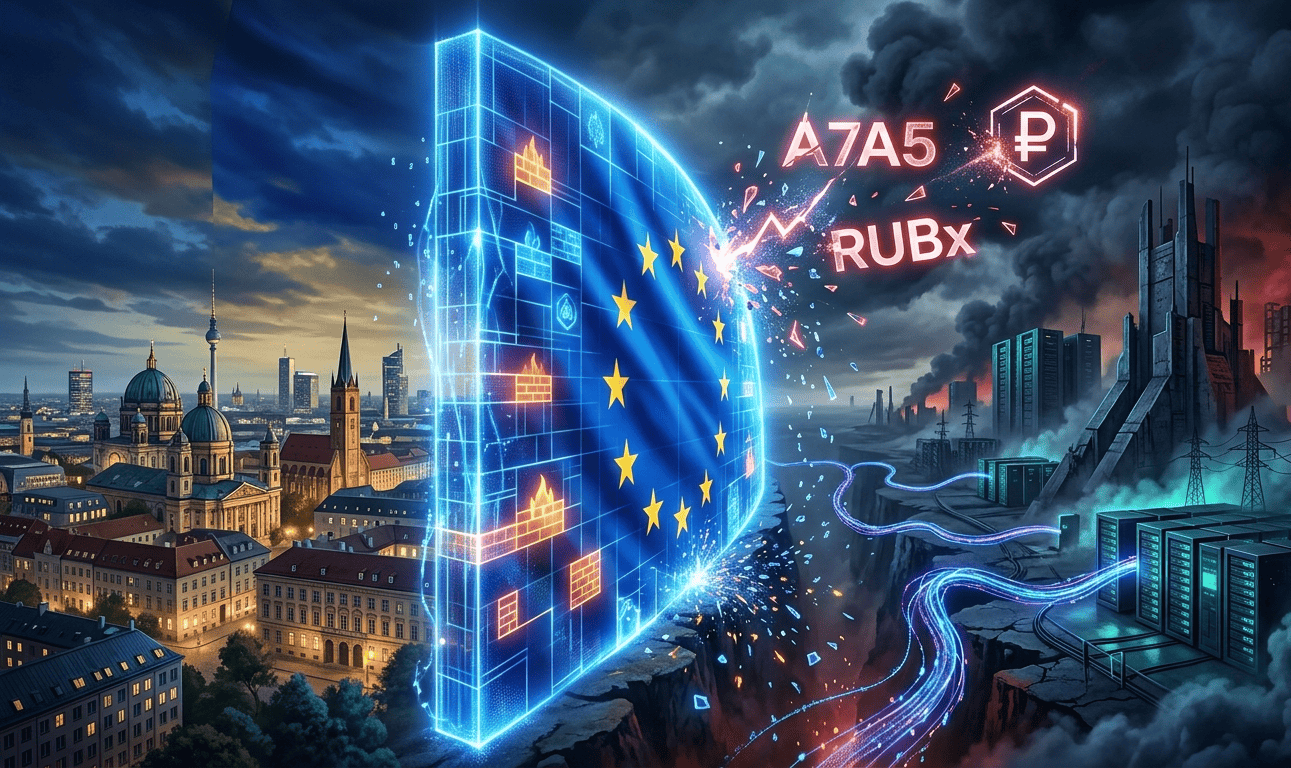
The EU just stopped targeting individual Russian crypto exchanges and went after the entire sector instead. On April 23, the European Union adopted its 20th sanctions package against Russia, imposing a total ban on every crypto service provider and exchange platform operating from Russia or Belarus. No exceptions. No case-by-case reviews. The full sector is cut off from European markets effective May 24.
European Commission President Ursula von der Leyen called it the EU’s “biggest package” of sanctions in two years. For the first time, Brussels is not chasing individual exchanges. It is shutting the door on an entire country’s crypto infrastructure.


Why Did the EU Switch From Targeting Exchanges to Banning the Whole Sector?
Because the old approach kept failing. For years, the EU sanctioned individual Russian exchanges one at a time. It sanctioned Garantex in 2025. Garantex shut down and its employees immediately launched a clone called Grinex. The EU sanctioned the A7A5 stablecoin. Russia kept using it anyway. Every time Brussels cut one head off, another grew back.
The numbers show why. Russia’s ruble-pegged stablecoin A7A5 processed over $100 billion in transactions in less than a year. The entire Garantex-Grinex-A7A5 ecosystem has handled $119.7 billion to date, according to Chainalysis. That is not a fringe operation. That is a parallel financial system purpose-built to route sanctioned Russian money into the global economy.
The EU concluded that targeting individual platforms was like plugging holes in a sinking ship. So it stopped plugging and banned the ship.
What Exactly Does the Ban Cover?
The scope is sweeping. Here is what EU residents and companies can no longer do as of May 24:
No transacting with any crypto service provider based in Russia or Belarus. That includes centralised exchanges, custodial services, and even decentralised platforms that facilitate Russian crypto trade. No providing MiCA-regulated crypto services to Russian or Belarusian individuals or entities. No supporting the development, distribution, or use of the digital ruble, Russia’s planned central bank digital currency. No transacting in the RUBx stablecoin, which was built by sanctioned Russian defence conglomerate Rostec on the Tron blockchain. No using “netting” arrangements, mirror structures, or any other workaround designed to settle transactions with Russian counterparties.
The digital ruble ban is preemptive. Russia plans to roll out its CBDC to the mass market starting September 2026. By banning it now, the EU is closing the door before Russia can walk through it.
The package also targets 20 Russian banks and four third-country financial institutions linked to SPFS, Russia’s alternative to SWIFT. And for the first time, the EU sanctioned a crypto exchange in a third country: TengriCoin in Kyrgyzstan, which operates under the name Meer.kg and has been a major trading venue for A7A5.
What Does This Mean for Crypto Users in Europe?
If you are in the EU and have any exposure to Russian crypto platforms, you have until May 24 to wind down those positions. After that date, any transaction with a Russian-based provider is a sanctions violation.
For most European retail crypto users, this changes nothing. You were not using Russian exchanges anyway. The real impact falls on institutional players, OTC desks, and payment processors that may have indirect exposure through correspondent relationships or liquidity arrangements with entities in Russia-adjacent jurisdictions like Kyrgyzstan, Kazakhstan, and the UAE.
Chainalysis warned that the new measures require compliance teams to conduct enhanced due diligence not just on direct counterparties but on the “netting mechanics of their settlement infrastructure.” In plain language: it is no longer enough to know who you are trading with. You need to know who they are trading with, and who those people are trading with. Any crypto that touches Russian infrastructure may be flagged as contaminated.
How Is Russia Responding?
With centralisation. Russia is simultaneously pushing its own crypto legislation that would require all cryptocurrency to be stored in government-controlled depositories under Central Bank oversight. Personal wallets would be banned. Unqualified investors would be limited to 300,000 rubles (roughly $3,500) per year. That law could take effect on July 1, 2026.
The result is a trap. Russia is forcing its crypto users onto domestic platforms. The EU is banning all domestic Russian platforms from European markets. Russian crypto users who comply with their own government’s rules automatically become cut off from European counterparties. And any coins that pass through Russian-controlled infrastructure risk being labelled as “dirty” by compliance systems worldwide, the same way Iranian and North Korean crypto is treated today.
What Does This Mean for the Broader Crypto Market?
The EU’s sectoral approach sets a precedent. Until now, crypto sanctions targeted specific entities. This is the first time a major jurisdiction has banned an entire country’s crypto sector as a category. If the model works, it could be applied to other sanctioned regimes. Iran, North Korea, and potentially others could face similar blanket bans rather than the whack-a-mole approach that has defined crypto sanctions until now.
For stablecoin issuers, the message is clear. Tether froze $344 million in Iranian USDT last week. The EU just banned three Russian stablecoins entirely. Stablecoins are becoming the front line of sanctions enforcement, and issuers who do not cooperate risk losing access to their largest markets.
The ban takes effect May 24. Between now and then, compliance teams across Europe will be scrambling to map their exposure, update their screening systems, and ensure they are not touching anything that connects back to a Russian crypto provider. For an industry that has spent years arguing it should be treated like traditional finance, this is what that treatment actually looks like.