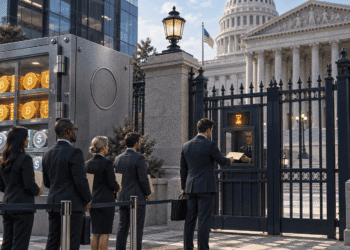

The world’s largest Bitcoin event just opened in Las Vegas. Over 40,000 people showed up. More than 500 speakers took the stage across three days at The Venetian. The SEC chair was there. The CFTC chair was there. The FBI director was there. Eric Trump was there. Michael Saylor was there. Senator Cynthia Lummis announced the CLARITY Act markup would happen in May.
And the people who built Bitcoin are asking: what happened to us?


Early Bitcoin investor Simon Dixon publicly called the conference “compromised,” arguing that marketing ETFs and corporate treasury products reverses Bitcoin’s founding promise of individual sovereignty. One user on X put it more bluntly: “Meet the 2026 Bitcoin Conference speakers. Or how Bitcoin slowly became the system it was built to escape.”
What Did the Conference Actually Deliver?
Beneath the culture war, some genuinely significant things happened.
SEC Chair Paul Atkins unveiled “Project Crypto,” a Commission-wide initiative to modernize securities rules for digital assets. He outlined a new token taxonomy that classifies most digital assets as non-securities, alongside innovation exemptions for on-chain tokenisation. This is the clearest signal yet that the SEC is pivoting from “regulation by enforcement” to a framework designed to actually let the industry operate.
Senator Lummis confirmed the CLARITY Act will be marked up in May. She said the stablecoin language and market structure provisions are “almost 99% sorted out.” She also pushed her BITCOIN Act, which would establish a US strategic Bitcoin reserve of up to one million BTC.
FBI Director Kash Patel and Acting Attorney General Todd Blanche appeared in a fireside chat titled “Code is Free Speech: Ending the War on Bitcoin.” Patel said Bitcoin has “staying power” and “is not going anywhere.” Blanche emphasised reduced enforcement pressure on developers.
MARA Holdings announced the MARA Foundation, focused on quantum resistance and network stewardship. The quantum threat got its own dedicated panel, following the release of BIP 361, the three-phase proposal to migrate Bitcoin toward quantum-resistant outputs.
In terms of policy output, this was probably the most productive Bitcoin conference ever held.
Why Are the Cypherpunks Angry?
The criticism is not about any single speaker. It is about what the lineup represents. Bitcoin was created in 2009 as a tool to bypass banks, governments, and centralised institutions. The whitepaper was published by an anonymous person specifically to avoid institutional capture. The early community was built by cryptographers, privacy advocates, and people who believed the financial system was broken beyond repair.
Fast forward to 2026. The biggest Bitcoin conference in the world features the head of the SEC, the head of the CFTC, the FBI director, a Trump family member, and the CEO of the company that holds more Bitcoin than any other entity on the planet. Tickets cost up to $12,999 for the “Whale Pass” with luxury perks.
Simon Dixon argued that “code is open source” and that wrapping Bitcoin in ETFs, corporate treasuries, and regulatory frameworks reverses the founding promise. Bitcoin was supposed to make institutions irrelevant. Now institutions are the headline act.
The complaint is philosophical but it has practical implications. More coins are now held through ETFs, corporate treasuries, and funds than directly by individuals. Strategy holds 818,334 BTC. BlackRock holds over 812,000 through IBIT. Fidelity, Grayscale, and ARK hold billions more. That concentration introduces custody risk and centralises market power in fewer hands. If BlackRock or Strategy ever sell, or get forced to sell, the impact on Bitcoin’s price would be enormous.
Can Wall Street and Cypherpunks Coexist?
This is the real question, and there is no easy answer.
The bull case for institutional adoption is straightforward. ETFs brought billions in new capital. Corporate treasuries provide a price floor. Regulatory clarity lets builders operate without fear of prosecution. Mainstream legitimacy attracts the next hundred million users. All of that makes Bitcoin more valuable and more durable.
The bear case is equally clear. Institutional adoption changes what Bitcoin is. When most coins sit in ETF custodians rather than personal wallets, Bitcoin stops being a peer-to-peer payment system and becomes a financial product. When the SEC chair and FBI director are keynote speakers, Bitcoin stops being a tool to bypass the state and becomes a tool the state has embraced and, by extension, can regulate.
The tension between these two visions has existed since the first exchange launched. But it has never been this visible. Forty thousand people in a Las Vegas casino watching the FBI director praise Bitcoin while the cypherpunks who built it post angry threads on X about institutional capture. Both sides have a point. Neither side is going away.
Bitcoin hit $79,000 on the conference’s opening day before retreating to $76,700 by Tuesday as Iran uncertainty pushed oil back above $104. The macro environment that drives the institutional demand story is the same environment that can reverse it within hours. That volatility will not be solved by a conference, no matter how many speakers it has.