
US spot bitcoin exchange-traded funds pulled in $986.9 million during the week ending Friday, completing their strongest three-week stretch of 2026.
Combined inflows across those three weeks reached $3.8 billion, according to SoSoValue. Total net assets across the funds stood at $101.3 billion on Friday, after briefly touching $103.3 billion the day before, with cumulative net inflows since launch reaching $55.6 billion.


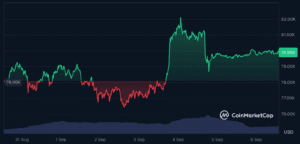
Bitcoin traded near $79,700 at the end of the week, having dipped below $79,000 on Friday after touching $81,265 the previous day.
The funds now hold roughly 6% of all bitcoin that will ever exist.
One day did most of the work
The week’s flows were heavily concentrated rather than steady.
Thursday alone accounted for $730.9 million, the largest single-day net inflow since 14 January. BlackRock’s iShares Bitcoin Trust took roughly $454 million of that, with six other funds including Fidelity’s and Grayscale’s also recording inflows.
Friday cooled sharply to $174.6 million, a drop of roughly 76% in a single session. IBIT drew $117.4 million, about 67% of the day’s total, and Fidelity’s FBTC was the only other fund to record inflows at $57.2 million. Every other US spot bitcoin ETF recorded no net flows at all.
That pattern tells you something about who is buying. Large institutional allocations arrive in blocks rather than as a continuous stream, and a single day can define a week.
IBIT’s dominance remains striking. BlackRock listed the fund’s net assets at $62.52 billion on 4 September, giving it roughly 62% of the entire sector.
The year is still negative
The headline numbers look considerably better than the annual picture.
Despite $3.8 billion arriving in three weeks and $3.5 billion during August, year-to-date net flows remain roughly $1 billion negative.
That gap illustrates how severe the earlier exodus was. Bitcoin ETFs bled through the first half of 2026, with June alone recording $4.7 billion in outflows, the worst month since the products launched. Three weeks of heavy buying has narrowed the deficit substantially without closing it.
August was the strongest month since September 2025. It still was not enough to turn the year positive.
Bitcoin fell anyway
The disconnect between flows and price is the more interesting part of the week.
Despite nearly a billion dollars arriving, bitcoin dropped from $81,265 on Thursday to $79,671 on Friday, a decline of about 2%. Daily trading volume rose to $39.84 billion from $26.62 billion.
The cause was employment data. A stronger-than-expected US nonfarm payrolls print raised interest-rate concerns and pressured risk assets broadly, undoing the optimism that had built earlier in the week when Fed Governor Chris Waller suggested next week’s inflation report would decide his vote.
Strong jobs numbers make a September rate increase more likely. Higher rates raise the opportunity cost of holding an asset that pays nothing.
That is the recurring pattern of 2026. ETF demand is genuine and substantial, and it can still be overwhelmed by a single macroeconomic release.
Bitcoin is pulling away from the rest
The week produced a clear divergence within crypto ETFs, and it ran in bitcoin’s favour.
Bitcoin ETF inflows rose about 7% week on week. Over the same period, spot ether ETF inflows fell roughly 74%, dropping to $218.4 million from $824.4 million. XRP ETF inflows declined about 83%, falling to $19 million from $110.5 million.
That reverses the pattern from earlier in the summer, when ether and XRP funds were taking money on days bitcoin products recorded outflows.
Neither category has turned negative. US spot ether ETFs have recorded roughly $863 million in net inflows year to date. But the concentration of institutional appetite has shifted back toward bitcoin, at least for now.
What decides the next stretch
Two dates dominate the near term.
August consumer price index data arrives on 11 September, the report Waller specifically identified as decisive for his position. The Federal Reserve then meets on 15 and 16 September.
Friday’s payrolls print has already moved expectations toward a hike. A hot CPI reading would reinforce that and likely pressure both flows and price. A softer one would restore the case that carried bitcoin above $81,000 earlier in the week.
The three-week run demonstrates that institutional demand returns when conditions allow. Whether it persists through a hawkish Fed is a different question, and one the market has not tested since the funds were bleeding earlier this year.
FAQ
How much did bitcoin ETFs take in?
$986.9 million for the week ending 5 September, bringing three-week inflows to $3.8 billion, the strongest such stretch of 2026. Total assets reached $101.3 billion.
Why did bitcoin fall despite the inflows?
Stronger-than-expected US payrolls data raised the likelihood of a September rate increase, pressuring risk assets. Bitcoin fell from $81,265 to $79,671 across Thursday and Friday.
Are ETF flows positive for the year?
No. Year-to-date net flows remain roughly $1 billion negative despite the recent run, reflecting heavy outflows earlier in 2026 including $4.7 billion in June alone.
Disclaimer: This article is for informational purposes only and does not constitute financial advice. Cryptocurrency investments carry significant risk. Always conduct your own research before making any investment decisions.