
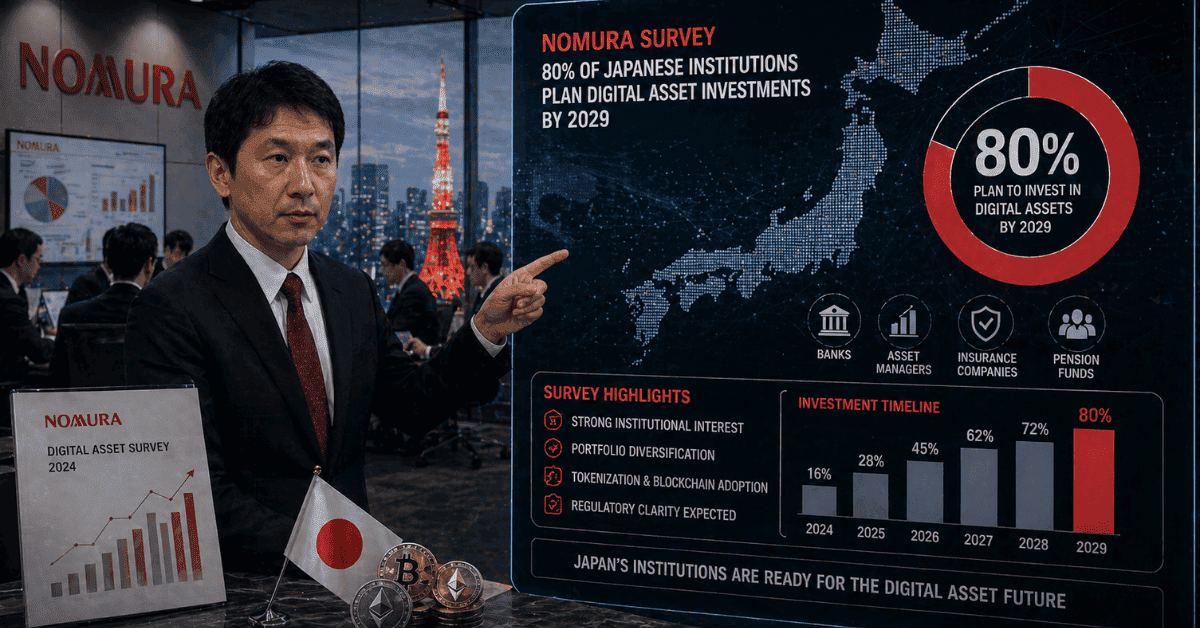
Japanese institutional investors are becoming much more serious about digital assets, according to Nomura’s 2026 Institutional Investor Survey on Digital Asset Investment Trends.
The survey, conducted by Nomura and its digital asset arm Laser Digital from December 2025 to January 2026, gathered responses from 518 investment professionals at institutions, family offices and public organizations in Japan.


The headline finding is clear: 79% of respondents who are considering crypto investment said they plan to invest over the next three years. Most are not talking about tiny test positions either. Of those planning to invest, 60% expect to allocate between 2% and less than 5% of their portfolios.
That is a meaningful shift for a market where major institutions have traditionally been cautious about crypto exposure.
Why the Nomura Survey Matters
Japan Is a Regulated Crypto Market
Japan is not an offshore crypto hotspot with loose rules. It is one of the most regulated digital asset markets in the world, shaped by years of exchange oversight, custody rules and consumer protection measures.
That makes institutional interest in Japan especially important. When professional investors in a tightly regulated market say they are preparing digital asset allocations, it suggests crypto is becoming easier to evaluate inside traditional portfolio frameworks.
The survey does not mean Japanese pension funds, insurers, banks and asset managers are all buying immediately. It does show that the conversation is changing. The question is no longer only whether crypto belongs in institutional portfolios. Increasingly, it is how much exposure is appropriate and which products are safest to use.
Sentiment Has Improved
Nomura’s survey also shows that investor sentiment has become more constructive. Thirty-one percent of respondents described their outlook on crypto assets over the next year as positive, up from 25% in the previous survey.
Negative sentiment also fell to 18%, down from 23%. That is still not universal enthusiasm, but it shows that skepticism is easing as products, custody solutions and regulatory frameworks improve.
This matters because institutional adoption usually moves slowly. Large investors often need internal risk approvals, compliance reviews, custody arrangements and board-level comfort before deploying capital. Improved sentiment is an early signal that those processes may be moving forward.
Diversification Is the Main Reason Institutions Are Interested
Crypto Is Being Treated as a Portfolio Tool
The strongest investment argument in the survey was diversification. Sixty-five percent of respondents said they see crypto assets as an opportunity to diversify portfolios, up from 62% in the previous survey.
That is an important distinction. Institutions are not only looking at crypto as a high-risk speculation. They are increasingly considering whether digital assets can play a role alongside equities, bonds, commodities and alternatives.
The logic is familiar. Bitcoin and other digital assets often behave differently from traditional assets, although correlations can rise during market stress. For allocators, even a small position can be attractive if it improves risk-adjusted returns over time.
Most Planned Allocations Are Moderate
The 2% to 5% allocation range is also notable because it is large enough to matter, but not so large that it suggests reckless exposure.
For a family office, hedge fund or asset manager, a 2% to 5% allocation can provide meaningful upside if digital assets perform well, while limiting portfolio damage if volatility remains high.
That measured approach fits the institutional mindset. Investors are not saying they want to bet the entire portfolio on crypto. They are saying digital assets may deserve a defined role within a broader allocation strategy.
Interest Is Expanding Beyond Spot Crypto
Staking, Lending and Derivatives Are in Demand
Nomura’s survey shows that institutions are looking beyond simple price exposure.
More than 60% of respondents expressed interest in staking or mining, lending and collateralized loans, derivatives and tokenized assets. The specific figures were 66% for staking and mining, 65% for lending and collateralized loans, 63% for derivatives and 65% for tokenized assets.
That suggests Japanese institutions are thinking about digital assets as a full financial ecosystem. They are not only asking whether Bitcoin or Ethereum will rise. They are also asking whether digital assets can generate yield, support collateral strategies and connect with tokenized real-world assets.
This is where institutional crypto adoption may look different from retail adoption. Retail traders often focus on token prices. Institutions focus on products, infrastructure, risk controls and ways to use assets efficiently.
Stablecoins Are Becoming More Practical
The survey also found that 63% of respondents identified potential use cases for stablecoins. Those uses included treasury management, cross-border payments, foreign exchange transactions, crypto investment and investment in tokenized securities.
Trust remains a key issue. Across JPY, USD and EUR stablecoins, respondents showed the strongest preference for stablecoins issued by major financial institutions.
That finding is especially relevant in Japan, where regulated financial groups may be better positioned than unknown offshore issuers to win institutional confidence.
The Barriers Have Not Disappeared
Risk Management Still Matters
Despite the improved sentiment, Nomura’s survey shows that institutions still see real obstacles. The main barriers include weak frameworks for fundamental analysis, counterparty risk, high volatility and regulatory uncertainty.
These are not small issues. Professional investors need reliable valuation methods, audited custody, clear legal treatment, liquidity management and operational controls. Without those, digital assets remain difficult to approve at scale.
The difference is that the barriers are becoming more practical than philosophical. In earlier years, many institutions questioned whether crypto had any place in a serious portfolio. Now, more appear to be asking what systems need to be in place before they can invest responsibly.
Regulation Could Decide the Pace
Japan’s regulatory direction will be crucial. If authorities continue creating clearer rules for digital asset products, stablecoins, custody and tokenized securities, institutions may move faster.
If rules become too restrictive or remain uncertain in key areas, planned allocations may remain just plans. That is the gap the market now needs to watch: stated intent versus actual capital deployment.
What This Means for the Crypto Market
Nomura’s survey adds to a broader global trend. Institutions are increasingly treating digital assets as part of the financial system rather than a niche retail market.
Japan’s role is especially important because the country has a mature financial sector, a large savings base and regulators that have already spent years building crypto oversight. If Japanese institutions begin allocating even modestly, it could deepen liquidity and support more regulated product development.
Still, investors should not read the survey as an immediate wave of buying. Many respondents are preparing for allocations over a three-year window, which means adoption may be gradual.
The more important signal is structural. Digital assets are becoming investable enough for traditional institutions to discuss target weights, product types and implementation plans.
What Comes Next
The next thing to watch is whether Japanese regulators finalize clearer rules that make institutional deployment easier, especially around custody, tokenized assets, derivatives and stablecoins.
The second signal is product availability. Institutions will need regulated funds, trusted custodians, reliable reporting, risk tools and liquid markets before a 2% to 5% target allocation becomes reality.
The third signal is actual deployment. Surveys show intent, but capital flows prove adoption. If Japanese institutions begin moving from planning to execution by 2027 and 2028, Nomura’s findings may look like an early sign of a major allocation cycle.
For now, the message from Japan is unmistakable. Digital assets are no longer being discussed only at the edge of institutional finance. They are moving into serious portfolio conversations, with nearly 80% of surveyed investors preparing to take a closer look before 2029.
Disclaimer: This article is for informational purposes only and does not constitute financial, investment, or legal advice. Always conduct your own research before making any investment decisions.