The most important crypto bill in US history might die because of one Republican senator and the president’s own business deals. Senator Thom Tillis told reporters on Monday that the CLARITY Act must include ethics language restricting White House officials from sponsoring, endorsing, or issuing digital assets. If it does not, he will vote against the bill he has been helping to negotiate.
“There has to be ethics language in the bill before it leaves the Senate, or I’ll go from one of the people working on negotiating it to voting against it,” Tillis said.


This is not a bluff. Tillis is retiring early next year. He has no re-election to worry about. No political incentive to soften his position. And he sits on the Senate Banking Committee, the exact body that needs to approve the bill before it reaches the Senate floor.
Why Is Tillis Blocking the Bill?
The Trump family’s crypto ventures. They are now worth over $1 billion and growing. World Liberty Financial launched the USD1 stablecoin. The TRUMP memecoin generated hundreds of millions in trading volume. Trump held a private dinner for top memecoin holders at Mar-a-Lago last week where he promised to protect the industry from bank lobbyists.
Democrats have been pushing for ethics provisions all along. Senator Ruben Gallego made the position clear: “No final bill, there is no final movement, unless there is a bipartisan agreement when it comes to the ethics provision.” Senator Adam Schiff said talks are “narrowing our differences” but stressed that resolution is not the same as agreement.
What changed is that a Republican joined them. Tillis is not a Democrat using the bill as leverage. He is a senior Republican on the Banking Committee who was actively negotiating the stablecoin yield compromise. His shift from insider to potential no-vote is a material change. Without him, the math does not work.
The bill needs 60 votes for cloture in the Senate. If Tillis defects and Democrats hold firm on ethics, the bill stalls regardless of what leadership wants.
What Is the CLARITY Act and Why Does It Matter?
The Digital Asset Market Clarity Act is the bill that would finally answer the question crypto has been asking for years: who regulates what?
Right now, nobody knows whether most tokens are securities (SEC territory) or commodities (CFTC territory). That uncertainty has driven companies overseas, slowed institutional adoption, and created a regulatory environment where enforcement substitutes for legislation. The CLARITY Act would divide oversight between the CFTC and SEC, establish licensing for exchanges and stablecoin issuers, protect DeFi developers from prosecution, and create the legal framework that institutions need before deploying capital at scale.
The House passed its version in July 2025. The Senate has been stuck ever since. First it was the stablecoin yield dispute between banks and crypto firms. Then it was DeFi protections. Those are reportedly settled now. The ethics fight is what remains.
How Much Time Is Left?
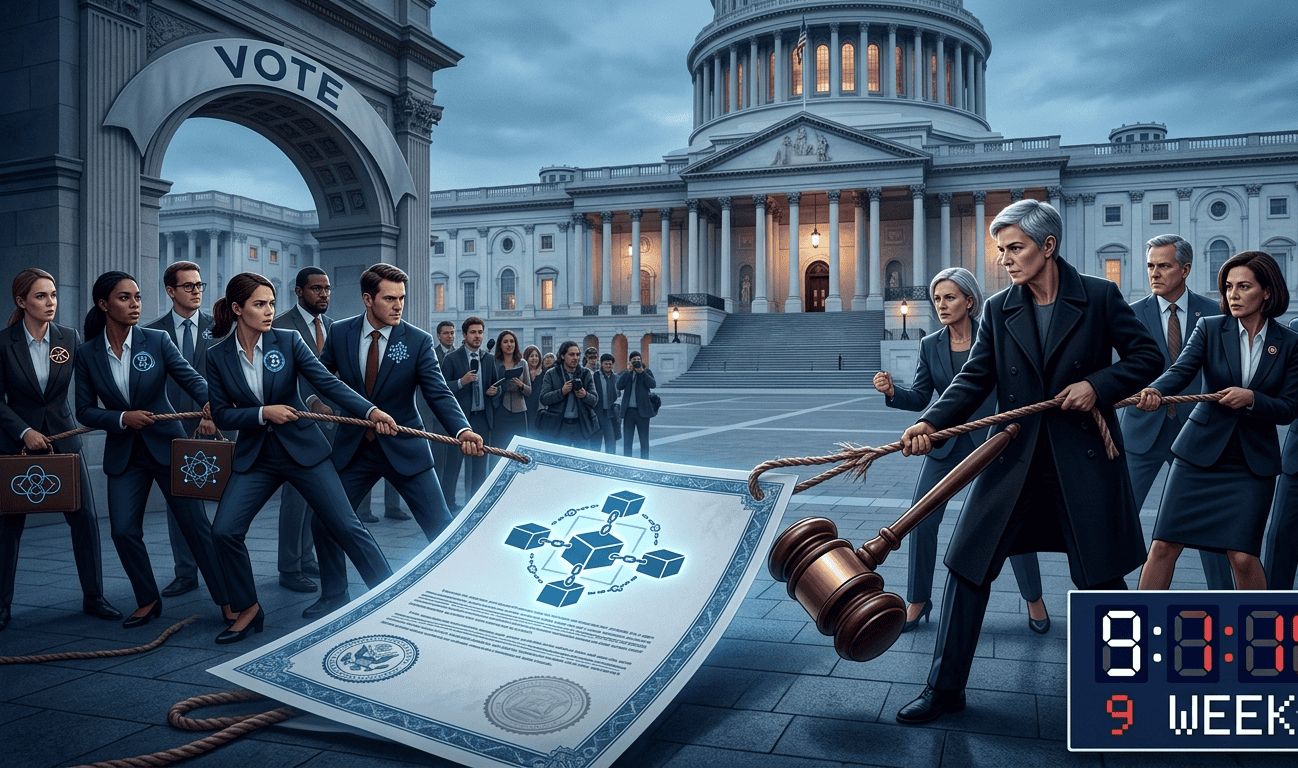
Not much. Ji Kim, CEO of the Crypto Council for Innovation, estimated that the Senate has roughly 13 weeks of floor time before the August recess. But once scheduled recesses are stripped out, the real number is closer to 9 or 10 working weeks. After August, the midterm elections take over. Congress does not legislate during campaign season.
Senator Cynthia Lummis offered the clearest timeline at the Bitcoin 2026 Conference in Las Vegas: “We are going to markup the CLARITY Act in May. We are going to get it to the finish line.” She said stablecoin language and market structure provisions are “almost 99% sorted out.”
But Tillis asked Chairman Tim Scott to delay the markup from April to May specifically to give him more time to negotiate with bankers. That two-week delay has now collided with the ethics dispute. If May becomes June, and June bumps into the August recess, Galaxy Research estimates the odds of the bill becoming law in 2026 at “roughly 50-50, and possibly lower.”
What Happens If the Bill Dies?
If the CLARITY Act does not pass in 2026, the next chance is 2030. A new Congress would have to restart the entire legislative process from scratch. The SEC’s recent staff statements clarifying crypto token treatment are temporary guidance, not permanent rules. Without legislation, the regulatory ambiguity that has defined US crypto policy since 2017 continues.
That means more enforcement actions substituting for clear rules. More companies relocating to Dubai, Singapore, and Abu Dhabi. More institutional capital sitting on the sidelines waiting for clarity that never comes. And more frustration from an industry that spent over $100 million on lobbying and political donations to get a bill that its own president’s business interests might torpedo.
Over 120 crypto firms including Coinbase, Ripple, and Circle signed a letter demanding the Senate schedule a markup “as soon as practicable.” The Digital Chamber sent its own letter. The North Carolina Blockchain Initiative urged Tillis directly to move the bill forward.
The White House is engaged. Patrick Witt, Trump’s lead crypto policy adviser, is reportedly negotiating ethics language alongside Senators Lummis and Bernie Moreno. The administration is not stonewalling. But it is also not accepting any language that would force Trump to divest from his crypto ventures, which is the core of what Tillis and the Democrats are asking for.
The irony is hard to miss. The most pro-crypto president in American history might be the reason the most important crypto bill in American history does not pass. Not because he opposes it, but because his own financial entanglements give his opponents the ammunition to block it.