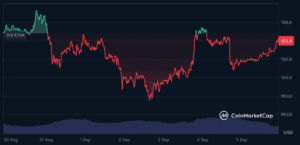
Solana traded near $105 this week, holding above the $100 level it reclaimed in late August after breaking out of a descending channel that had capped it for months.
The weekly chart cleared the upper boundary of that channel with a strong green close, ending a structure that had defined SOL’s price action through most of the year. Weekly RSI sits around 57.62, above its moving average but well short of overbought territory.


Market capitalisation stands near $59 billion, with roughly 585 million SOL in circulation out of a total supply of about 633 million.
Two changes to Solana’s supply landed in the same week, and they pull in opposite directions. That tension is the more interesting story than the chart.
$103 is the level that matters
Analyst Ali Martinez has identified $103 as the key support zone, noting that around 39 million SOL was acquired near that price.
That figure gives the level real weight. When a large volume of coins changes hands at a specific price, those buyers tend to defend it, and holding above it signals that the people who bought the breakout are still willing to back it.
Losing $103 would undo the accumulation structure that has formed since the channel break. Below it, the next levels sit at $94.40 and then $85.79, with $82.19 marking a deeper support zone on the weekly chart.
The immediate range is tighter. Support sits between $100 and $102, with resistance concentrated at $105 to $110.
The upside path is well mapped
A decisive break above $110 would open a path toward $120.
Beyond that, the weekly chart points to $118.84 as the first significant resistance zone, the level that decides whether this becomes a genuine trend or another failed bounce. Clearing it on strong volume would put $140.45 in play, with $176 as a longer-term target.
Martinez has flagged $123 and $132 as the resistance levels to watch, with $150 as the September target if both give way.
Positioning currently favours the bulls, though not overwhelmingly. Binance recorded roughly 1.93 long accounts for every short, with OKX at 1.8. Short sellers lost $3.96 million in liquidations against $2.69 million for longs.
Trading activity has been lighter than the price move suggests, which means the rally needs fresh participation rather than short covering to extend.
Two supply changes, working against each other
Solana validators approved a plan this week to cut roughly 18.9 million SOL from future issuance over six years, alongside a separate proposal raising daily token burns substantially. Both reduce the amount of new SOL entering circulation.
At almost the same moment, the network activated the first of five rent reductions, lowering the deposit required to keep an account open. Once all five steps complete, roughly 3.08 million SOL currently locked in accounts becomes reclaimable, worth around $307 million.
The first change tightens supply. The second loosens it.
The issuance cut is the larger number and the more durable one, since it reduces new supply permanently. The rent unlock is a one-time release, and it is unlikely to arrive all at once because nothing is distributed automatically. Token programs have to actively withdraw the surplus, which means most of that SOL will simply stay where it is.
There is a subtler point underneath. Locked deposits were, in a small way, a reason SOL had to be held rather than sold. Reducing them removes part of that structural demand, even if the practical effect on price is minimal.
Net effect: mildly positive, with the issuance cut outweighing the unlock.
The demand side is stronger than the chart
The fundamentals supporting the move have been building for weeks and are more concrete than most altcoin narratives.
Spot Solana ETFs recorded $33.49 million on 24 August, their strongest single day since December 2025, extending an inflow streak that has pushed cumulative net inflows to a record $1.22 billion. Bitwise’s BSOL accounts for roughly 80% of that total.
Solana’s decentralised exchange volumes have exceeded those of major centralised exchanges for nine consecutive weeks. Exchange balances have been falling, and the network leads in real-world asset inflows.
That combination, institutional flows plus genuine on-chain usage, is what separates this from a purely technical bounce. It does not guarantee the price holds, but it means the move has something underneath it.
What decides the next leg
The framework is straightforward.
Holding $103 keeps the breakout structure intact and leaves $118.84 as the level to clear. Clearing it with volume opens $123, $132 and eventually $150.
Losing $103 undoes the accumulation and exposes $94.40, then $85.79, running into the seasonal weakness that typically hits crypto markets in September.
The broader market matters more than any Solana-specific factor. Bitcoin traded above $81,000 on Friday, its highest since May, after Federal Reserve Governor Chris Waller said next week’s inflation report would determine whether he supports holding or raising rates. US CPI lands on 11 September, with the Fed meeting on 15 and 16 September.
SOL is a higher-beta asset than bitcoin. If the inflation print supports a hold, Solana would likely outperform on the way up. If it does not, the $103 level gets tested quickly.
FAQ
What is the key level for SOL?
$103, where roughly 39 million SOL was acquired. Holding it keeps the breakout intact; losing it exposes $94.40 and $85.79.
Do the supply changes help or hurt SOL?
Net mildly positive. The 18.9 million SOL issuance cut is permanent and larger, while the rent unlock is a one-time release that mostly will not be claimed.
What is the upside target?
$110 opens $120, with $118.84 the first major weekly resistance. Clearing it puts $123, $132 and eventually $150 in play.
Disclaimer: This article is for informational purposes only and does not constitute financial advice. Cryptocurrency investments carry significant risk. Always conduct your own research before making any investment decisions.